 뒤로
Muscle Contraction: Ch 9C Properties, Mechanisms, and Factors in Skeletal Muscle
스터디 가이드 - 스마트 노트
 자료에 맞춘 맞춤형 노트, 핵심 정의, 예시, 맥락을 확장해 제공합니다.
Muscle Contraction: Properties, Mechanisms, and Factors in Skeletal Muscle
Overview of Muscle Contraction
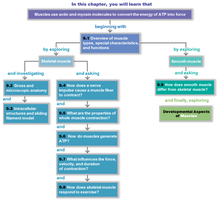
Muscle contraction is a fundamental process in human physiology, enabling movement and force generation. Skeletal muscles use actin and myosin molecules to convert the energy of ATP into force, regulated by neural and biochemical mechanisms. This section explores the properties of muscle contraction, the structure and function of motor units, and the factors influencing contraction force, velocity, and duration.
The Motor Unit
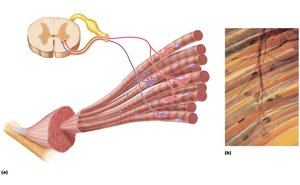
A motor unit consists of a single motor neuron and all the muscle fibers it innervates. The number of fibers per motor unit varies, affecting the precision of muscle control. Motor units are distributed throughout the muscle, so activation of one unit results in a weak contraction of the entire muscle.
Fine control is achieved with smaller motor units (fewer fibers per neuron).
Gross movements use larger motor units (more fibers per neuron).
Motor neuron axons branch to form neuromuscular junctions with muscle fibers.
Muscle Twitch
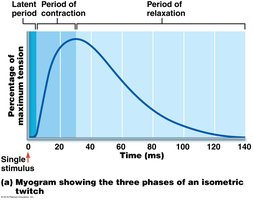
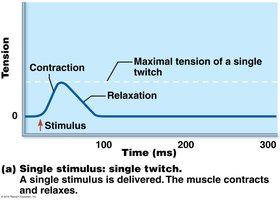
A muscle twitch is the simplest contraction, resulting from a muscle fiber's response to a single action potential. It consists of three phases:
Latent period: Time between stimulus and contraction; events of excitation-contraction coupling occur, but no tension is seen.
Period of contraction: Cross-bridge formation; tension increases.
Period of relaxation: Ca2+ reentry into the sarcoplasmic reticulum; tension declines to zero.
Muscle contracts faster than it relaxes. Twitch can be recorded as a myogram.
Graded Muscle Responses
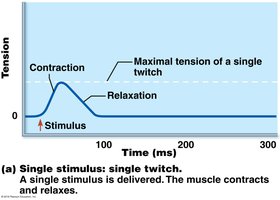
Normal muscle contraction is smooth and strength varies with demand. Graded muscle responses allow for proper control of skeletal movement and are achieved by changing the frequency and strength of stimulation.
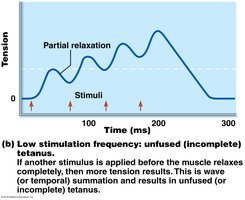
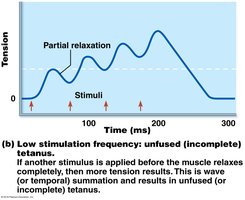
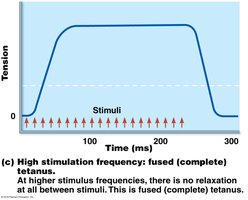
Frequency: Increasing stimulus frequency leads to wave (temporal) summation and tetanus.
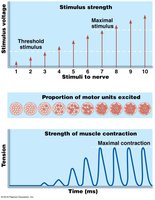
Strength: Increasing stimulus strength recruits more motor units (recruitment).
Single stimulus produces a single twitch; rapid stimuli produce summation and tetanus.
Recruitment and Motor Unit Summation
Recruitment is the process of activating more motor units to increase muscle contraction strength. Types of stimulus:
Subthreshold stimulus: Not strong enough; no contraction.
Threshold stimulus: First observable contraction.
Maximal stimulus: All motor units recruited; maximal contraction.
Muscle Tone
Muscle tone is the constant, slightly contracted state of all muscles, maintained by spinal reflexes. It keeps muscles firm, healthy, and ready to respond to stimuli.
Isotonic and Isometric Contractions
Muscle contractions are classified as isotonic or isometric:
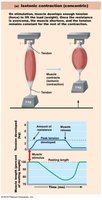
Isotonic contractions: Muscle changes length and moves a load.
Concentric: Muscle shortens and does work (e.g., lifting a book).
Eccentric: Muscle lengthens while generating force (e.g., lowering a book).
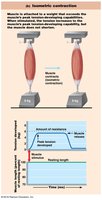
Isometric contractions: Muscle does not change length; tension increases but load is not moved.
Factors Influencing Force of Muscle Contraction
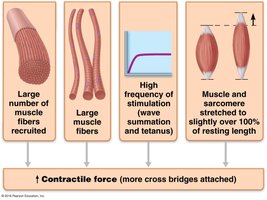
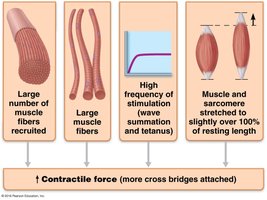
The force generated by a muscle depends on the number of cross-bridges attached, influenced by four main factors:
Number of muscle fibers stimulated (recruitment): More motor units recruited, greater force.
Relative size of fibers: Larger muscles generate more tension; hypertrophy increases fiber size.
Frequency of stimulation: Higher frequency increases force (summation and tetanus).
Degree of muscle stretch: Sarcomeres at 80–120% of resting length generate optimal force; too much or too little overlap reduces force.
Length-Tension Relationship
The length-tension relationship describes how sarcomere length affects muscle tension. Optimal overlap of actin and myosin filaments (80–120% of resting length) allows maximal cross-bridge formation and force generation.
Sarcomere Length | Tension Produced |
|---|---|
Less than 80% resting length | Low (filaments overlap too much) |
80–120% resting length | High (optimal overlap) |
Greater than 120% resting length | Low (filaments do not overlap enough) |

Summary Table: Factors Affecting Muscle Contraction
Factor | Effect on Contraction |
|---|---|
Number of fibers recruited | Increases force |
Fiber size | Increases force |
Frequency of stimulation | Increases force |
Degree of stretch | Optimal force at 80–120% resting length |
Example: During weightlifting, muscle fibers are recruited, frequency of stimulation increases, and muscle size grows with regular exercise, all contributing to greater contractile force.
Additional info: The notes above expand on brief lecture points, providing definitions, examples, and context for each concept. All images included directly reinforce the explanation of the adjacent paragraph, as required.
