 뒤로
Muscle Contraction, Recruitment, and Lever Systems: Study Notes for Anatomy & Physiology L14
스터디 가이드 - 스마트 노트
 자료에 맞춘 맞춤형 노트, 핵심 정의, 예시, 맥락을 확장해 제공합니다.
Muscle Twitch and Phases
Understanding Muscle Twitch
Muscle twitch is the response of a muscle fiber to a single stimulus. It consists of three distinct phases, each representing a different stage of contraction and relaxation.
Latent Phase: The period after the stimulus but before contraction begins. During this phase, the action potential travels along the sarcolemma and calcium ions are released.
Contraction Phase: Muscle fibers shorten as cross-bridges form and tension increases.
Relaxation Phase: Calcium ions are reabsorbed, cross-bridges detach, and muscle tension decreases.
Types of Muscle Stimulation
Summation and Tetanus
Muscle fibers can be stimulated in different ways, leading to varying levels of tension and contraction.
Concept | Stimulus Relative to Relaxation | Tension | Key Feature |
|---|---|---|---|
Treppen (Staircase Effect) | Repeated stimuli with full relaxation between twitches | Stepwise increase in twitch strength | Due to increased calcium availability |
Wave Summation | Stimulus arrives before full relaxation | Overlapping twitches add together | Greater force than a single twitch |
Incomplete Tetanus | Rapid, repeated stimuli with only partial relaxation | Sustained contraction with visible oscillations | Stronger and smoother than summation |
Complete Tetanus | Very rapid, continuous stimuli with no relaxation | Smooth, sustained maximal contraction | Calcium remains high; muscle locked at peak force |
Whole Muscle Actions
Motor Units & Recruitment
A motor unit consists of a motor neuron and all the muscle fibers it innervates. All fibers in a motor unit contract simultaneously.
Small motor units: Few fibers, precise movements (e.g., eyes).
Large motor units: Many fibers, large loads (e.g., legs).
Recruitment is the process of increasing the number of active motor units to generate more tension. Maximum tension occurs when all available units are recruited.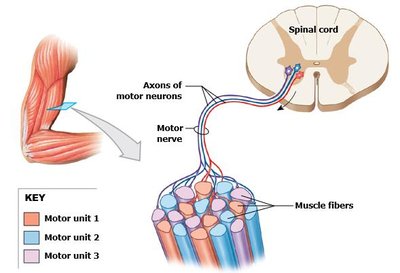
Muscle Tone
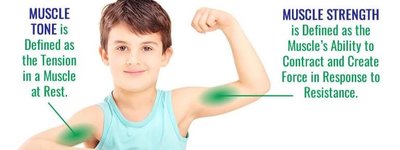
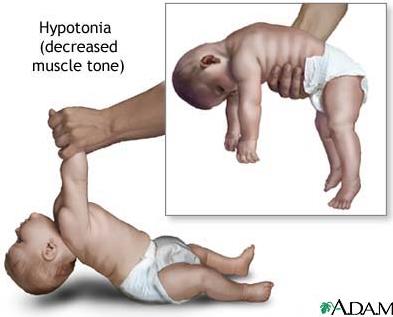
Muscle tone is the resting tension in a muscle, maintained by continuous, partial activation of motor units.
Stabilizes bones and joints
Maintains balance and posture
Elevated muscle tone increases resting energy consumption
Muscle Contractions
Types of Contractions
Muscle contractions are classified based on whether the muscle changes length.
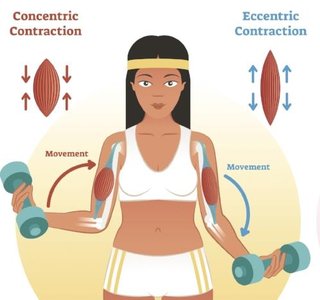
Isotonic Contraction: Muscle changes length while producing tension.
Concentric Contraction: Muscle shortens to move a load (tension > load).
Eccentric Contraction: Muscle lengthens as it resists a load (tension < load).
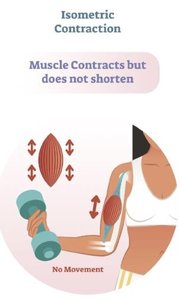
Isometric Contraction: Muscle produces tension without changing length (tension = load).
Coordination Within Muscle Groups
Functional Muscle Groups
Muscles work together in groups to produce coordinated movements.
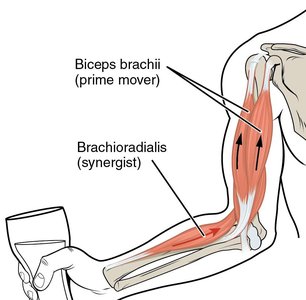
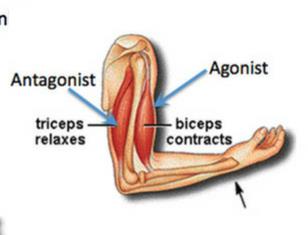
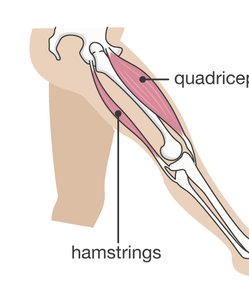
Prime Mover (Agonist): Main force for movement.
Synergist: Assists agonist by adding force or reducing unwanted movement.
Fixator: Stabilizes the origin of the agonist.
Antagonist: Opposes the agonist, usually on the opposite side of the joint.
Lever Systems in the Body
Muscle Attachments and Levers
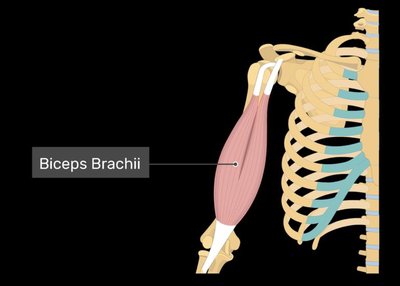
Most muscles attach to bones across a joint, creating lever systems.
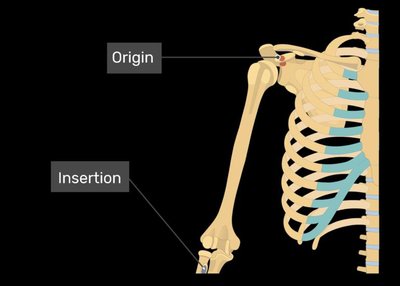
Origin: Attachment to fixed bone (usually proximal).
Insertion: Attachment to movable bone (usually distal).
Levers and Fulcrums
A lever is a rigid structure (bone) that moves around a fulcrum (joint). Muscles apply tension (effort) to overcome a load.
Levers can reverse force direction, move large loads with small effort, or increase speed and distance.
Types of Levers
There are three classes of levers in the body:
First Class: Fulcrum is between effort and load (e.g., neck).
Second Class: Load is between fulcrum and effort (e.g., standing on tiptoe).
Third Class: Effort is between fulcrum and load (e.g., elbow flexion).
Muscle Metabolism & ATP
ATP Production in Muscle
ATP is the only energy source used in muscle contractions. Muscles do not store enough ATP, so it must be regenerated by three methods:
Creatine Phosphate: Fastest, shortest, anaerobic.
Glycolysis: Fast, short, anaerobic.
Cellular Respiration: Slowest, longest, aerobic.
Method | Uses | ATP Produced | Oxygen Required? | When Used? | Duration |
|---|---|---|---|---|---|
Creatine Phosphate | Creatine phosphate & creatine kinase | 1 ATP | No | Muscles changing activity levels | Seconds |
Glycolysis | Glucose | 2 ATP | No | Peak activity in fast twitch fibers | Minutes |
Aerobic Metabolism | Glucose, pyruvate, fatty acids | 34-38 ATP per glucose | Yes | Resting muscle, moderate activity in slow twitch fibers | Longer than minutes |
Levels of Muscular Activity
Resting muscle: Aerobic metabolism builds up creatine phosphate reserves.
Moderate activity: Aerobic metabolism, reserves decline.
Peak activity: Anaerobic glycolysis until fatigue.
Recovery Period
After exertion, muscles repay oxygen debt and clear lactate.
Oxygen debt: Extra O2 needed to return to resting conditions.
Cori Cycle: Lactate transferred to liver, converted to pyruvate, then glucose, rebuilding glycogen reserves.
Muscle Performance & Fiber Types
Muscle Performance
Muscle performance is determined by tension (force) and endurance (duration). These depend on muscle fiber types and physical conditioning.
Slow Twitch (Slow-Oxidative): High endurance, low force, many capillaries, mitochondria, and myoglobin.
Fast Twitch (Fast-Glycolytic): Low endurance, high force, large diameter, few capillaries, mitochondria, and myoglobin, much glycogen.
Intermediate: Properties between slow and fast twitch.
Example: Marathon runners have more slow-twitch fibers; sprinters have more fast-twitch fibers. Additional info: Fiber type distribution is influenced by genetics and training. ----------------------------------------
