 뒤로
뒤로Muscle Fascicle Arrangements and Muscle Naming in Anatomy & Physiology
스터디 가이드 - 스마트 노트
 자료에 맞춘 맞춤형 노트, 핵심 정의, 예시, 맥락을 확장해 제공합니다.
Muscle Fascicle Arrangements
Introduction
Muscle fascicles are bundles of muscle fibers arranged in specific patterns. The arrangement of fascicles determines the range of motion and force produced by a muscle. Understanding these patterns is essential for identifying muscle function and structure.
Fascicle: A bundle of skeletal muscle fibers surrounded by connective tissue.
Arrangement: Fascicles are organized in different patterns that indicate the action and strength of a muscle.
Types of Fascicle Arrangements
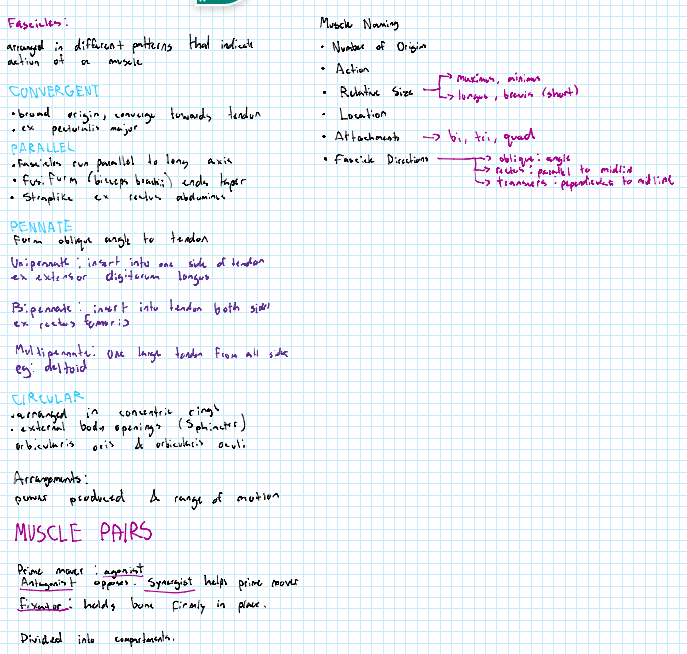
Convergent: Fascicles have a broad origin and converge toward a single tendon. This arrangement allows for versatile movement and force direction. Example: Pectoralis major.
Parallel: Fascicles run parallel to the long axis of the muscle. These muscles contract over a greater distance but produce less force. Examples: Sartorius, rectus abdominis.
Pennate: Fascicles form at an oblique angle to the tendon, increasing force production.
Unipennate: Fascicles insert into one side of the tendon. Example: Extensor digitorum longus.
Bipennate: Fascicles insert into the tendon from both sides. Example: Rectus femoris.
Multipennate: Fascicles attach to one large tendon from all sides. Example: Deltoid.
Circular: Fascicles are arranged in concentric rings, forming sphincters that control body openings. Examples: Orbicularis oculi, orbicularis oris.
Arrangement Impact: The fascicle arrangement affects the force produced and the range of motion of the muscle.
Muscle Naming
Introduction
Muscles are named based on several criteria, including their structure, function, and location. Understanding these naming conventions helps in identifying and describing muscles accurately.
Number of Origins: Indicates how many tendons or heads a muscle has. Examples: Biceps (two origins), triceps (three origins), quadriceps (four origins).
Action: Describes the primary movement produced by the muscle. Examples: Flexor, extensor, adductor.
Relative Size: Muscles are compared by size. Examples: Maximus (largest), minimus (smallest), longus (long), brevis (short).
Location: Indicates where the muscle is found in the body. Examples: Brachialis (arm), femoris (thigh).
Attachments: Named for the bones or structures to which they attach.
Fascicle Direction: Describes the orientation of fascicles relative to the midline or axis.
Oblique: Fascicles run at an angle.
Rectus: Fascicles run parallel to the midline.
Transversus: Fascicles run perpendicular to the midline.
Muscle Pairs
Introduction
Muscles often work in pairs to produce movement. These pairs include prime movers, antagonists, synergists, and fixators, each playing a distinct role in muscle action.
Prime Mover (Agonist): The muscle primarily responsible for a specific movement.
Antagonist: Opposes the action of the prime mover.
Synergist: Assists the prime mover in performing its action.
Fixator: Stabilizes the origin of the prime mover, holding it firmly in place.
Compartmentalization: Muscles are often divided into compartments based on their function and location.
