뒤로
Muscle Tension and Contraction: Mechanisms and Principles (M2)
스터디 가이드 - 스마트 노트
 자료에 맞춘 맞춤형 노트, 핵심 정의, 예시, 맥락을 확장해 제공합니다.
Muscle Fiber Excitation, Contraction, and Relaxation
Overview of Skeletal Muscle Fiber Contraction
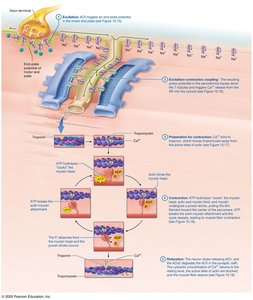
Skeletal muscle contraction is initiated by an action potential from a motor neuron, leading to a sequence of events that result in muscle tension. The process involves excitation, contraction, and relaxation phases, each regulated by specific cellular mechanisms.
Excitation: Acetylcholine (ACh) released from the motor neuron triggers an action potential in the muscle fiber.
Contraction: The action potential propagates along the sarcolemma, causing calcium ions (Ca2+) to be released from the sarcoplasmic reticulum (SR), which initiates cross-bridge cycling and muscle tension.
Relaxation: Ca2+ is pumped back into the SR, ending cross-bridge cycling and returning the muscle to its resting state.
Key Terms: Sarcolemma (muscle cell membrane), Sarcoplasmic Reticulum (Ca2+ storage), Cross-bridge cycling (interaction between actin and myosin).
Muscle Fiber Twitch and Myogram
Phases of Twitch Contraction
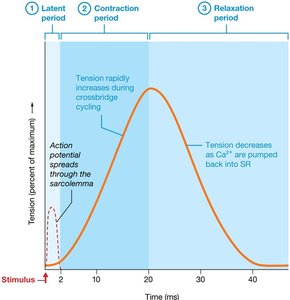
A muscle fiber twitch is the response of a single isolated muscle fiber to a single action potential. This response can be recorded using a myogram, which plots tension over time.
Latent Period: Time for the action potential to propagate and Ca2+ release.
Contraction Period: Cross-bridge cycling generates tension.
Relaxation Period: Ca2+ is pumped back into the SR, tension decreases.
Example: Laboratory isolation of a single muscle fiber to observe twitch.
Muscle Fiber Tension: Frequency and Length
Wave Summation and Tetanus
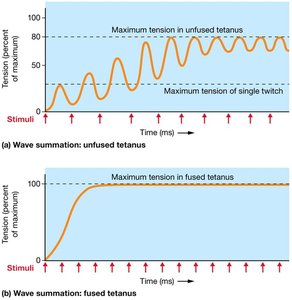
The total tension produced by a muscle fiber depends on the frequency of action potential firing and the fiber's resting length. Repeated stimulation can lead to greater tension if the fiber does not fully relax between twitches, a phenomenon known as wave summation.
Unfused Tetanus: Partial relaxation between stimuli, tension up to 80% of maximum.
Fused Tetanus: No relaxation between stimuli, tension reaches 100% of maximum.
Equation:
Length-Tension Relationship
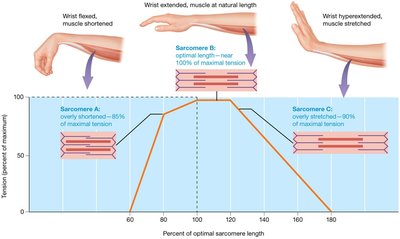
The amount of tension a muscle fiber can produce is also determined by its length at rest. There is an optimal sarcomere length for maximal tension generation; if the muscle is overly shortened or stretched, tension decreases.
Optimal Length: Sarcomere length allows maximal overlap of actin and myosin.
Overly Shortened: Reduced tension due to excessive overlap.
Overly Stretched: Reduced tension due to insufficient overlap.
Motor Units and Muscle Tension
Motor Neuron Pool and Motor Units
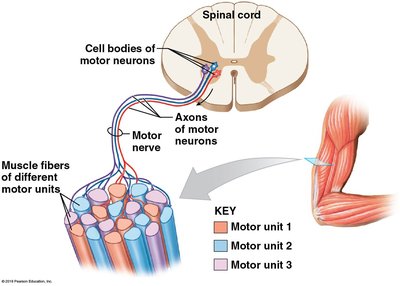
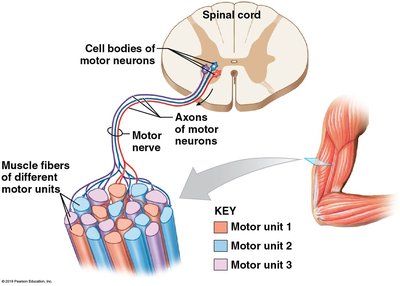
Each muscle fiber is innervated by a single motor neuron, but each motor neuron can innervate multiple muscle fibers, forming a motor unit. The collection of all motor neurons innervating a muscle is called the motor neuron pool.
Motor Unit: One motor neuron and all the muscle fibers it innervates.
Motor Neuron Pool: All motor neurons innervating a single muscle.
Example: Fine motor control (eye muscles) vs. gross motor control (leg muscles).
Motor Unit Size and Recruitment
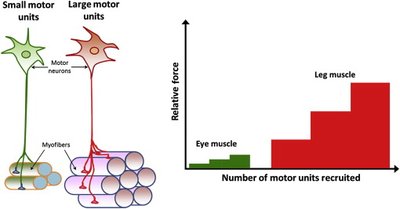
Motor unit size varies depending on muscle function. Smaller motor units are recruited first for fine control, while larger units are recruited as force requirements increase. This is known as the motor unit size principle.
Small Motor Units: Few muscle fibers, fine control (e.g., eye muscles).
Large Motor Units: Many muscle fibers, high power (e.g., leg muscles).
Recruitment: As force increases, more and larger motor units are recruited.
Developing Muscle Tension: Recruitment and Frequency
Factors Affecting Total Muscle Tension
The total muscle tension produced depends on both the number of motor units recruited and the frequency of action potential firing. As the force required increases, more motor units are activated.
Recruitment: Progressive activation of motor units increases force.
Frequency: Higher frequency of action potentials increases tension via wave summation.
Types of Muscle Contractions
Isotonic and Isometric Contractions
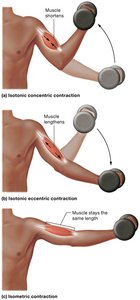
Muscle contractions can be classified based on whether the muscle length changes during tension production. Isotonic contractions involve a change in muscle length, while isometric contractions maintain constant muscle length.
Isotonic Contraction: Muscle length changes, tension remains constant.
Concentric Contraction: Muscle shortens, force generated exceeds external force.
Eccentric Contraction: Muscle lengthens, external force exceeds force generated by muscle.
Isometric Contraction: Muscle length remains constant, external force equals muscle force.
Example: Lifting a weight (concentric), lowering a weight (eccentric), holding a weight steady (isometric).