 뒤로
Muscle Tension, Contraction, Leverage, Energy, Fiber Types, and Disorders: Study Notes for Anatomy & Physiology
스터디 가이드 - 스마트 노트
 자료에 맞춘 맞춤형 노트, 핵심 정의, 예시, 맥락을 확장해 제공합니다.
Muscle Tension
Determinants of Muscle Tension
The tension produced by a skeletal muscle depends on both the tension generated by individual muscle fibers and the number of fibers activated. The frequency of stimulation also plays a critical role in overall muscle tension.
Amount of tension per fiber: Each muscle fiber can be 'on' or 'off' depending on stimulation.
Number of fibers stimulated: More fibers activated means greater total tension.
Stimulation frequency: Higher frequency increases tension due to summation.
Motor Unit
A motor unit consists of a motor neuron and all the muscle fibers it innervates. One neuron can control multiple fibers, allowing coordinated contraction.
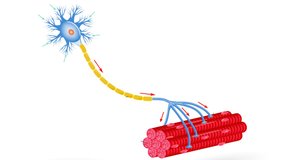
Motor Unit Recruitment and Summation
Recruitment is the process of activating more motor units to increase muscle tension. Smaller units are activated first, followed by larger, more powerful units. Asynchronous summation allows sustained contraction by rotating active units.
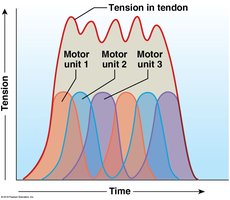
Muscle Tone
Muscle tone is the resting tension in skeletal muscle, maintained by a variable number of motor units active subconsciously. This low-level tension increases energy consumption and raises resting metabolism.
Isotonic contractions: Muscle changes length while tension remains constant.
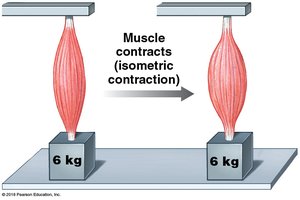
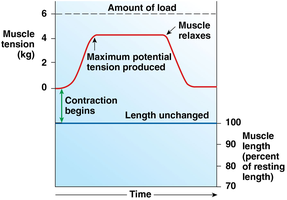
Isometric contractions: Muscle length does not change, but tension is generated.
Muscle Contraction
Isotonic Contraction
In isotonic contractions, muscle tension remains stable while the muscle changes length. This is typical in movements like lifting, walking, or running.
Concentric contraction: Muscle shortens as tension exceeds load.
Eccentric contraction: Muscle lengthens as peak tension is less than the load.
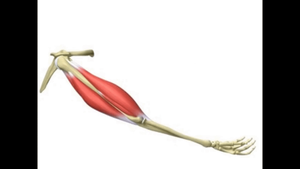
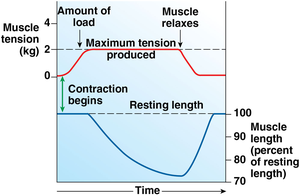
Concentric Contraction
During concentric contraction, muscle tension rises until it exceeds the load, causing the muscle to shorten. Example: flexing the elbow while holding a dumbbell.
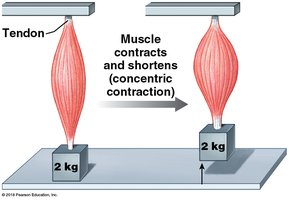
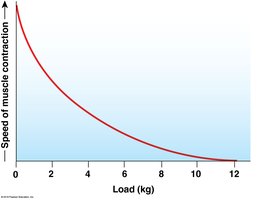
Muscle Contraction Speed and Load
The speed of muscle contraction decreases as the load increases. This relationship is described by a hyperbolic curve.
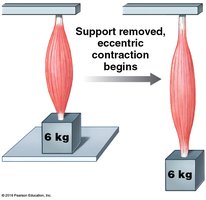
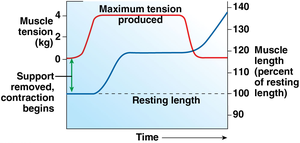
Eccentric Contraction
In eccentric contraction, the muscle produces less tension than the load, causing it to lengthen. Example: lowering a dumbbell from flexed to extended position. If the load is too great, muscle or tendon injury may occur.
Isometric Contraction
In isometric contractions, muscle length does not change, but tension is generated. These contractions are important for maintaining posture.
Contractions Occur in Pairs
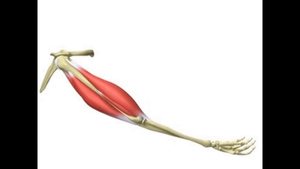
Muscle contractions typically occur in pairs, with one muscle contracting while its antagonist relaxes.
Muscle Activity
Origin, Insertion, and Action
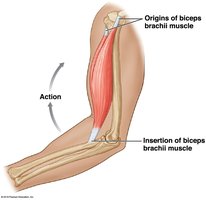
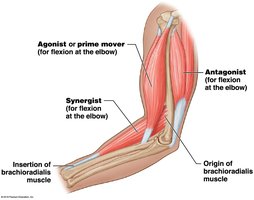
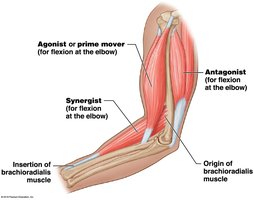
The origin is the fixed attachment point of a muscle, usually proximal. The insertion is the movable attachment, usually distal. The action is the specific movement produced by the muscle.
Muscle Groups: Agonist, Antagonist, Synergist, Fixator
Muscles work in groups to produce movement:
Agonist (prime mover): Main muscle responsible for movement (e.g., biceps brachii for elbow flexion).
Antagonist: Opposes the agonist (e.g., triceps brachii for elbow flexion).
Synergist: Assists the agonist, providing additional pull or stabilizing origin (e.g., brachioradialis).
Fixator: Synergist that prevents movement at another joint.
Muscle Leverage
Levers and Fulcrums
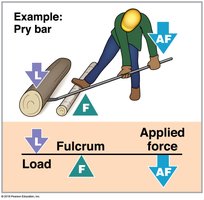
A lever is a rigid structure that moves when force is applied to overcome a load. The fulcrum is the fixed point (joint) on which the lever pivots.
Classes of Levers
There are three classes of levers in the body:
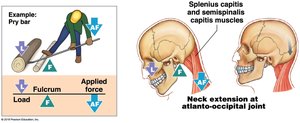
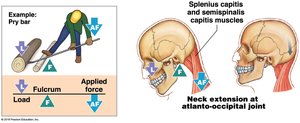
First-class lever: Fulcrum is between applied force and load (e.g., neck extension).
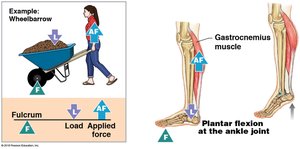
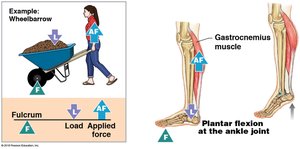
Second-class lever: Load is between applied force and fulcrum (e.g., plantar flexion at ankle).
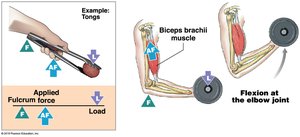
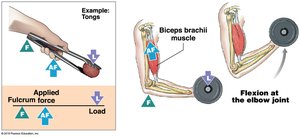
Third-class lever: Force is applied between load and fulcrum (most common, e.g., elbow flexion).
First-Class Lever
Second-Class Lever
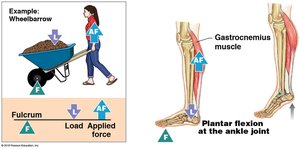
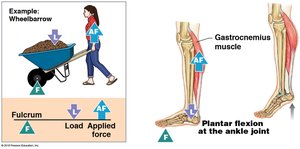
Third-Class Lever
Energy for Movement
Sources of ATP in Muscles
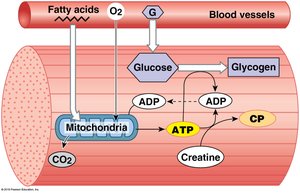
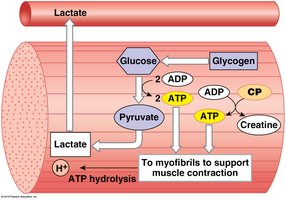
Muscle contraction requires ATP, which is generated through anaerobic and aerobic metabolism.
Anaerobic metabolism: Glycolysis produces 2 ATP per glucose without oxygen.
Aerobic metabolism: Citric acid cycle and electron transport chain produce up to 15 ATP per pyruvate with oxygen.
Energy Reserves in Muscle Fibers
Free ATP: Supports a few seconds of activity.
Creatine phosphate (CP): Reforms ATP for short bursts.
Anaerobic respiration: Glycogen stores provide energy for minutes.
Aerobic respiration: Glycogen and lipids support hours of activity.
Metabolic Levels and Muscle Activity
Low metabolic level: ATP demand is low; muscles burn more lipids than glucose.
Moderate metabolic level: ATP demand is moderate; aerobic respiration is maximized.
High metabolic level: ATP demand is high; anaerobic metabolism increases, leading to lactate buildup and fatigue.
Muscle Recovery
Muscle Fatigue and Recovery
Muscle fatigue occurs when muscles can no longer perform at the required level, often due to decreased pH and altered enzyme activity. Recovery involves restoring ATP, creatine phosphate, and glycogen levels, and converting lactate back to pyruvate or glucose.
Cori Cycle (Lactic Acid Cycle)
The Cori cycle shuttles lactate from muscles to the liver, where it is converted to pyruvate and then glucose, which returns to muscles for energy.
Oxygen Debt (EPOC)
Oxygen debt is the amount of oxygen required to restore normal conditions after exertion, including replenishing energy stores and converting lactate.

Muscle Fibers
Types of Skeletal Muscle Fibers
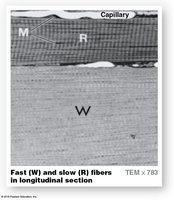
Skeletal muscle fibers differ in their capacity for aerobic and anaerobic metabolism, oxygen usage, and ATP production. There are three main types:
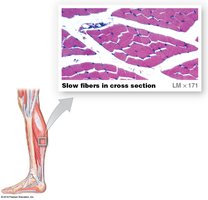
Slow fibers (Type I): Slow to contract, fatigue-resistant, high aerobic capacity, rich in myoglobin.
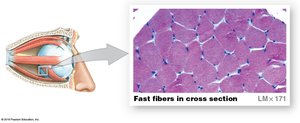
Fast fibers (Type IIx): Rapid contraction, powerful, fatigue quickly, high anaerobic capacity.
Intermediate fibers (Type IIa): Characteristics between slow and fast fibers, more fatigue-resistant than fast fibers.
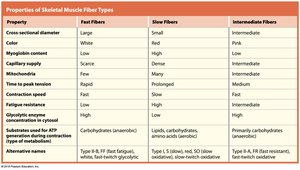
Properties of Muscle Fiber Types
Property | Fast Fibers | Slow Fibers | Intermediate Fibers |
|---|---|---|---|
Cross sectional diameter | Large | Small | Intermediate |
Color | White | Red | Pink |
Myoglobin content | Low | High | Intermediate |
Capillary supply | Few | Many | Intermediate |
Mitochondria | Few | Many | Intermediate |
Contraction speed | Fast | Slow | Fast |
Fatigue resistance | Low | High | Intermediate |
Glycolytic enzyme concentration | High | Low | Intermediate |
Substrates used for ATP production | Carbohydrates (anaerobic) | Lipids, carbohydrates, amino acids (aerobic) | Primarily carbohydrates |
Alternative names | Type II, IIx, fast twitch glycolytic | Type I, slow twitch oxidative | Type IIa, fast twitch resistant |

Muscle Disorders
Hypertrophy and Atrophy
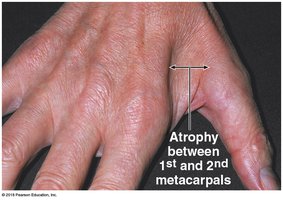
Hypertrophy is muscle enlargement due to increased stress, resulting in more myofibrils, myofilaments, mitochondria, and glycogen. Atrophy is decreased muscle size, tone, and power due to reduced stimulation or use.
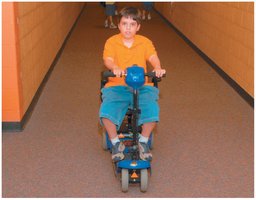
Muscular Dystrophy
Muscular dystrophy is a group of inherited diseases causing progressive muscle weakness and deterioration. Duchenne and Becker muscular dystrophy are common forms, often leading to respiratory paralysis.
Polio
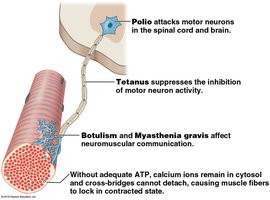
Polio is a viral disease that attacks motor neurons in the CNS, causing atrophy and paralysis. Vaccines have greatly reduced its incidence.
Tetanus
Tetanus is caused by a bacterial toxin that suppresses inhibition of motor neuron activity, resulting in sustained, powerful contractions. It thrives in low-oxygen environments and can be fatal.
Botulism
Botulism is caused by toxins from Clostridium botulinum, which block acetylcholine release at neuromuscular junctions, leading to paralysis.
Myasthenia Gravis
Myasthenia gravis is an autoimmune disease resulting in loss of acetylcholine receptors at neuromuscular junctions, causing progressive muscle weakness.
Rigor Mortis
Rigor mortis is the generalized muscle contraction that occurs shortly after death due to ATP depletion and sustained calcium presence in the sarcoplasm, preventing myosin cross-bridge detachment.
Summary Table: Muscle Disorders
Disorder | Cause | Effect |
|---|---|---|
Hypertrophy | High stress, hormones | Muscle enlargement |
Atrophy | Reduced stimulation/use | Muscle shrinkage |
Muscular dystrophy | Genetic | Progressive weakness |
Polio | Virus | Motor neuron damage |
Tetanus | Bacterial toxin | Sustained contraction |
Botulism | Bacterial toxin | Paralysis |
Myasthenia gravis | Autoimmune | Weakness |
Rigor mortis | ATP depletion | Sustained contraction after death |
