 뒤로
Muscles of the Shoulder, Trunk, and Thigh: Comparative Anatomy in Humans and Cats
스터디 가이드 - 스마트 노트
 자료에 맞춘 맞춤형 노트, 핵심 정의, 예시, 맥락을 확장해 제공합니다.
Muscular System: Anatomy of the Shoulder, Trunk, and Thigh
Overview of Muscular Anatomy
The muscular system is essential for movement, stability, and posture. This section focuses on the superficial and deep muscles of the shoulder, trunk, and thigh, comparing human anatomy with that of the cat, a common model organism in anatomical studies.
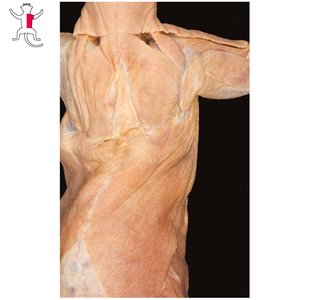
Superficial Muscles of the Shoulder, Trunk, and Neck (Cat)
Superficial muscles are those closest to the skin and are often involved in large movements and stabilization of the body. In the cat, these muscles are analogous to those found in humans, though their arrangement may differ slightly due to quadrupedal locomotion.
Trapezius: Elevates, retracts, and rotates the scapula.
Latissimus dorsi: Extends, adducts, and medially rotates the arm.
Deltoid: Abducts the arm at the shoulder.
Rhomboid muscles: Retract the scapula.
Serratus anterior: Protracts the scapula and holds it against the thoracic wall.
Example: The trapezius muscle in both cats and humans is responsible for moving the scapula, but in cats, it is more elongated to accommodate their quadrupedal stance.
Deep Muscles of the Dorsal Thorax (Cat)
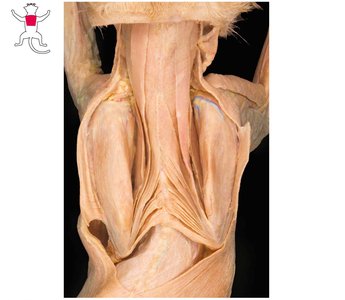
Deep muscles lie beneath the superficial muscles and are crucial for maintaining posture and stabilizing the vertebral column. These muscles are often involved in fine movements and support.
Spinalis, Longissimus, and Iliocostalis (Erector Spinae Group): Extend and laterally flex the vertebral column.
Multifidus: Stabilizes vertebrae during local movements.
Semispinalis: Extends the head and vertebral column.
Example: The erector spinae group is prominent in both humans and cats, providing the main support for the back and allowing for extension and lateral flexion.
Muscles of the Posterolateral Thigh (Cat)
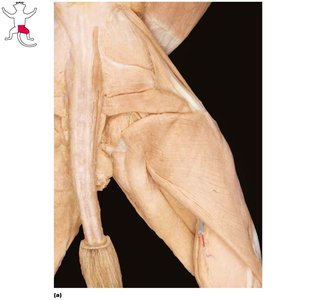
The posterolateral thigh muscles are involved in movement of the hip and knee joints. These muscles are important for locomotion, especially in quadrupeds like cats.
Gluteus maximus: Extends and laterally rotates the thigh.
Biceps femoris: Flexes the knee and extends the hip.
Semitendinosus and Semimembranosus: Flex the knee and extend the hip.
Tensor fasciae latae: Abducts and medially rotates the thigh.
Example: The gluteal muscles in cats are adapted for powerful jumping and running, similar to their function in humans but with greater emphasis on propulsion.
Comparative Anatomy: Human vs. Cat Musculature
While the basic muscle groups are conserved between humans and cats, their arrangement and function are adapted to the species' mode of locomotion. Cats, being quadrupeds, have elongated and more robust muscles for running and jumping, whereas humans, as bipeds, have muscles adapted for upright posture and fine motor control.
Similarities: Both species have trapezius, latissimus dorsi, gluteal, and thigh muscles.
Differences: Muscle shape and attachment points differ due to posture and movement requirements.
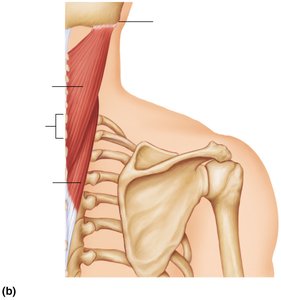
Human Muscular Anatomy: Dorsal Trunk and Shoulder
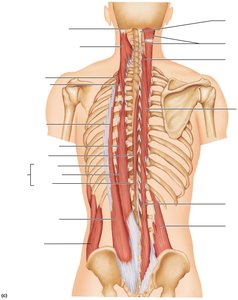
In humans, the dorsal trunk and shoulder muscles are responsible for movements of the upper limb and stabilization of the back. These muscles are organized in layers, with superficial muscles controlling large movements and deep muscles providing stability.
Trapezius: Moves the scapula and supports the arm.
Latissimus dorsi: Important for arm extension and adduction.
Rhomboids: Retract the scapula.
Erector spinae: Maintain posture and extend the vertebral column.
Human Muscular Anatomy: Lateral Neck and Shoulder
The lateral neck and shoulder muscles facilitate movement of the head and upper limb. These muscles are essential for actions such as turning the head and raising the arm.
Sternocleidomastoid: Rotates and flexes the neck.
Deltoid: Abducts the arm.
Trapezius: Elevates the scapula.
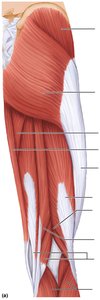
Human Muscular Anatomy: Posterolateral Thigh
The posterolateral thigh muscles are involved in extension, abduction, and rotation of the hip, as well as flexion of the knee. These muscles are crucial for walking, running, and maintaining balance.
Gluteus maximus: Main extensor of the hip.
Biceps femoris: Flexes the knee and extends the hip.
Semitendinosus and Semimembranosus: Flex the knee and extend the hip.
Summary Table: Key Muscles and Their Functions
Muscle Group | Location | Function |
|---|---|---|
Trapezius | Shoulder/Back | Moves scapula, supports arm |
Latissimus dorsi | Back | Extends, adducts, rotates arm |
Gluteus maximus | Thigh | Extends, rotates thigh |
Biceps femoris | Thigh | Flexes knee, extends hip |
Erector spinae | Back | Extends vertebral column |
Additional info:
These notes expand upon the visual materials by providing academic context, definitions, and comparative anatomy between humans and cats. The images included are directly relevant to the anatomical regions discussed and reinforce the educational content.
