 뒤로
Respiratory System: Gas Exchange and Transport
스터디 가이드 - 스마트 노트
 자료에 맞춘 맞춤형 노트, 핵심 정의, 예시, 맥락을 확장해 제공합니다.
Respiratory System: Gas Exchange and Transport
Overview of Respiration
The process of respiration involves several integrated steps that ensure the exchange of gases between the atmosphere and body tissues. These steps include pulmonary ventilation, pulmonary gas exchange, gas transport in blood, and tissue gas exchange.
Pulmonary ventilation: Movement of air into and out of the lungs.
Pulmonary gas exchange: Exchange of gases between alveoli and pulmonary capillaries.
Gas transport in blood: Movement of oxygen and carbon dioxide through the bloodstream.
Tissue gas exchange: Exchange of gases between systemic capillaries and tissue cells.
Partial Pressures and Gas Laws
Gas exchange is governed by the behavior of gases as described by Dalton’s Law and Henry’s Law. These laws explain how gases exert pressure and dissolve in liquids, which is fundamental to understanding pulmonary and tissue gas exchange.
Dalton’s Law: Each gas in a mixture exerts its own partial pressure, and the total pressure is the sum of all partial pressures.
Henry’s Law: The amount of gas that dissolves in a liquid is proportional to its partial pressure and solubility.
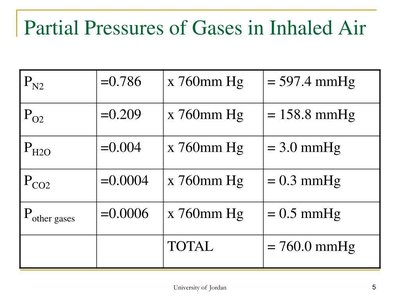
Example: The partial pressures of gases in inhaled air are calculated using Dalton’s Law.
Pulmonary Gas Exchange
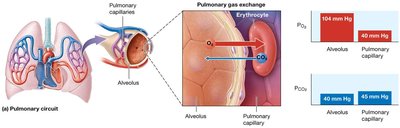
Pulmonary gas exchange occurs in the alveoli, where oxygen diffuses from alveolar air into the blood, and carbon dioxide diffuses from blood into the alveoli. The direction and rate of diffusion are determined by partial pressure gradients.
Oxygen: Moves from alveoli (high PO2) to pulmonary capillaries (low PO2).
Carbon dioxide: Moves from pulmonary capillaries (high PCO2) to alveoli (low PCO2).
Ventilation-Perfusion Matching
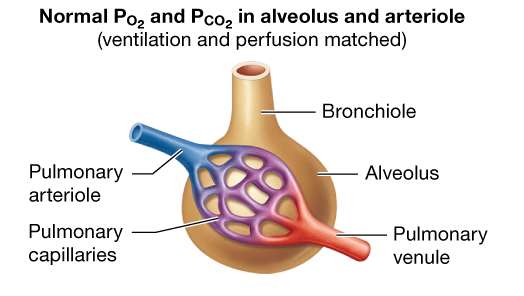
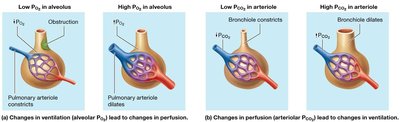
Efficient gas exchange requires matching the amount of air reaching the alveoli (ventilation) with the blood flow in pulmonary capillaries (perfusion). Mismatches can reduce gas exchange efficiency.
Normal: PO2 and PCO2 are balanced in alveolus and arteriole.
Mismatches: Can occur due to obstruction or changes in blood flow.
Tissue Gas Exchange
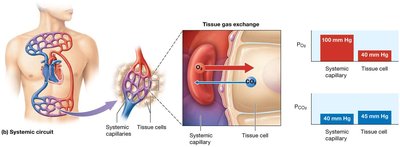
Tissue gas exchange is the reverse of pulmonary gas exchange. Oxygen diffuses from systemic capillaries into tissue cells, while carbon dioxide diffuses from tissue cells into capillaries. Partial pressure differences drive these movements.
Oxygen: PO2 is higher in systemic capillaries than in tissue cells.
Carbon dioxide: PCO2 is higher in tissue cells than in systemic capillaries.
Transport of Gases in Blood
Oxygen Transport
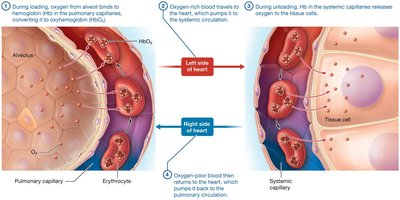
Oxygen is transported in blood primarily bound to hemoglobin in erythrocytes. The loading and unloading of oxygen depend on the partial pressure of oxygen (PO2) and hemoglobin’s affinity for oxygen.
Loading: Occurs in pulmonary capillaries where PO2 is high.
Unloading: Occurs in systemic capillaries where PO2 is low.
Oxygen-Hemoglobin Dissociation Curve
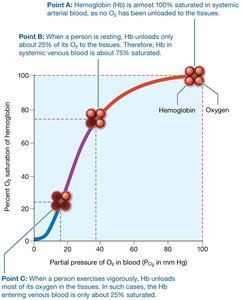
The oxygen-hemoglobin dissociation curve shows the relationship between PO2 and hemoglobin saturation. Factors such as temperature, pH, PCO2, and BPG affect hemoglobin’s affinity for oxygen.
High PO2: Hemoglobin is highly saturated.
Low PO2: Hemoglobin releases oxygen.
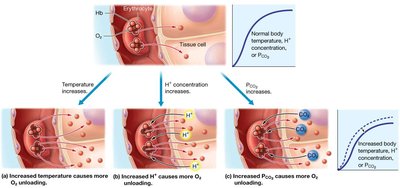
Curve shifts: Increased temperature, decreased pH, increased PCO2, and increased BPG cause more oxygen unloading.
Carbon Dioxide Transport
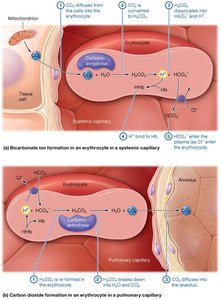
Carbon dioxide is transported in blood in three ways:
Dissolved in plasma
Bound to hemoglobin
As bicarbonate ions
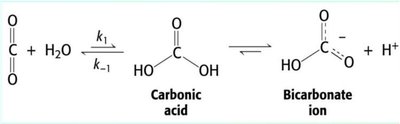
The conversion of carbon dioxide to bicarbonate ions is catalyzed by carbonic anhydrase in erythrocytes. This reaction is reversible and helps maintain acid-base balance.
Equation:
Effect of Carbon Dioxide on Blood pH
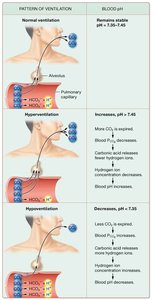
Changes in carbon dioxide levels affect blood pH through the carbonic acid-bicarbonate buffer system. Hyperventilation and hypoventilation alter CO2 levels and thus pH.
Hyperventilation: Decreases CO2, increases pH (alkalosis).
Hypoventilation: Increases CO2, decreases pH (acidosis).
Summary Table: Partial Pressures of Gases in Inhaled Air
This table summarizes the partial pressures of major gases in inhaled air, illustrating Dalton’s Law in practice.
Gas | Fraction | Pressure (mmHg) |
|---|---|---|
N2 | 0.786 | 597.4 |
O2 | 0.209 | 158.8 |
H2O | 0.004 | 3.0 |
CO2 | 0.0004 | 0.3 |
Other gases | 0.0006 | 0.5 |
Total | 760.0 |
Additional info: The notes expand on the brief points by providing definitions, examples, and academic context for each step of respiration, gas laws, and transport mechanisms. The images included directly reinforce the explanations of gas exchange, transport, and pH regulation.
