 뒤로
뒤로Skeletal Muscle Contraction: Sliding Filament Theory and the Cross-Bridge Cycle
스터디 가이드 - 스마트 노트
 자료에 맞춘 맞춤형 노트, 핵심 정의, 예시, 맥락을 확장해 제공합니다.
Skeletal Muscle
Introduction to Skeletal Muscle Contraction
Skeletal muscle contraction is a highly organized process that enables voluntary movement in the human body. The contraction mechanism is based on the interaction between actin and myosin filaments within the sarcomere, the fundamental contractile unit of muscle tissue.
Sliding Filament Theory of Contraction
The sliding filament theory explains how muscle fibers contract by the sliding of thin (actin) and thick (myosin) filaments past each other, resulting in shortening of the sarcomere without a change in filament length.
Actin and Myosin: Myofibrils are composed of overlapping actin (thin) and myosin (thick) filaments.
Fixed Length: The filaments themselves do not shorten; instead, they slide past one another.
Energy Dependence: This process requires energy in the form of ATP.
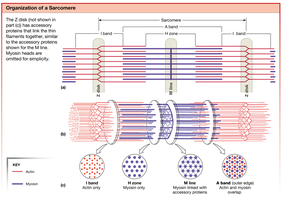
Example: During muscle contraction, the H zone and I band decrease in width, while the A band remains constant, reflecting the sliding of filaments.
Myosin Crossbridges and the Power Stroke
Muscle contraction is driven by the cyclical interaction of myosin heads (crossbridges) with actin filaments, known as the cross-bridge cycle.
Power Stroke: The myosin head pivots, pulling the actin filament toward the M line of the sarcomere.
Release and Reset: After the power stroke, myosin releases actin, resets, and binds to a new actin site.
Asynchronous Action: Not all myosin heads release actin simultaneously, ensuring smooth contraction.
ATPase Activity: Myosin ATPase hydrolyzes ATP, providing energy to 'cock' the myosin head for the next cycle.
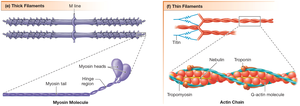
Example: Each myosin thick filament can interact with six actin thin filaments, and each actin filament can be contacted by three different myosin filaments.
Role of Calcium in Muscle Contraction
Calcium ions (Ca2+) play a critical regulatory role in initiating muscle contraction by controlling the interaction between actin and myosin.
Troponin Complex: Troponin is a complex of three proteins, including Troponin C, which binds Ca2+ reversibly.
Tropomyosin Regulation: In the absence of Ca2+, tropomyosin blocks the myosin-binding sites on actin, preventing contraction.
Calcium Release: Upon stimulation, Ca2+ is released from the sarcoplasmic reticulum and binds to troponin.
Exposure of Binding Sites: Troponin undergoes a conformational change, moving tropomyosin away from the binding sites, allowing myosin to bind actin and initiate contraction.
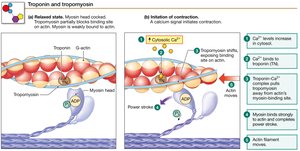
Example: Muscle contraction continues as long as Ca2+ is present and ATP is available to fuel the cycle.
The Cross-Bridge Cycle
The cross-bridge cycle describes the sequence of events that occur during muscle contraction at the molecular level.
Rigor State: Myosin is tightly bound to actin after a power stroke; this state is brief under normal conditions.
ATP Binding: ATP binds to myosin, causing it to detach from actin.
ATP Hydrolysis: Myosin ATPase hydrolyzes ATP to ADP and Pi, energizing the myosin head and allowing it to reattach to a new actin site in a 'cocked' position.
Power Stroke: Release of Pi initiates the power stroke, moving actin toward the M line.
ADP Release: Myosin releases ADP, returning to the rigor state and ready for the next cycle.
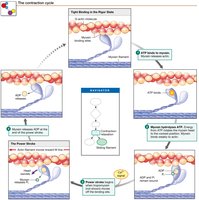
Example: In the absence of ATP (as in rigor mortis), myosin remains bound to actin, causing muscles to become stiff.
Summary Table: Key Steps in the Cross-Bridge Cycle
Step | Description |
|---|---|
1. Rigor State | Myosin tightly bound to actin; no ATP or ADP bound |
2. ATP Binding | ATP binds to myosin, causing detachment from actin |
3. ATP Hydrolysis | ATP is hydrolyzed; myosin head is energized and reattaches to actin |
4. Power Stroke | Release of Pi triggers the power stroke, moving actin |
5. ADP Release | ADP is released; cycle is ready to repeat |
Key Equations
ATP Hydrolysis:
Learning Objectives
Diagram the sliding filament mechanism of contraction.
Describe the role of Ca2+ in muscle contraction.
Explain the steps of the cross-bridge cycle.
Additional info: The cross-bridge cycle is fundamental to all muscle contraction, and defects in any step can lead to muscle weakness or disease. Understanding these mechanisms is essential for fields such as medicine, physical therapy, and sports science.
