 뒤로
Special Senses: Olfaction and Gustation – Structure, Function, and Clinical Relevance
스터디 가이드 - 스마트 노트
 자료에 맞춘 맞춤형 노트, 핵심 정의, 예시, 맥락을 확장해 제공합니다.
Special Senses: Overview
The special senses include vision, taste (gustation), smell (olfaction), hearing, and equilibrium. Unlike general senses, which are distributed throughout the body, special senses are localized in complex sense organs primarily in the head. This guide focuses on the chemical senses: olfaction and gustation, and reviews the general sensory receptors that provide foundational understanding for these systems.
General Sensory Receptors
Classification of Sensory Receptors
Sensory receptors are specialized to respond to changes in the environment (stimuli). They can be classified by:
Stimulus Type: Mechanoreceptors (touch, pressure), Thermoreceptors (temperature), Photoreceptors (light), Chemoreceptors (chemicals), Nociceptors (pain)
Body Location: Exteroceptors (external environment), Interoceptors (internal environment), Proprioceptors (body position)
Structural Complexity: Nonencapsulated (free) nerve endings, Encapsulated nerve endings
Levels of Sensory Processing
Sensory information is processed at three main levels:
Receptor Level: Sensory reception and transmission to the CNS
Circuit Level: Processing in ascending pathways (spinal cord, brainstem)
Perceptual Level: Processing in cortical sensory centers (conscious perception)
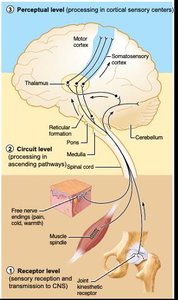
Types of General Sensory Receptors
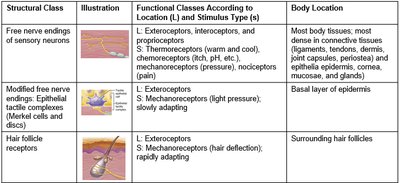
General sensory receptors are either nonencapsulated or encapsulated. They detect tactile, temperature, pain, and muscle sense. The following tables summarize their structure, function, and location:
Structural Class | Functional Classes (Location & Stimulus) | Body Location |
|---|---|---|
Free nerve endings of sensory neurons | Exteroceptors, interoceptors, proprioceptors; thermoreceptors, chemoreceptors, mechanoreceptors, nociceptors | Most body tissues; especially connective tissues and epithelia |
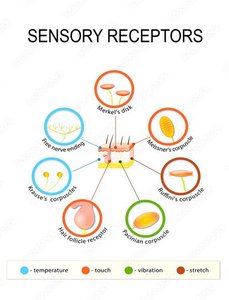
Modified free nerve endings (Merkel discs) | Exteroceptors; mechanoreceptors (light pressure), slowly adapting | Basal layer of epidermis |
Hair follicle receptors | Exteroceptors; mechanoreceptors (hair deflection), rapidly adapting | Surrounding hair follicles |
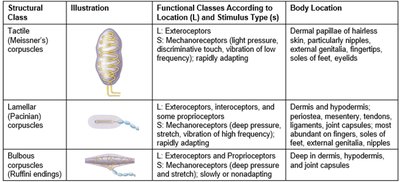
Structural Class | Functional Classes (Location & Stimulus) | Body Location |
|---|---|---|
Tactile (Meissner's) corpuscles | Exteroceptors; mechanoreceptors (light pressure, discriminative touch, vibration of low frequency), rapidly adapting | Dermal papillae of hairless skin (fingertips, soles, eyelids, etc.) |
Lamellar (Pacinian) corpuscles | Exteroceptors, interoceptors, some proprioceptors; mechanoreceptors (deep pressure, stretch, vibration of high frequency), rapidly adapting | Dermis, hypodermis, periostea, tendons, ligaments, etc. |
Bulbous (Ruffini) corpuscles | Exteroceptors, proprioceptors; mechanoreceptors (deep pressure and stretch), slowly or nonadapting | Deep in dermis, hypodermis, joint capsules |
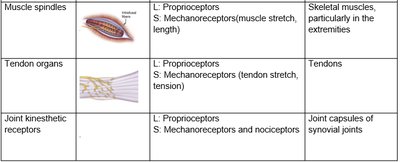
Receptor | Functional Class | Body Location |
|---|---|---|
Muscle spindles | Proprioceptors; mechanoreceptors (muscle stretch, length) | Skeletal muscles, especially extremities |
Tendon organs | Proprioceptors; mechanoreceptors (tendon stretch, tension) | Tendons |
Joint kinesthetic receptors | Proprioceptors; mechanoreceptors and nociceptors | Joint capsules of synovial joints |
For a visual summary of sensory receptor types and their functions:
Special Senses: Olfaction (Smell)
Olfactory Anatomy and Physiology
Olfaction is the sense of smell, detected by the olfactory mucosa in the superior region of the nasal cavity. Olfactory cells are unique neurons that are directly exposed to the environment and regenerate every 30–60 days. The olfactory nerve (CN I) transmits signals to the brain.
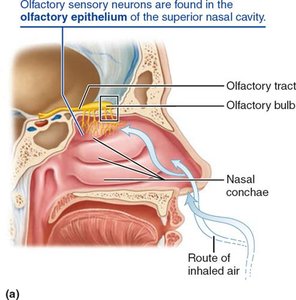
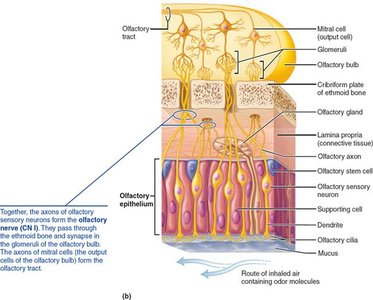
Humans can detect a vast range of odors (10,000 to 1 trillion), using ~350 different odorant receptors.
Pain and temperature receptors are also present in the nasal cavity.
Olfactory Transduction Process
The process of olfactory transduction involves several steps:
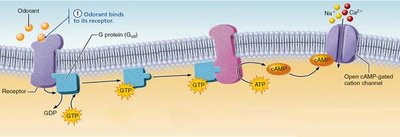
Odor molecules dissolve in mucus and bind to receptors on olfactory cilia.
This activates a G protein, which triggers a cascade leading to the production of cAMP.
cAMP opens ion channels, causing depolarization and the generation of an action potential.
Olfactory nerve fibers transmit the signal to the olfactory bulb, then to various brain regions.
Clinical Relevance: Olfactory Disorders
Anosmia: Loss of smell, which can result from head injuries, nasal inflammation, neurological disorders (e.g., Parkinson’s disease), or viral infections (e.g., COVID-19).
Olfactory hallucinations: Often associated with temporal lobe epilepsy.
Special Senses: Gustation (Taste)
Gustatory Anatomy and Physiology
The sense of taste begins with the stimulation of sensory cells in taste buds, which are primarily located on the tongue within papillae (fungiform, foliate, and vallate). Taste buds are also found on the soft palate, cheeks, pharynx, and epiglottis.
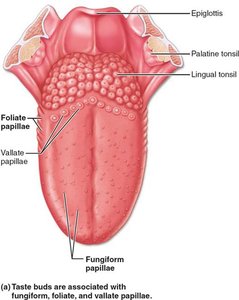
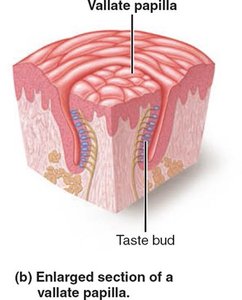
Each taste bud contains 50–100 epithelial cells, including gustatory epithelial cells (with microvilli called gustatory hairs) and basal epithelial cells (stem cells that regenerate every 7–10 days).
Basic Taste Sensations
There are five primary taste sensations:
Sweet: Sugars, saccharin, alcohol, some amino acids, some lead salts
Sour: Hydrogen ions from acids
Salty: Metal ions (especially sodium chloride)
Bitter: Alkaloids (quinine, nicotine, caffeine) and some non-alkaloids (aspirin)
Umami: Amino acids glutamate and aspartate (e.g., beef, cheese, MSG)
There is no such thing as a 'taste map'—all taste qualities can be detected across the tongue.
Requirements for Taste Perception
Chemicals must be dissolved in saliva.
They must diffuse into the taste pore and contact gustatory hairs.
Influence of Other Sensations on Taste
Taste is closely linked to smell (about 80% of taste is due to olfaction).
Other sensations, such as texture and temperature, also influence taste perception.
Some 'tastes' (e.g., hot pepper) are due to stimulation of the trigeminal nerve, not taste buds.
Taste signals are conveyed to the brain via the facial, glossopharyngeal, and vagus nerves.
Clinical Relevance: Taste Disorders
Loss of taste (ageusia) can result from infections, neurological disorders, or damage to taste pathways.
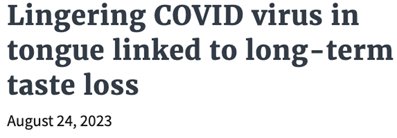
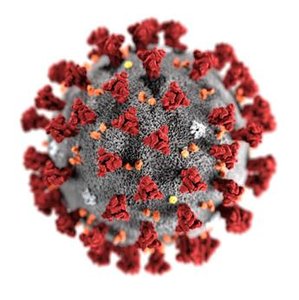
Recent research links lingering COVID-19 virus in the tongue to long-term taste loss.
Additional info: The integration of olfactory and gustatory information in the brain is essential for the perception of flavor. Disruption in either system can significantly affect quality of life and nutritional status.
