 뒤로
Study Guidance for Blood Vessels of the Cardiovascular System (Anatomy & Physiology)
스터디 가이드 - 스마트 노트
 자료에 맞춘 맞춤형 노트, 핵심 정의, 예시, 맥락을 확장해 제공합니다.
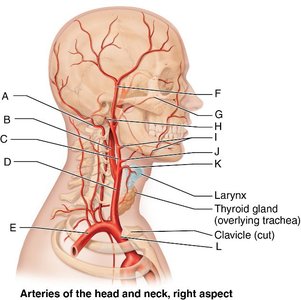
Q1. Assign the letters (A–L) to the corresponding arteries of the head and neck shown below. Refer to Figure 19.24 for help.
Background
Topic: Arteries of the Head and Neck
This question tests your knowledge of the major arteries supplying the head and neck, their anatomical locations, and their functions in delivering oxygenated blood to various regions.
Key Terms:
Artery: A blood vessel that carries blood away from the heart.
Common carotid artery: Major artery supplying blood to the head and neck.
External carotid artery: Supplies blood to the face and neck.
Internal carotid artery: Supplies blood to the brain.
Subclavian artery: Supplies blood to the upper limb and parts of the neck.
Step-by-Step Guidance
Examine the diagram and identify the main trunk arteries (such as the common carotid and subclavian arteries).
Locate the branches that supply the face, scalp, and neck (e.g., external carotid, facial, and superficial temporal arteries).
Identify arteries that supply deeper structures, such as the internal carotid artery (which enters the skull to supply the brain).
Match each labeled letter (A–L) to the correct artery based on its anatomical position and pathway.
Refer to your textbook or lecture notes for the specific names and functions of each artery shown in the diagram.
Try solving on your own before revealing the answer!
Final Answer:
A: Brachiocephalic trunk
B: Subclavian artery
C: Vertebral artery
D: Common carotid artery
E: External carotid artery
F: Superficial temporal artery
G: Maxillary artery
H: Facial artery
I: Lingual artery
J: Superior thyroid artery
K: Occipital artery
L: Internal carotid artery
These arteries are responsible for supplying blood to the head, neck, face, and brain. The diagram helps visualize their anatomical relationships and branching patterns.
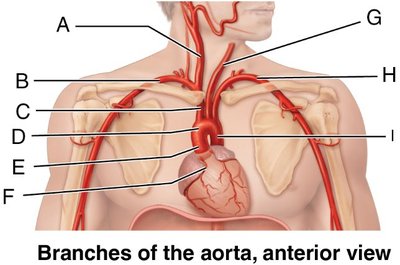
Q2. Assign the letters (A–I) to the corresponding portions of the aorta and the main branches of the aorta shown below. Refer to the text and Figures 19.23 and 19.25 for help.
Background
Topic: Branches of the Aorta
This question tests your understanding of the anatomy of the aorta and its major branches, which are essential for distributing blood throughout the body.
Key Terms:
Aorta: The largest artery in the body, originating from the left ventricle.
Ascending aorta: The initial upward segment of the aorta.
Aortic arch: The curved portion of the aorta.
Brachiocephalic trunk: First major branch from the aortic arch.
Subclavian and common carotid arteries: Branches supplying the upper limbs and head.
Step-by-Step Guidance
Identify the central vessel (aorta) and its ascending, arch, and descending segments.
Locate the major branches coming off the aortic arch: brachiocephalic trunk, left common carotid, and left subclavian arteries.
Match each labeled letter (A–I) to the correct anatomical structure based on its position and direction of blood flow.
Refer to your textbook diagrams for confirmation of each branch's name and function.
Try solving on your own before revealing the answer!
Final Answer:
A: Coronary artery
B: Brachiocephalic trunk
C: Ascending aorta
D: Right subclavian artery
E: Left common carotid artery
F: Aortic arch
G: Left subclavian artery
H: Right common carotid artery
I: Descending aorta
The aorta and its branches are critical for distributing oxygenated blood to the head, neck, upper limbs, and the rest of the body.
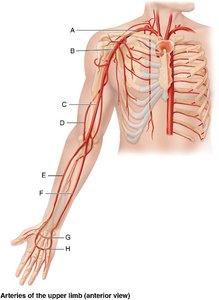
Q3. Assign the letters (A–H) to the corresponding arteries of the right upper limb shown below. Refer to Figure 19.25 for help.
Background
Topic: Arteries of the Upper Limb
This question assesses your ability to identify the major arteries supplying the upper limb, which are important for delivering blood to the arm, forearm, and hand.
Key Terms:
Subclavian artery: Supplies blood to the upper limb.
Axillary artery: Continuation of the subclavian artery in the armpit region.
Brachial artery: Main artery of the upper arm.
Radial and ulnar arteries: Supply the forearm and hand.
Step-by-Step Guidance
Start by identifying the main artery entering the upper limb (subclavian artery).
Follow the pathway as it becomes the axillary artery in the armpit and then the brachial artery in the upper arm.
Locate the branching of the brachial artery into the radial and ulnar arteries at the elbow.
Identify the arteries forming the palmar arches in the hand.
Match each letter (A–H) to the correct artery based on its anatomical location.
Try solving on your own before revealing the answer!
Final Answer:
A: Subclavian artery
B: Axillary artery
C: Brachial artery
D: Deep artery of arm
E: Radial artery
F: Ulnar artery
G: Superficial palmar arch
H: Deep palmar arch
These arteries are responsible for supplying blood to the shoulder, arm, forearm, and hand. Understanding their pathways is essential for clinical procedures and pulse measurement.
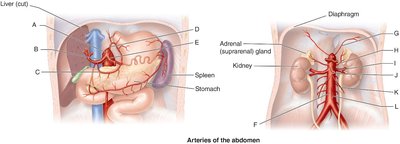
Q4. Assign the letters (A–L) to the corresponding arteries of the abdomen shown below. Refer to Figure 19.26 for help.
Background
Topic: Arteries of the Abdomen
This question tests your knowledge of the major abdominal arteries and their branches, which supply blood to the digestive organs, kidneys, and other abdominal structures.
Key Terms:
Abdominal aorta: Main artery supplying the abdomen.
Celiac trunk: Branch supplying the stomach, liver, and spleen.
Renal artery: Supplies the kidneys.
Superior and inferior mesenteric arteries: Supply the intestines.
Step-by-Step Guidance
Identify the abdominal aorta and its major branches.
Locate the celiac trunk and its branches (hepatic, splenic, gastric arteries).
Find the renal arteries supplying the kidneys.
Identify the superior and inferior mesenteric arteries supplying the intestines.
Match each letter (A–L) to the correct artery based on its anatomical location and the organ it supplies.
Try solving on your own before revealing the answer!
Final Answer:
A: Abdominal aorta
B: Celiac trunk
C: Left gastric artery
D: Splenic artery
E: Common hepatic artery
F: Inferior phrenic artery
G: Superior mesenteric artery
H: Renal artery
I: Middle suprarenal artery
J: Gonadal artery
K: Inferior mesenteric artery
L: Right gastric artery
These arteries supply blood to the abdominal organs, including the digestive tract, kidneys, and adrenal glands.
Q5. Assign the letters (A–M) to the corresponding arteries of the pelvis and lower limb shown below. Refer to Figure 19.27 for help.
Background
Topic: Arteries of the Pelvis and Lower Limb
This question assesses your ability to identify the major arteries supplying the pelvis and lower limb, which are important for delivering blood to the hip, thigh, leg, and foot.
Key Terms:
Common iliac artery: Main artery supplying the pelvis.
Femoral artery: Main artery of the thigh.
Popliteal artery: Supplies the knee region.
Anterior and posterior tibial arteries: Supply the leg and foot.
Step-by-Step Guidance
Identify the common iliac artery and its branches (internal and external iliac arteries).
Follow the pathway as the external iliac artery becomes the femoral artery in the thigh.
Locate the popliteal artery behind the knee and its branches into the anterior and posterior tibial arteries.
Identify the arteries supplying the foot, such as the dorsalis pedis and plantar arch.
Match each letter (A–M) to the correct artery based on its anatomical location.
Try solving on your own before revealing the answer!
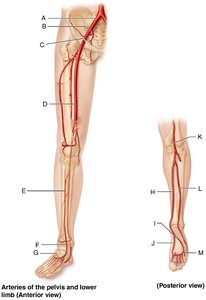
Final Answer:
A: Common iliac artery
B: Internal iliac artery
C: External iliac artery
D: Femoral artery
E: Popliteal artery
F: Anterior tibial artery
G: Posterior tibial artery
H: Fibular artery
I: Dorsalis pedis artery
J: Plantar arch
K: Medial plantar artery
L: Lateral plantar artery
M: Arcuate artery
These arteries are responsible for supplying blood to the pelvis, thigh, leg, and foot. Knowing their locations is important for understanding circulation and clinical assessments.
