 뒤로
Study Guide: Synovial Joints and Movements in Human Anatomy & Physiology
스터디 가이드 - 스마트 노트
 자료에 맞춘 맞춤형 노트, 핵심 정의, 예시, 맥락을 확장해 제공합니다.
Joints: Synovial Joints and Movements
Overview of Synovial Joints
Synovial joints are a major category of joints in the human body, characterized by a fluid-filled joint cavity that allows for a wide range of movements. These joints are essential for mobility and are found throughout the skeletal system.
Structural Characteristics: Synovial joints have articular cartilage, a joint cavity filled with synovial fluid, an articular capsule, and supporting ligaments.
Bursae and Tendon Sheaths: Bursae are fluid-filled sacs that reduce friction between moving structures, while tendon sheaths are elongated bursae that wrap around tendons.
Stabilization Factors: Synovial joints are stabilized by the shape of articular surfaces, ligaments, and muscle tone.
Classification of Synovial Joint Movements
Synovial joints allow for various types of movement, classified by the axes and planes in which they occur:
Nonaxial: Gliding movements only
Uniaxial: Movement in one plane
Biaxial: Movement in two planes
Multiaxial: Movement in or around all three planes
Types of Movements at Synovial Joints
There are three general types of movements permitted by synovial joints:
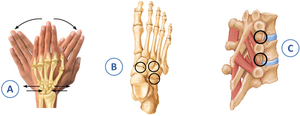
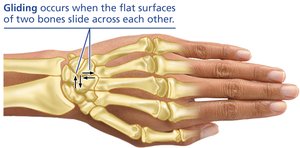
Gliding: One flat bone surface glides or slips over another similar surface. Common in intercarpal, intertarsal, and vertebral joints.
Angular Movements: These movements change the angle between two bones and occur along the sagittal or frontal plane.
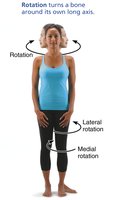
Rotation: Turning of a bone around its own long axis, either toward or away from the midline.
Gliding Movements
Gliding occurs when the flat surfaces of two bones slide across each other, such as in the wrist and ankle joints.
Angular Movements
Angular movements increase or decrease the angle between two bones. These include:
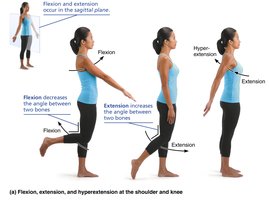
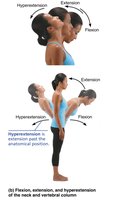
Flexion: Decreases the angle of the joint.
Extension: Increases the angle of the joint.
Hyperextension: Movement beyond the anatomical position.
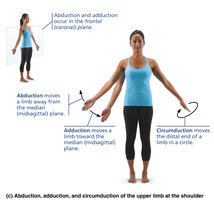
Abduction: Movement away from the midline along the frontal plane.
Adduction: Movement toward the midline along the frontal plane.
Circumduction: Combination of flexion, abduction, extension, and adduction, resulting in a limb describing a cone in space.
Rotational Movements
Rotation involves turning a bone around its own long axis. Examples include rotation of the vertebrae, humerus, and femur.
Medial Rotation: Rotation toward the midline.
Lateral Rotation: Rotation away from the midline.
Special Movements at Synovial Joints
Some synovial joints allow for special movements unique to certain body regions:
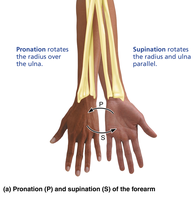
Supination and Pronation: Rotation of the radius and ulna. Supination turns the palm anteriorly, pronation turns it posteriorly.
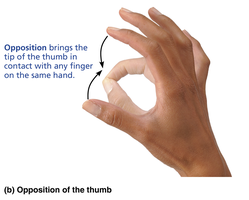
Opposition: Movement of the thumb to touch the tips of other fingers, essential for grasping.
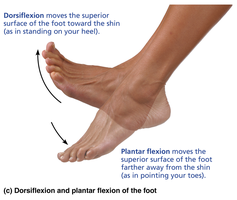
Dorsiflexion and Plantar Flexion: Dorsiflexion bends the foot toward the shin; plantar flexion points the toes.
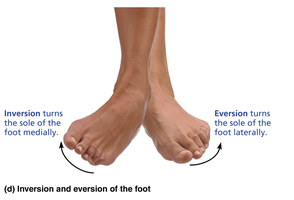
Inversion and Eversion: Inversion turns the sole of the foot medially; eversion turns it laterally.
Elevation and Depression: Elevation lifts a body part superiorly (e.g., shrugging shoulders); depression lowers it (e.g., opening jaw).
Protraction and Retraction: Protraction moves a body part forward; retraction pulls it backward.
Types of Synovial Joints
Synovial joints are classified into six types based on the shape of their articular surfaces and the movements they allow:
Plane Joints: Allow gliding movements (e.g., intercarpal joints).
Hinge Joints: Permit flexion and extension (e.g., elbow).
Pivot Joints: Allow rotation (e.g., proximal radioulnar joint).
Condylar (Ellipsoid) Joints: Permit flexion, extension, abduction, and adduction (e.g., wrist).
Saddle Joints: Allow similar movements to condylar joints but with greater freedom (e.g., thumb carpometacarpal joint).
Ball-and-Socket Joints: Allow multiaxial movement (e.g., shoulder and hip joints).
Structural and Functional Characteristics of Body Joints
Body joints are compared based on their structural and functional characteristics, including the type of movement allowed, stability, and anatomical features.
Joint Type | Movement | Example |
|---|---|---|
Plane | Gliding | Intercarpal joints |
Hinge | Flexion/Extension | Elbow |
Pivot | Rotation | Proximal radioulnar joint |
Condylar | Flexion/Extension, Abduction/Adduction | Wrist |
Saddle | Flexion/Extension, Abduction/Adduction | Thumb |
Ball-and-Socket | Multiaxial | Shoulder, Hip |
Example: The shoulder joint is a ball-and-socket joint, allowing the greatest range of motion in the human body.
Additional info: The notes above expand on brief points from the slides, providing definitions, examples, and a classification table for clarity and completeness.
