 뒤로
Study Guide: The Endocrine System (Anatomy & Physiology)
스터디 가이드 - 스마트 노트
 자료에 맞춘 맞춤형 노트, 핵심 정의, 예시, 맥락을 확장해 제공합니다.
The Endocrine System
Overview of the Endocrine System
The endocrine system is a complex network of organs that synthesize and secrete chemical messengers called hormones. These hormones interact with specific target cells to regulate vital functions such as fluid, electrolyte, and acid-base homeostasis, growth, and metabolic reactions.
Hormones: Chemical messengers secreted by endocrine glands; regulate functions of other cells.
Target Cells: Cells with specific protein receptors for hormones; only these cells are affected by a given hormone.
Homeostasis: Hormones help maintain internal balance by influencing physiological processes.
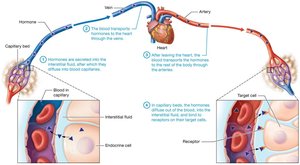
Comparison of Endocrine and Nervous Systems:
Nervous System: Uses neurotransmitters for rapid, short-lived effects.
Endocrine System: Uses hormones for slower, longer-lasting effects; hormones travel via bloodstream to distant targets.
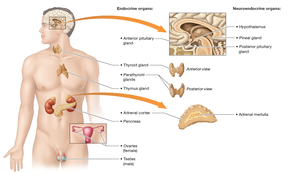
Endocrine Organs
Endocrine glands are distributed throughout the body and regulate other cell types by producing and secreting hormones. They are classified as primary or secondary organs.
Primary Endocrine Organs: Anterior pituitary, thyroid, parathyroid, adrenal cortices, pancreas, thymus.
Secondary Endocrine Organs: Heart, kidneys, small intestines, testes, ovaries.
Neuroendocrine Organs: Hypothalamus, pineal gland, adrenal medulla; consist of nervous tissue and secrete neurohormones.
Hormone Classes and Actions
Hormones are classified by their chemical structure and mechanism of action.
Amino-acid hormones: Hydrophilic; bind to plasma membrane receptors.
Steroid hormones: Hydrophobic; derived from cholesterol; bind to cytosolic or nuclear receptors.
Hormone Effects: Stimulate secretion, activate/inhibit enzymes, regulate mitosis/meiosis, alter membrane potential, and affect gene expression.
Hormone Interactions: Synergists (same effect, amplified), Antagonists (opposite effects).
Regulation of Hormone Secretion
Hormone secretion is regulated by various stimuli and feedback loops to maintain homeostasis.
Hormonal Stimuli: Endocrine cells respond to other hormones.
Humoral Stimuli: Endocrine cells respond to changes in ion/molecule concentration.
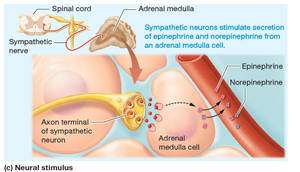
Neural Stimuli: Endocrine cells respond to nervous system signals.
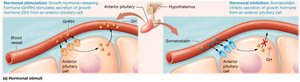
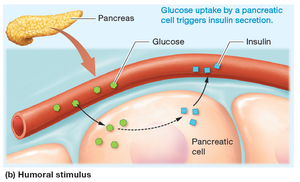
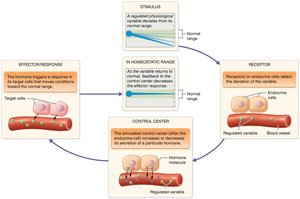
Feedback Loops: Negative feedback loops regulate hormone secretion, ensuring variables return to normal range.
Stimulus: Variable deviates from normal.
Receptor: Detects deviation.
Control Center: Adjusts hormone secretion.
Effector/Response: Hormone triggers response to restore normal range.
The Hypothalamus and Pituitary Gland
Anatomy and Functional Relationship
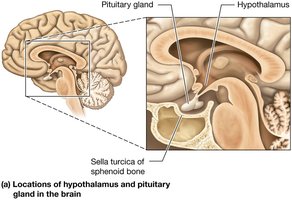
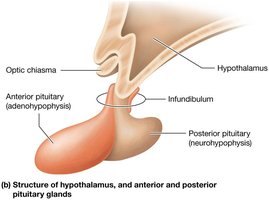
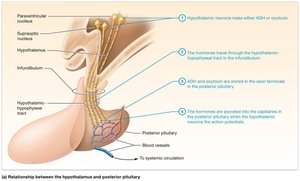
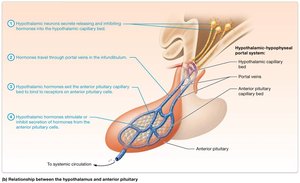
The hypothalamus and pituitary gland are central to endocrine regulation. The hypothalamus is located in the diencephalon and connected to the pituitary gland by the infundibulum.
Pituitary Gland: Sits in sella turcica of sphenoid bone; consists of anterior (adenohypophysis) and posterior (neurohypophysis) lobes.
Hormones of Hypothalamus and Posterior Pituitary
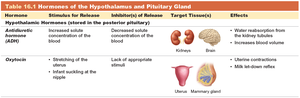
The posterior pituitary stores and releases two neurohormones produced by the hypothalamus: antidiuretic hormone (ADH) and oxytocin.
ADH (Vasopressin): Water retention; regulates water balance.
Oxytocin: Stimulates uterine contractions and milk ejection; operates via positive feedback during lactation.
Hormones of the Anterior Pituitary
The anterior pituitary releases several tropic hormones that regulate other endocrine glands. These hormones are controlled by hypothalamic releasing and inhibiting hormones via the hypothalamic-hypophyseal portal system.
TSH (Thyroid-stimulating hormone): Stimulates thyroid gland.
ACTH (Adrenocorticotropic hormone): Stimulates adrenal cortex.
Prolactin (PRL): Stimulates mammary gland growth and milk production.
LH (Luteinizing hormone): Stimulates gonadal hormone production and ovulation.
FSH (Follicle-stimulating hormone): Stimulates gamete production and follicle maturation.
GH (Growth hormone): Regulates growth of various tissues.
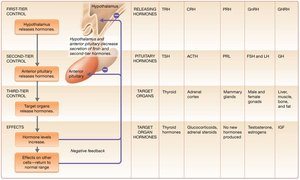
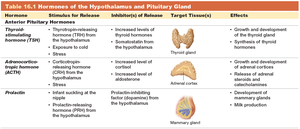
Table: Hormones of the Hypothalamus and Pituitary Gland
Hormone | Stimulus for Release | Inhibitor(s) of Release | Target Tissue(s) | Effects |
|---|---|---|---|---|
Antidiuretic hormone (ADH) | Increased solute concentration of blood | Decreased solute concentration of blood | Kidneys, brain | Water reabsorption, increases blood volume |
Oxytocin | Stretching of uterus, infant suckling | Lack of appropriate stimuli | Uterus, mammary gland | Uterine contractions, milk let-down reflex |
TSH | TRH from hypothalamus, exposure to cold | Somatostatin from hypothalamus | Thyroid gland | Growth and development, synthesis of thyroid hormones |
ACTH | CRH from hypothalamus, stress | Increased levels of cortisol | Adrenal cortex | Growth and development, release of adrenal corticosteroids |
Prolactin | Infant suckling, PRH from hypothalamus | Dopamine from hypothalamus | Mammary gland | Development of mammary glands, milk production |
The Thyroid and Parathyroid Glands
Anatomy and Functions
The thyroid gland is located in the anterior neck and secretes thyroid hormone and calcitonin. The parathyroid glands are found on the posterior surface of the thyroid and secrete parathyroid hormone (PTH).
Thyroid Hormone: Regulates metabolic rate, thermoregulation, growth, and development; synergizes with sympathetic nervous system.
Calcitonin: Lowers blood calcium levels.
Parathyroid Hormone (PTH): Increases blood calcium levels by stimulating osteoclasts and increasing intestinal absorption.
The Adrenal Glands
Anatomy and Hormones
Adrenal glands are located on the superior aspect of each kidney and consist of an outer cortex and inner medulla.
Cortex: Produces steroid hormones (mineralocorticoids, glucocorticoids, and gonadocorticoids).
Medulla: Secretes catecholamines (epinephrine and norepinephrine) for immediate stress responses.
The Endocrine Pancreas
Anatomy and Hormones
The pancreas is both an endocrine and exocrine gland. Its endocrine portion consists of pancreatic islets containing alpha and beta cells.
Alpha cells: Secrete glucagon, which increases blood glucose.
Beta cells: Secrete insulin, which decreases blood glucose.
Other Endocrine Glands and Hormone-Secreting Tissues
Pineal Gland, Thymus, and Gonads
Pineal Gland: Secretes melatonin, regulates sleep-wake cycles.
Thymus: Secretes thymopoietin, assists in T lymphocyte maturation.
Gonads: Testes produce testosterone; ovaries produce estrogen and progesterone, regulating reproductive functions.
Summary Table: Hormones and Their Functions
Hormone | Source | Target | Main Function |
|---|---|---|---|
ADH | Posterior pituitary | Kidneys, brain | Water retention |
Oxytocin | Posterior pituitary | Uterus, mammary glands | Uterine contraction, milk ejection |
TSH | Anterior pituitary | Thyroid gland | Stimulates thyroid hormone production |
ACTH | Anterior pituitary | Adrenal cortex | Stimulates corticosteroid production |
Prolactin | Anterior pituitary | Mammary glands | Milk production |
GH | Anterior pituitary | Various tissues | Growth regulation |
Thyroid hormone | Thyroid gland | Most cells | Metabolic rate, growth |
PTH | Parathyroid gland | Bones, intestines | Increase blood calcium |
Aldosterone | Adrenal cortex | Kidneys | Regulate sodium/potassium |
Cortisol | Adrenal cortex | Various tissues | Stress response |
Epinephrine | Adrenal medulla | Various tissues | Fight-or-flight response |
Insulin | Pancreas (beta cells) | Liver, muscle, fat | Decrease blood glucose |
Glucagon | Pancreas (alpha cells) | Liver, muscle, fat | Increase blood glucose |
Melatonin | Pineal gland | Brain | Regulate sleep |
Testosterone | Testes | Various tissues | Male sex characteristics |
Estrogen | Ovaries | Various tissues | Female sex characteristics |
Progesterone | Ovaries | Uterus | Pregnancy support |
