 뒤로
The Autonomic Nervous System: Structure, Function, and Regulation
스터디 가이드 - 스마트 노트
 자료에 맞춘 맞춤형 노트, 핵심 정의, 예시, 맥락을 확장해 제공합니다.
The Autonomic Nervous System (ANS)
Overview and Organization
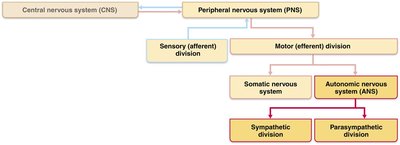
The autonomic nervous system (ANS) is a division of the peripheral nervous system responsible for regulating involuntary functions of smooth muscle, cardiac muscle, and glands. It operates largely below the level of conscious control and is essential for maintaining homeostasis.
Motor neurons in the ANS innervate visceral organs and tissues.
ANS activity adjusts heart rate, blood pressure, and digestive processes.
It is also known as the involuntary nervous system or visceral motor system.
Sympathetic and Parasympathetic Nerve Pathways
The ANS is divided into two main branches: the sympathetic division and the parasympathetic division. Both divisions are regulated by higher brain centers and often work together to maintain internal balance.
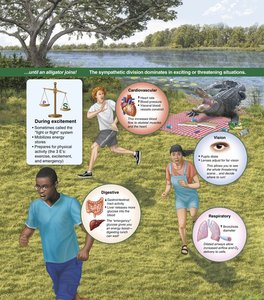
Sympathetic division: Mobilizes the body during activity ("fight-or-flight" response).
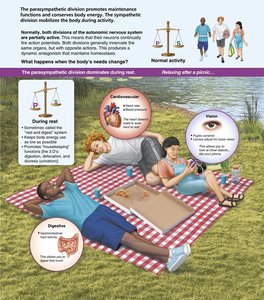
Parasympathetic division: Promotes maintenance functions and conserves energy ("rest-and-digest" response).
Dual innervation: Most visceral organs receive input from both divisions, which often have opposing effects.
Dynamic antagonism: The interplay between the two divisions allows precise control of visceral activity.
Visceral Effects of Sympathetic and Parasympathetic Innervation
Parasympathetic Division: Rest-and-Digest
The parasympathetic division keeps body energy use low and directs activities such as digestion, diuresis, and defecation. It dominates during periods of rest and relaxation.
Blood pressure, heart rate, and respiratory rates are low.
Gastrointestinal tract activity is high.
Pupils are constricted and lenses are accommodated for close vision.
Sympathetic Division: Fight-or-Flight
The sympathetic division prepares the body for stressful or emergency situations. It mobilizes energy stores and increases alertness.
Heart rate increases; skin becomes cold and sweaty; pupils dilate.
Blood is shunted to skeletal muscles and heart.
Bronchioles dilate; liver releases glucose.
Digestive and urinary functions are inhibited.
Anatomical Differences Between Sympathetic and Parasympathetic Divisions
Sites of Origin, Fiber Lengths, and Ganglia Location
There are three main anatomical differences between the two divisions:
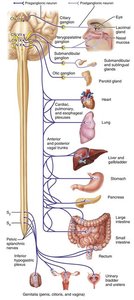
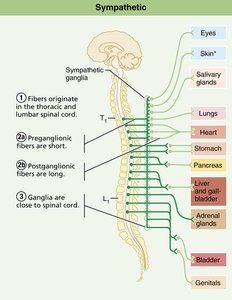
Sites of origin: Parasympathetic fibers are craniosacral (brain and sacral spinal cord); sympathetic fibers are thoracolumbar (thoracic and lumbar spinal cord).
Relative lengths of fibers: Parasympathetic has long preganglionic and short postganglionic fibers; sympathetic has short preganglionic and long postganglionic fibers.
Location of ganglia: Parasympathetic ganglia are in or near visceral effectors; sympathetic ganglia are close to the spinal cord.
Sympathetic Trunk and Ganglia
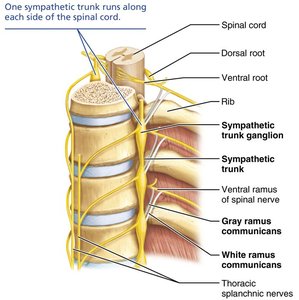
The sympathetic division is more complex and innervates more organs. It includes sympathetic trunk ganglia, which run alongside the spinal cord.
Typically, there are 23 sympathetic trunk ganglia per trunk: 3 cervical, 11 thoracic, 4 lumbar, 4 sacral, 1 coccygeal.
Preganglionic axons may synapse at the same level, at higher or lower levels, or in collateral ganglia (abdomen and pelvis).
Receptors and Neurotransmitters of the Two Divisions
Somatic vs. Autonomic Nervous System
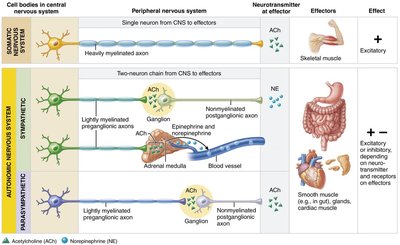
Both systems have motor fibers, but differ in effectors, number of neurons, and neurotransmitter actions.
Somatic nervous system: Innervates skeletal muscle; uses a single, thick myelinated axon; releases acetylcholine (ACh); always excitatory.
Autonomic nervous system: Innervates cardiac muscle, smooth muscle, and glands; uses a two-neuron chain (preganglionic and postganglionic); preganglionic fibers release ACh; postganglionic fibers release norepinephrine (NE) in sympathetic, ACh in parasympathetic; effects can be excitatory or inhibitory depending on receptor type.
Visceral Reflex Arcs
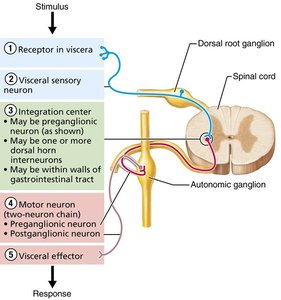
Visceral reflex arcs control involuntary responses in organs. They have similar components to somatic reflex arcs but differ in the number of neurons and effectors.
Components: receptor, sensory neuron, integration center, motor neuron, effector.
Motor pathway uses two consecutive neurons.
Afferent fibers are visceral sensory neurons.
Effectors are smooth muscle, cardiac muscle, and glands.
Sympathetic Tone and Blood Pressure Regulation
Almost all blood vessel smooth muscle is innervated only by sympathetic fibers, which control blood pressure even at rest.
Sympathetic tone (vasomotor tone): Continual partial constriction of blood vessels.
If blood pressure drops, sympathetic fibers fire faster to increase constriction and raise blood pressure.
If blood pressure rises, sympathetic fibers fire less, causing dilation and lowering blood pressure.
This allows the sympathetic system to shunt blood where needed.
Summary Table: Comparison of Sympathetic and Parasympathetic Divisions
Feature | Sympathetic Division | Parasympathetic Division |
|---|---|---|
Origin | Thoracolumbar (T1-L2) | Craniosacral (brainstem & S2-S4) |
Preganglionic Fiber Length | Short | Long |
Postganglionic Fiber Length | Long | Short |
Ganglia Location | Near spinal cord | In/near effector organs |
Main Neurotransmitter | Norepinephrine (NE) | Acetylcholine (ACh) |
General Function | Fight-or-flight | Rest-and-digest |
Key Equations
Neurotransmitter release and effect:
Additional info: The enteric nervous system, a subdivision of the ANS, is involved in gastrointestinal reflexes and contains its own sensory, interneurons, and motor neurons.
