 뒤로
The Endocrine System: Structure, Function, and Regulation
스터디 가이드 - 스마트 노트
 자료에 맞춘 맞춤형 노트, 핵심 정의, 예시, 맥락을 확장해 제공합니다.
The Endocrine System
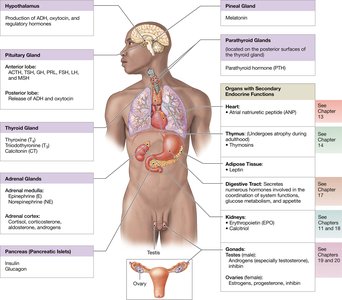
Overview of Endocrine Organs and Tissues
The endocrine system is composed of glands and tissues that release hormones directly into the bloodstream, regulating various physiological processes throughout the body. Unlike exocrine glands, which secrete substances onto epithelial surfaces, endocrine glands secrete hormones into the extracellular fluid for systemic distribution.
Endocrine cells: Specialized secretory cells that release hormones.
Hormones: Chemical messengers transported by blood to target cells in distant tissues.
Primary endocrine organs: Pituitary gland, thyroid gland, adrenal glands, pancreas, pineal gland, parathyroid glands.
Organs with secondary endocrine functions: Heart, thymus, adipose tissue, digestive tract, kidneys, gonads.
Major Structural Classes of Hormones
Hormones are classified based on their chemical structure, which determines their mechanism of action and solubility.
Amino acid derivatives: Small molecules similar to amino acids (e.g., epinephrine, norepinephrine, thyroid hormones, melatonin).
Peptide hormones: Chains of amino acids, ranging from short polypeptides (ADH, oxytocin) to small proteins (growth hormone, prolactin). This is the largest hormone class.
Lipid derivatives: Includes steroid hormones (derived from cholesterol; e.g., sex hormones, adrenal cortex hormones) and eicosanoids (derived from arachidonic acid; e.g., prostaglandins).
Hormone Action and Target Cell Sensitivity
Hormones exert their effects by binding to specific receptors on or within target cells. The presence of these receptors determines a cell's sensitivity to a particular hormone.
Receptor location: Can be on the plasma membrane or inside the cell.
Hormone-receptor interaction: Initiates changes in cellular activity, such as enzyme activation, protein synthesis, or gene expression.
Specificity: Only cells with the appropriate receptors respond to a given hormone.
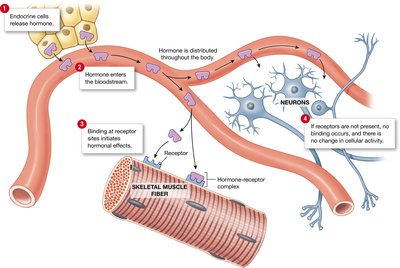
Processes of Hormone Action
The mechanism by which hormones affect target cells depends on the location of their receptors:
Plasma membrane receptors: Used by amino acid derivatives, peptide hormones, and eicosanoids. Hormones bind to membrane receptors, triggering a cascade involving first and second messengers (e.g., cAMP, calcium ions).
Intracellular receptors: Used by steroid and thyroid hormones. These hormones cross the plasma membrane and bind to receptors in the cytoplasm or nucleus, directly affecting gene expression and protein synthesis.
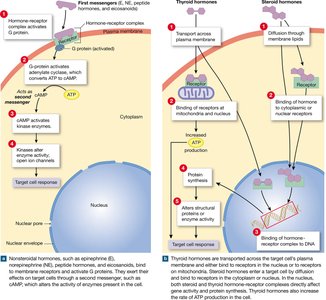
Key Steps in Second Messenger System
Hormone (first messenger) binds to membrane receptor.
G protein is activated, which then activates adenylate cyclase.
Adenylate cyclase converts ATP to cyclic-AMP (cAMP; second messenger).
cAMP activates kinases, leading to phosphorylation of proteins and cellular responses.
Phosphodiesterase (PDE) inactivates cAMP, terminating the signal.
Key Steps in Intracellular Receptor System
Hormone crosses plasma membrane (diffusion or carrier-mediated transport).
Binds to intracellular receptor (cytoplasm or nucleus).
Hormone-receptor complex activates or inactivates specific genes.
Alters mRNA transcription, changing protein synthesis and cell function.
Secretion, Distribution, and Inactivation of Hormones
Hormones are released into areas with abundant capillaries and quickly enter the bloodstream. Their duration of action depends on their mode of transport:
Freely circulating hormones: Remain functional for less than an hour; inactivated by binding to target cells, breakdown in liver/kidneys, or plasma enzymes.
Bound hormones: Steroid and thyroid hormones attach to transport proteins, remaining in circulation longer.
Control of Endocrine Activity
Hormone secretion is primarily regulated by negative feedback mechanisms, which maintain homeostasis by reducing the intensity of the initial stimulus.
Humoral stimuli: Changes in extracellular fluid composition (e.g., blood glucose levels).
Hormonal stimuli: Changes in circulating hormone levels, often involving multiple hormones and intermediary steps.
Neural stimuli: Neurotransmitter release at neuroglandular junctions (e.g., hypothalamic control).
Hypothalamic Regulation of Endocrine Function
The hypothalamus is the highest regulatory center for endocrine activity, linking the nervous and endocrine systems. It controls hormone secretion in three main ways:
Direct hormone secretion: Produces ADH and oxytocin, released via the posterior pituitary.
Regulatory hormones: Releases hormones that control the anterior pituitary (releasing and inhibiting hormones).
Sympathetic control: Regulates adrenal medullae via autonomic nervous system centers, triggering release of epinephrine and norepinephrine.
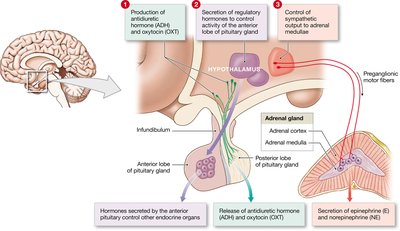
Summary Table: Major Endocrine Organs and Their Hormones
Organ | Hormones Produced | Main Functions |
|---|---|---|
Hypothalamus | ADH, oxytocin, regulatory hormones | Controls pituitary gland, links nervous and endocrine systems |
Pituitary gland | ACTH, TSH, GH, PRL, FSH, LH, MSH | Regulates other endocrine glands |
Thyroid gland | T3, T4, calcitonin | Regulates metabolism, calcium balance |
Adrenal glands | Epinephrine, norepinephrine, corticosteroids | Stress response, metabolism, electrolyte balance |
Pancreas | Insulin, glucagon | Regulates blood glucose |
Pineal gland | Melatonin | Regulates circadian rhythms |
Parathyroid glands | Parathyroid hormone | Regulates calcium levels |
Gonads | Estrogens, progesterone, testosterone | Reproduction, secondary sex characteristics |
Key Terms and Concepts
Endocrine system: Network of glands that secrete hormones for body regulation.
Hormone: Chemical messenger affecting distant target cells.
Receptor: Protein that binds a hormone, triggering cellular response.
Negative feedback: Regulatory mechanism reducing stimulus intensity.
Second messenger: Intracellular molecule relaying signals from membrane receptors.
Important Equations
Conversion of ATP to cAMP by adenylate cyclase:
Phosphorylation by kinases:
Example: Hormonal Regulation of Blood Glucose
When blood glucose rises, the pancreas releases insulin, stimulating glucose uptake by cells and lowering blood glucose. As glucose levels normalize, insulin secretion decreases, illustrating negative feedback control.
Additional info: The notes expand on brief points by providing definitions, examples, and mechanisms, ensuring completeness and academic quality for exam preparation.
