 뒤로
The Human Body: An Orientation – Structured Study Notes
스터디 가이드 - 스마트 노트
 자료에 맞춘 맞춤형 노트, 핵심 정의, 예시, 맥락을 확장해 제공합니다.
The Human Body: An Orientation
Introduction
This topic introduces the foundational concepts of anatomy and physiology, the levels of structural organization, necessary life functions, organ systems, directional terms, body planes, cavities, and homeostasis. Understanding these basics is essential for further study in Anatomy & Physiology.
Definitions of Anatomy and Physiology
Anatomy
Anatomy is the study of the structure and shape of the body and its parts. It involves observation to understand sizes and relationships between parts.
Gross anatomy: Study of large, easily observable structures.
Microscopic anatomy: Study of structures too small to be seen with the naked eye, such as cells and tissues.
Physiology
Physiology is the study of how the body and its parts function. It emphasizes the collaboration between organs and organ systems to maintain life.
Structure determines function: For example, the thin walls of lung air sacs allow for efficient gas exchange.
Levels of Structural Organization
Hierarchy of Organization
The human body is organized into six structural levels, each building upon the previous:
Atoms: Smallest units of matter.
Cells: Basic units of life.
Tissues: Groups of similar cells performing a specific function.
Organs: Structures composed of two or more tissue types.
Organ systems: Groups of organs working together.
Organism: The living human body as a whole.
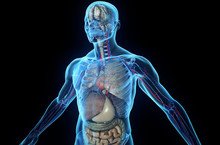
Necessary Functions of Life
Maintaining Life
To sustain life, the body must perform several essential functions:
Maintaining boundaries: Separates internal from external environments.
Movement: Includes locomotion and movement of substances within the body.
Responsiveness (irritability): Ability to sense and respond to changes.
Digestion: Breakdown and absorption of nutrients.
Metabolism: Chemical reactions that build and break down molecules, producing energy (ATP). Regulated by hormones.
Excretion: Removal of waste products (urine, feces, sweat).
Reproduction: Cellular (growth and repair) and organismal (offspring) levels.
Growth: Increase in cell or body size, often regulated by hormones.
Survival Needs
Requirements for Life
The body requires several key resources to survive:
Nutrients: Carbohydrates, proteins, lipids, vitamins, minerals.
Oxygen: Essential for metabolic reactions; supplied by respiratory and cardiovascular systems.
Water: Vital for chemical reactions and temperature regulation.
Stable body temperature: Necessary for proper metabolic function.
Organ Systems and Collaboration
Overview of Organ Systems
Organ systems consist of multiple organs working together to perform complex functions. For example, the digestive system includes the oral cavity, esophagus, stomach, intestines, and rectum. Collaboration between systems is essential for maintaining life.
The Language of Anatomy
Special Terminology
Anatomical terminology is used to describe positions, directions, regions, and structures precisely, avoiding confusion.
Anatomical position: Standard reference position: standing erect, feet parallel, arms at sides, palms forward, thumbs outward.
Directional Terms
Definitions and Examples
Directional terms describe the location of one body structure relative to another:
Superior (cranial/cephalic): Toward the head or upper part; above.
Inferior (caudal): Away from the head; below.
Anterior (ventral): Toward the front; in front of.
Posterior (dorsal): Toward the back; behind.
Medial: Toward the midline; inner side.
Lateral: Away from the midline; outer side.
Intermediate: Between medial and lateral structures.
Proximal: Close to the origin or point of attachment.
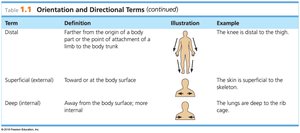
Distal: Farther from the origin or point of attachment.
Superficial (external): Toward or at the body surface.
Deep (internal): Away from the body surface; more internal.
Term | Definition | Illustration | Example |
|---|---|---|---|
Distal | Farther from the origin of a body part or the point of attachment of a limb to the body trunk | Human figure with highlighted limbs | The knee is distal to the thigh. |
Superficial (external) | Toward or at the body surface | Head and torso illustration | The skin is superficial to the skeleton. |
Deep (internal) | Away from the body surface; more internal | Head and torso illustration | The lungs are deep to the rib cage. |
Body Planes and Sections
Types of Planes
Body planes are imaginary lines used to divide the body:
Sagittal plane: Divides body into left and right parts.
Median (midsagittal) plane: Divides body into equal left and right parts.
Frontal (coronal) plane: Divides body into anterior and posterior parts.
Transverse (cross) plane: Divides body into superior and inferior parts.
Body Cavities
Major Cavities
The body contains internal cavities that protect organs:
Dorsal cavity: Includes cranial (brain) and spinal (spinal cord) cavities.
Ventral cavity: Includes thoracic (heart, lungs) and abdominopelvic (digestive, reproductive organs) cavities, separated by the diaphragm.
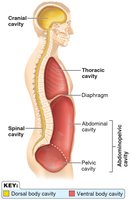
Other cavities: Oral, nasal, orbital, and middle ear cavities.
Homeostasis
Definition and Importance
Homeostasis is the maintenance of stable internal conditions. It is a dynamic equilibrium necessary for normal functioning and survival. The nervous and endocrine systems are primary controllers.
Homeostatic imbalance: Disturbances can lead to disease.
Components of Homeostatic Control
Receptor: Detects changes (stimuli) and sends information to the control center via afferent pathways.
Control center: Determines set point, analyzes information, and decides response.
Effector: Carries out the response via efferent pathways.
Feedback Mechanisms
Negative feedback: Most common; reduces or shuts off the original stimulus (e.g., temperature regulation).
Positive feedback: Rare; increases the original stimulus (e.g., blood clotting, childbirth).
Example: Negative feedback in temperature regulation: If body temperature rises, mechanisms such as sweating are activated to cool the body.
Additional info: The notes have been expanded with academic context to ensure completeness and clarity for exam preparation.
