 뒤로
The Integumentary System: Skin Appendages and Their Functions
스터디 가이드 - 스마트 노트
 자료에 맞춘 맞춤형 노트, 핵심 정의, 예시, 맥락을 확장해 제공합니다.
The Integumentary System
Overview of Skin Appendages
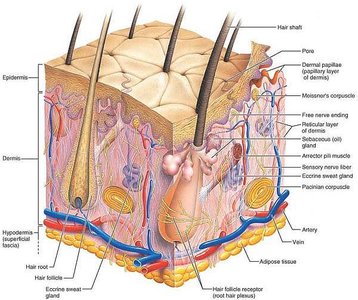
The integumentary system consists of the skin and its appendages, which play crucial roles in protection, sensation, thermoregulation, and excretion. The main skin appendages include sweat glands, sebaceous (oil) glands, nails, and hair follicles.
Sweat glands: Regulate body temperature and excrete waste.
Sebaceous glands: Lubricate and protect the skin and hair.
Nails: Provide protection and aid in fine manipulation.
Hair follicles and hair: Offer protection and sensory input.
Sweat (Sudoriferous) Glands
Sweat glands are exocrine glands that help regulate body temperature and remove waste products. There are two main types: eccrine and apocrine.
Eccrine (Merocrine) Sweat Glands:
Produce true sweat, mainly water, NaCl, vitamin C, antibodies, dermicidin, and metabolic wastes.
Most numerous, especially on palms, soles, and forehead.
Structure: Simple, coiled, tubular glands with secretory part in the dermis and duct opening at the skin surface.
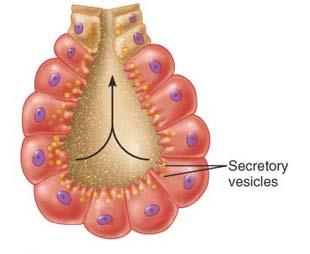
Secretion is released by exocytosis and is typically acidic (pH 4–6).
Apocrine Sweat Glands:
About 2000 in the body, located in armpits and genital areas.
Become functional at puberty; larger than eccrine glands.
Produce sweat containing fatty substances and proteins; ducts empty into hair follicles.
Secretion is odorless until decomposed by skin bacteria, resulting in body odor.
Ceruminous Glands: Modified apocrine glands in the ear canal that produce cerumen (ear wax), which protects against insects and foreign material.
Mammary Glands: Modified sweat glands in the breasts that secrete milk.

Functions of Sweating
Thermoregulation: Prevents overheating by evaporative cooling.
Heat-induced sweating: Begins on the forehead and spreads downward.
Emotionally induced sweating: Starts on palms, soles, and axillae, then spreads.
Sebaceous (Oil) Glands
Sebaceous glands are holocrine exocrine glands that secrete sebum, an oily substance that lubricates and protects the skin and hair.
Location: Found everywhere except palms and soles; largest on face, neck, and upper chest.
Function: Secrete sebum into hair follicles or skin pores; secretion is stimulated by androgens.
Role: Softens and lubricates skin and hair, slows water loss, and kills bacteria.
Holocrine mechanism: Cells accumulate product and rupture, releasing sebum and cell fragments.

Homeostatic Imbalances of Sebaceous Glands
Whitehead: Blocked sebaceous gland duct with accumulated sebum.
Blackhead: Oxidized and dried sebum, darkened on the skin surface.
Acne: Inflammation of sebaceous glands, often due to bacterial infection (e.g., staphylococcus), can cause scarring.
Seborrhea (Cradle Cap): Overactive sebaceous glands in infants, resulting in oily, scaly lesions.
Nails
Nails are scale-like modifications of the epidermis composed of hard keratin. They protect the distal phalanges and aid in fine manipulation.
Structure:
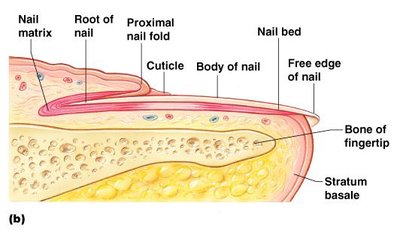
Free edge, body (visible attached portion), and proximal root (embedded in skin).
Nail corresponds to superficial keratinized layers; nail bed contains deeper epidermal layers.
Nail matrix (thickened proximal nail bed) is responsible for nail growth.
Nail body slides distally as cells become heavily keratinized.
Appearance:
Nails appear pink due to underlying capillaries.
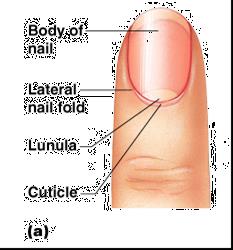
Lunula: White crescent over the nail matrix.
Nail folds: Skin folds overlapping the nail borders.
Cuticle (eponychium): Proximal nail fold projecting onto the nail body.
Hyponychium: Region under the free edge where debris accumulates.
Summary Table: Types of Exocrine Glands
The following table summarizes the main types of exocrine glands found in the skin and their mechanisms of secretion:
Gland Type | Mechanism | Example |
|---|---|---|
Merocrine | Secrete by exocytosis; cells remain intact | Eccrine sweat glands, salivary glands |
Apocrine | Secrete by pinching off portions of cells | Apocrine sweat glands, mammary glands |
Holocrine | Secrete by cell rupture; release cell fragments | Sebaceous (oil) glands |
Additional info:
Keratin is a tough, fibrous protein that provides strength and waterproofing to skin, hair, and nails.
Dermicidin is an antimicrobial peptide found in sweat, contributing to skin defense.
Androgens are hormones that stimulate sebaceous gland activity, especially during puberty.
