 뒤로
The Language of Anatomy and Homeostasis: Study Notes
스터디 가이드 - 스마트 노트
 자료에 맞춘 맞춤형 노트, 핵심 정의, 예시, 맥락을 확장해 제공합니다.
The Human Body: An Orientation
Anatomical Terminology
Precise terminology is essential in anatomy to avoid misunderstanding and ensure clear communication. Anatomical terms describe the position, direction, regions, and structures of the human body.
Anatomical Position: The standard reference position for the body is standing upright, feet parallel and flat, arms at the sides with palms facing forward, and thumbs pointing away from the body. The head is level and eyes face forward.
Prone: Lying face down.
Supine: Lying face up.
Body Regions
The human body is divided into externally identifiable regions:
Head
Neck
Trunk
Upper limbs
Lower limbs
Directional Terms
Directional terms describe the location of one body structure relative to another. Most are paired with opposite meanings.
Superior: Toward the upper part of the body.
Inferior (Caudal): Away from the head or toward the lower part.
Anterior (Ventral): Toward the front of the body.
Posterior (Dorsal): Toward the back of the body.
Medial: Toward the midline of the body.
Lateral: Away from the midline.
Intermediate: Between a more medial and a more lateral structure.
Ipsilateral: On the same side of the body as another structure.
Contralateral: On the opposite side of the body.
Proximal: Closer to the origin or point of attachment.
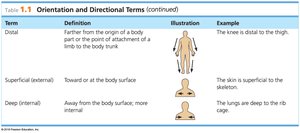
Distal: Farther from the origin or point of attachment.
Superficial (External): Toward or at the body surface.
Deep (Internal): Away from the body surface; more internal.
Term | Definition | Example |
|---|---|---|
Distal | Farther from the origin of a body part or the point of attachment of a limb to the body trunk | The knee is distal to the thigh. |
Superficial (external) | Toward or at the body surface | The skin is superficial to the skeleton. |
Deep (internal) | Away from the body surface; more internal | The lungs are deep to the rib cage. |
Planes and Sections
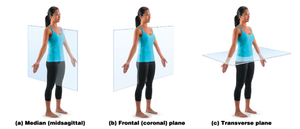
Body planes are imaginary flat surfaces that divide the body or organs. Understanding these planes is essential for describing anatomical structures and movements.
Sagittal Plane: Divides the body into right and left sides.
Midsagittal: Divides into equal right and left sides.
Parasagittal: Divides into unequal sides.
Frontal (Coronal) Plane: Divides the body into anterior (front) and posterior (back) portions.
Transverse Plane: Divides the body into superior and inferior portions; also called a cross-sectional plane.
Oblique Plane: Passes through the body at an angle between the other planes.
Body Cavities
Major Body Cavities
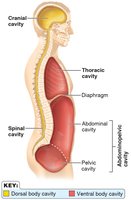
Body cavities are spaces within the body that contain, protect, separate, and support internal organs. There are two main internal body cavities:
Dorsal Body Cavity:
Cranial cavity: Contains the brain, protected by the skull.
Spinal cavity (vertebral canal): Contains the spinal cord, protected by the vertebrae.
Ventral Body Cavity:
Thoracic cavity: Superior to the diaphragm; contains heart, lungs, and other organs. Subdivided into mediastinum, pericardial cavity, and two pleural cavities.
Abdominopelvic cavity: Inferior to the diaphragm; divided into abdominal cavity (stomach, spleen, liver, gallbladder, small intestine, most of large intestine) and pelvic cavity (reproductive organs, bladder, rectum).
Abdominopelvic Regions
The abdominopelvic cavity contains many organs, and its regions are used to describe locations of pain or pathology.
8
Other Body Cavities
Oral and digestive cavities
Nasal cavity
Orbital cavities
Middle ear cavities
Homeostasis
Definition and Importance
Homeostasis is the maintenance of relatively stable internal conditions. It ensures that the body’s internal environment remains constant despite changes inside and outside the body, which is necessary for normal functioning and survival.
Homeostatic Imbalance: Disturbance in homeostasis can result in disease or, if severe, death.
Elements of a Homeostatic Control System
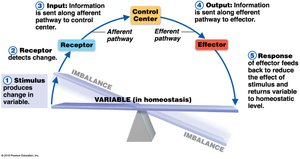
All homeostatic control mechanisms have at least three components:
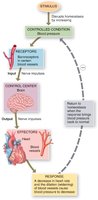
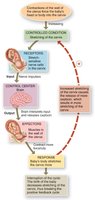
Receptor: Detects changes in the environment (stimuli) and sends information to the control center via the afferent pathway.
Control Center: Determines the set point, analyzes information, and determines the appropriate response.
Effector: Provides a means for response to the stimulus; information flows from the control center to the effector via the efferent pathway.
Feedback Mechanisms
Feedback systems regulate homeostasis by responding to changes in the internal environment.
Negative Feedback: Most homeostatic control mechanisms are negative feedback systems. They shut off the original stimulus or reduce its intensity. Example: regulation of blood pressure.
Positive Feedback: These mechanisms reinforce a change in a control system. Examples include blood clotting and childbirth.
Homeostasis and Disease
Disorders and Diseases
If one or more components of the body lose the ability to contribute to homeostasis, the normal balance among the body’s processes may be disturbed. Moderate imbalance may cause a disorder or disease; severe imbalance may result in death.
Disorder: Any abnormality of structure and/or function.
Disease: Illness characterized by a recognizable set of symptoms and signs.
Symptoms: Subjective changes not apparent to an observer (e.g., headache, anxiety, nausea).
Signs: Objective changes observable and measurable by a clinician (e.g., bleeding, swelling, fever, rash).
Aging and Homeostasis
Effects of Aging
Aging is a normal process characterized by a progressive decline in the body’s ability to return to homeostasis. It produces observable changes in structure and function and increases vulnerability to stress and disease.
Wrinkled skin and gray hair
Loss of bone mass, decreased muscle mass and strength, diminished reflexes
Decreased production of some hormones
Increased incidence of heart disease, susceptibility to infections and cancer
Summary Table: Key Anatomical Terms
Term | Definition | Example |
|---|---|---|
Superior | Toward the upper part of the body | The head is superior to the chest. |
Inferior | Away from the head or toward the lower part | The stomach is inferior to the lungs. |
Anterior | Toward the front of the body | The sternum is anterior to the heart. |
Posterior | Toward the back of the body | The esophagus is posterior to the trachea. |
Medial | Toward the midline | The nose is medial to the eyes. |
Lateral | Away from the midline | The ears are lateral to the eyes. |
Proximal | Closer to the origin | The elbow is proximal to the wrist. |
Distal | Farther from the origin | The fingers are distal to the wrist. |
Key Equations
Homeostatic Feedback Loop (Generalized)
The homeostatic feedback loop can be represented as:
Where the response returns the variable to its homeostatic level.
References
Essentials of Human Anatomy & Physiology, Thirteenth Edition
Tortora and Derrickson. Introduction to the Human Body (11th Ed.)
