Ch. 19 The Cardiovascular System: Blood Vessels
Marieb - Human Anatomy & Physiology 11th Edition
Marieb, Hoehn11th EditionHuman Anatomy & PhysiologyISBN: 9780136874034당신이 사용하는 게 아니라요?교과서 변경
19장, 문제 13

How is the anatomy of capillaries and capillary beds well suited to their function?

검증된 단계별 안내
1
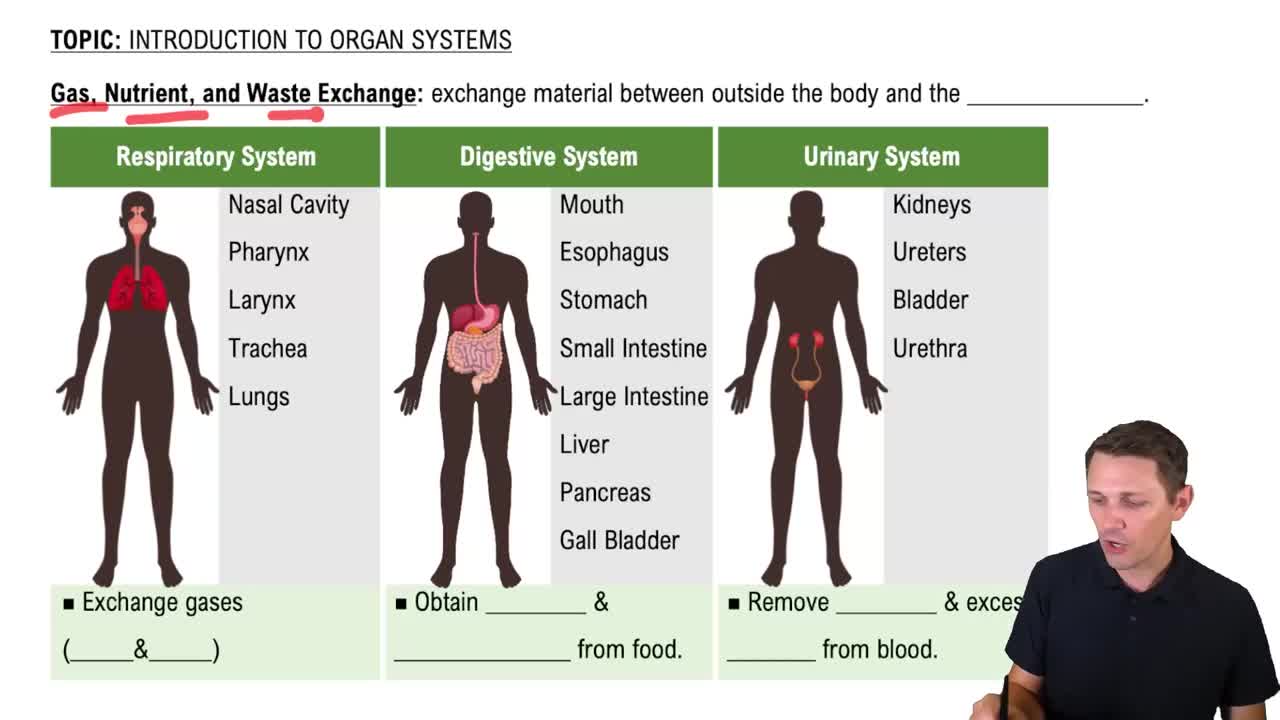
Step 1: Understand the primary function of capillaries, which is to facilitate the exchange of gases, nutrients, and waste products between blood and surrounding tissues.
Step 2: Recognize that capillaries have very thin walls composed of a single layer of endothelial cells, which minimizes the diffusion distance and allows efficient exchange.
Step 3: Note that capillaries are very small in diameter, just wide enough for red blood cells to pass through in single file, which slows blood flow and increases time for exchange.
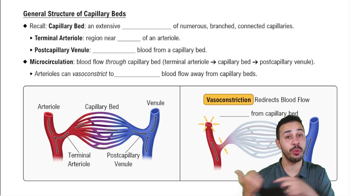
Step 4: Consider the structure of capillary beds, which are networks of many capillaries branching extensively to increase surface area and reach nearly all cells in tissues.
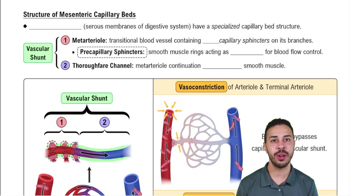
Step 5: Understand that the presence of precapillary sphincters in capillary beds regulates blood flow, directing it to areas where exchange is most needed, thus optimizing function.

비슷한 문제에 대한 검증된 영상 답변:

이 영상 해법은 위 문제에 도움이 된다고 튜터들이 추천한 것입니다.
영상 길이:
2m

주요 개념

질문에 올바르게 답하기 위해 반드시 이해해야 하는 핵심 개념들은 다음과 같습니다.

Structure of Capillaries

Capillaries are the smallest blood vessels with thin walls composed of a single layer of endothelial cells. This minimal barrier facilitates efficient exchange of gases, nutrients, and waste between blood and surrounding tissues.
추천 영상:
가이드 코스
5:59
General Structure of Capillary Beds

Capillary Beds and Network Arrangement

Capillary beds are dense networks of capillaries that increase surface area for exchange. Their extensive branching ensures that tissues receive adequate blood supply and allows selective blood flow regulation through precapillary sphincters.
추천 영상:
가이드 코스
6:52
Structure of Mesenteric Capillary Beds

Permeability and Exchange Mechanisms

Capillary walls have selective permeability, allowing substances like oxygen and glucose to diffuse easily while restricting larger molecules. This permeability supports vital processes such as nutrient delivery and waste removal at the cellular level.
추천 영상:
03:59
Gas, Nutrient and Waste Exchange
관련 실천
교과서 질문

Tracing the blood from the heart to the right hand, we find that blood leaves the heart and passes through the aorta, the right subclavian artery, the axillary and brachial arteries, and through either the radial or ulnar artery to arrive at the hand. Which artery is missing from this sequence?

a. Coronary

b. Brachiocephalic

c. Cephalic

d. Right common carotid

1420
views
교과서 질문

Blood flow in the capillaries is steady despite the rhythmic pumping of the heart because of the:

a. Elasticity of the large arteries

b. Small diameter of capillaries

c. Thin walls of the veins

d. Venous valves

1254
views
1
rank
교과서 질문

How are nutrients, wastes, and respiratory gases transported to and from the blood and tissue spaces?

1178
views
교과서 질문

Using the letters from column B, match the artery descriptions in column A. (Note that some require more than a single choice.)

Column A 

____  (1) unpaired branch of abdominal aorta 

____  (2) second branch of aortic arch 

____ 3) branch of internal carotid 

____ (4) branch of external carotid 

____  (5) origin of femoral arteries

Column B

a. right common carotid

b. superior mesenteric

c. left common carotid

d. external iliac

e. inferior mesenteric

f. superficial temporal

g. celiac trunk

h. facial

i. ophthalmic

j. internal iliac

1387
views
교과서 질문

a. Define blood pressure. Differentiate between systolic and diastolic blood pressure.

b. What is the normal blood pressure value for an adult?

1275
views
교과서 질문

Describe the neural mechanisms responsible for controlling blood pressure.

725
views