Ch. 23 The Respiratory System
Martini - Fundamentals of Anatomy & Physiology 11th Edition
Martini, Nath, Bartholomew11th EditionFundamentals of Anatomy & PhysiologyISBN: 9780136874089당신이 사용하는 게 아니라요?교과서 변경
23장, 문제 22a

What is the significance of
(a) Boyle's law, to the process of respiration?

검증된 단계별 안내
1
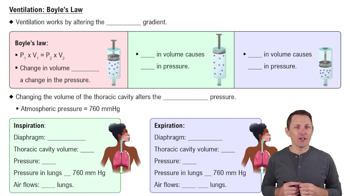
Understand Boyle's Law: Boyle's Law states that the pressure of a gas is inversely proportional to its volume, provided the temperature remains constant. Mathematically, this can be expressed as: P⁢×⁢V=k, where P is pressure, V is volume, and k is a constant.
Relate Boyle's Law to respiration: During respiration, the lungs act as a container for air, and changes in lung volume directly affect air pressure inside the lungs. This relationship is crucial for the movement of air in and out of the lungs.
Explain inhalation: During inhalation, the diaphragm contracts and moves downward, while the intercostal muscles expand the rib cage. This increases the volume of the thoracic cavity and lungs. According to Boyle's Law, as lung volume increases, the pressure inside the lungs decreases, creating a pressure gradient that allows air to flow into the lungs from the higher-pressure atmosphere.
Explain exhalation: During exhalation, the diaphragm relaxes and moves upward, and the rib cage returns to its resting position. This decreases the volume of the thoracic cavity and lungs. As lung volume decreases, the pressure inside the lungs increases, forcing air out of the lungs into the lower-pressure atmosphere.
Summarize the significance: Boyle's Law is fundamental to the mechanics of breathing, as it explains how changes in lung volume create pressure gradients that drive the movement of air during inhalation and exhalation. Without this principle, the process of respiration would not function effectively.

비슷한 문제에 대한 검증된 영상 답변:

이 영상 해법은 위 문제에 도움이 된다고 튜터들이 추천한 것입니다.

주요 개념

질문에 올바르게 답하기 위해 반드시 이해해야 하는 핵심 개념들은 다음과 같습니다.

Boyle's Law

Boyle's Law states that the pressure of a gas is inversely proportional to its volume when temperature is held constant. This means that as the volume of a gas decreases, its pressure increases, and vice versa. This principle is fundamental in understanding how gases behave under varying conditions, particularly in closed systems.
추천 영상:
4:23
Ventilation: Boyle’s Law

Respiration Mechanics

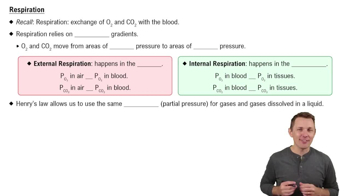
Respiration involves the exchange of gases, primarily oxygen and carbon dioxide, between the body and the environment. The mechanics of respiration include inhalation and exhalation, which are driven by changes in lung volume and pressure. Understanding these mechanics is crucial for grasping how Boyle's Law applies to the respiratory process.
추천 영상:
3:59
Respiration

Intrapulmonary Pressure

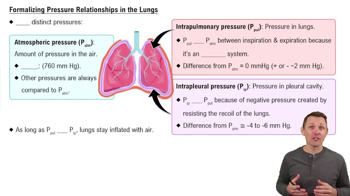
Intrapulmonary pressure refers to the pressure within the lungs during the breathing cycle. During inhalation, the diaphragm contracts, increasing lung volume and decreasing intrapulmonary pressure, allowing air to flow in. Conversely, during exhalation, lung volume decreases, increasing pressure and pushing air out, illustrating the application of Boyle's Law in respiration.
추천 영상:
5:46
Formalizing Pressure Relationships in the Lungs