Cary hyperventilates for several minutes before diving into a swimming pool. After he enters and begins swimming underwater, he blacks out and almost drowns. What caused this to happen?
Ch. 23 The Respiratory System
Martini, Nath, Bartholomew11th EditionFundamentals of Anatomy & PhysiologyISBN: 9780136874089당신이 사용하는 게 아니라요?교과서 변경
23장, 문제 22c
What is the significance of
(c) Henry's law to the process of respiration?
검증된 단계별 안내1
Understand the concept of Henry's law: Henry's law states that the amount of gas that dissolves in a liquid is directly proportional to the partial pressure of the gas above the liquid, provided the temperature remains constant. This principle is crucial in understanding gas exchange during respiration.
Relate Henry's law to oxygen and carbon dioxide: In the lungs, oxygen and carbon dioxide are exchanged between the alveoli and the blood. The partial pressure of oxygen in the alveoli determines how much oxygen dissolves into the blood, while the partial pressure of carbon dioxide in the blood determines how much carbon dioxide diffuses into the alveoli.
Consider the role of solubility: Henry's law also accounts for the solubility of gases. Carbon dioxide is more soluble in blood plasma than oxygen, which explains why it can be transported more efficiently in dissolved form compared to oxygen.
Apply Henry's law to gas exchange: During inhalation, the high partial pressure of oxygen in the alveoli drives oxygen into the blood. During exhalation, the high partial pressure of carbon dioxide in the blood drives carbon dioxide into the alveoli for removal from the body.
Connect Henry's law to physiological adaptations: The efficiency of gas exchange in the lungs is influenced by factors such as the partial pressures of gases, the solubility of gases, and the surface area of the alveoli. These adaptations ensure optimal oxygen uptake and carbon dioxide removal, as described by Henry's law.

비슷한 문제에 대한 검증된 영상 답변:
이 영상 해법은 위 문제에 도움이 된다고 튜터들이 추천한 것입니다.
주요 개념
질문에 올바르게 답하기 위해 반드시 이해해야 하는 핵심 개념들은 다음과 같습니다.
Henry's Law
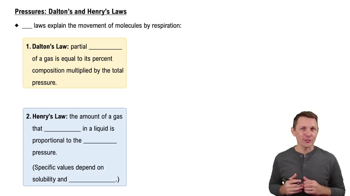
Henry's Law states that the amount of gas that dissolves in a liquid is directly proportional to the partial pressure of that gas above the liquid. This principle is crucial in understanding how gases like oxygen and carbon dioxide are exchanged in biological systems, particularly in the lungs where blood and air interface.
추천 영상:
Pressures: Dalton’s and Henry’s Laws
Gas Exchange in Respiration
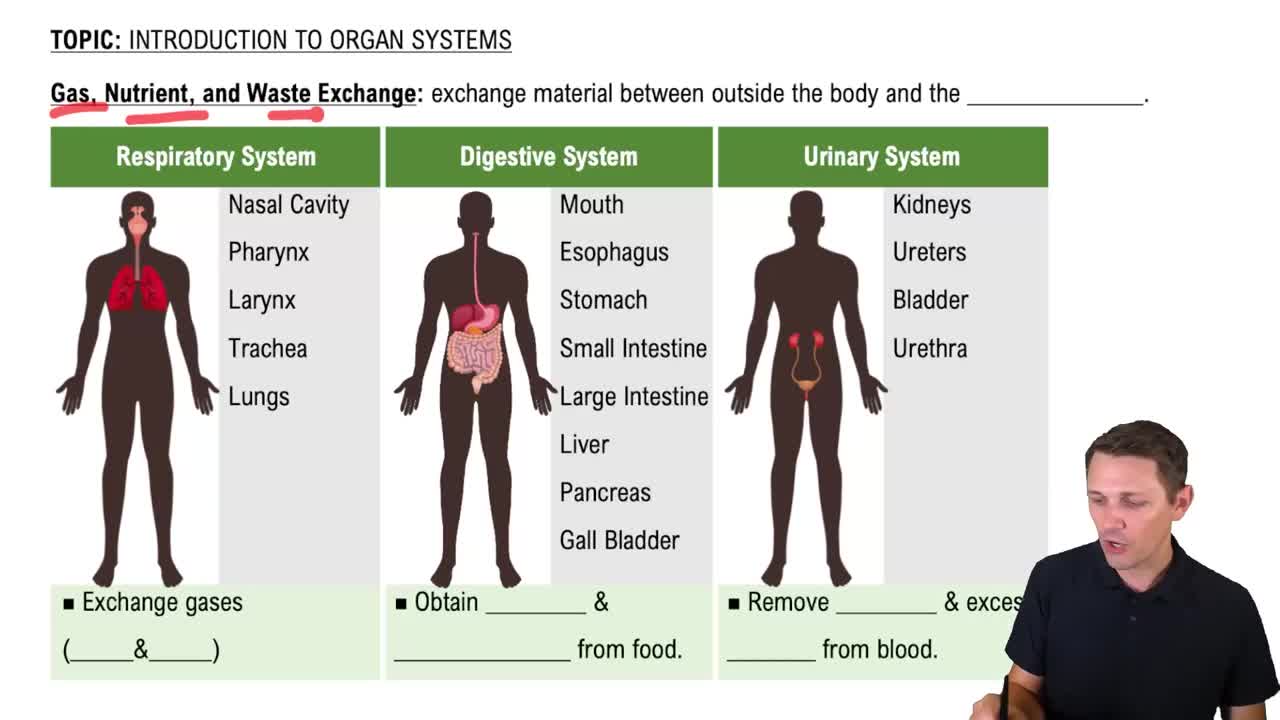
Gas exchange is the process by which oxygen is taken into the body and carbon dioxide is expelled. In the lungs, oxygen diffuses from the alveoli into the blood, while carbon dioxide moves from the blood into the alveoli, driven by differences in partial pressures, which is explained by Henry's Law.
추천 영상:
Gas, Nutrient and Waste Exchange
Partial Pressure
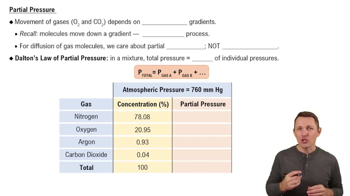
Partial pressure refers to the pressure exerted by a single type of gas in a mixture of gases. In the context of respiration, the partial pressures of oxygen and carbon dioxide in the alveoli and blood determine the direction and rate of gas diffusion, making it essential for efficient respiratory function.
추천 영상:
Partial Pressure
관련 실천
교과서 질문
843
views
교과서 질문
What is the significance of
(b) Dalton's law, to the process of respiration?
1035
views
교과서 질문
What are the differences between pulmonary volumes and respiratory capacities? How are pulmonary volumes and respiratory capacities determined?
46
views
교과서 질문
What is the significance of
(a) Boyle's law, to the process of respiration?
1163
views
교과서 질문
What happens to the process of respiration when a person is sneezing or coughing?
1058
views
교과서 질문
Gas exchange at the blood air barrier is efficient because
(a) The differences in partial pressure are substantial
(b) The gases are lipid soluble
(c) The total surface area is large
(d) Of all of these
915
views