 뒤로
Beginning Algebra Study Notes: Solving Word Problems and Inequalities
스터디 가이드 - 스마트 노트
 자료에 맞춘 맞춤형 노트, 핵심 정의, 예시, 맥락을 확장해 제공합니다.
Solving Word Problems
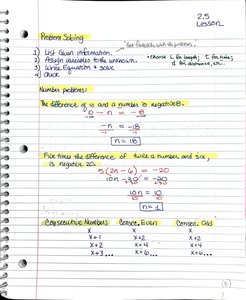
General Steps for Problem Solving
Word problems in algebra require translating real-world situations into mathematical equations. The following steps are essential for solving such problems:
List given information: Identify all known values and facts provided in the problem.
Assign variables to the unknowns: Choose a variable (such as x) to represent the unknown quantity.
Write an equation and solve: Formulate an equation based on the relationships described in the problem and solve for the variable.
Check: Substitute your solution back into the original context to verify correctness.
Number Problems
Number problems often involve finding unknown values based on relationships such as differences, sums, or multiples.
Difference of x and a number is negative 8:
Twice the difference of twice a number and six is negative 20:
Example: If the difference of x and a number is -8, and x = 10, then .
Consecutive Numbers
Consecutive numbers are numbers that follow each other in order. They are often used in word problems.
Consecutive Numbers:
Consecutive Even Numbers:
Consecutive Odd Numbers:
Applications of Number Problems
Sum of Consecutive Odd Integers
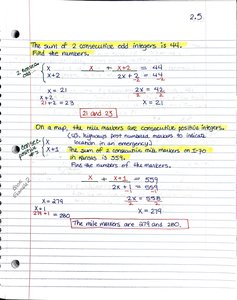
Problems may ask for the sum of consecutive odd or even integers. These are solved by setting up equations based on the definition of consecutive numbers.
Example: The sum of two consecutive odd integers is 44. Let be the first integer, then . The numbers are 21 and 23.
Consecutive Positive Integers
Similar methods are used for consecutive positive integers, often in practical contexts such as mile markers or other sequences.
Example: If the sum of two consecutive positive integers is 559, let be the first integer: . The numbers are 279 and 280.
Distance, Rate, and Time Problems
Distance Formula
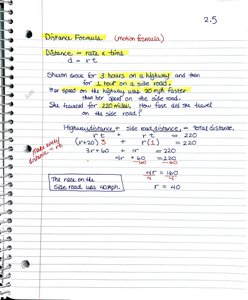
Distance problems use the formula , where d is distance, r is rate (speed), and t is time.
Example: If a person travels for 3 hours at a certain speed and then for 1 hour at a different speed, set up equations for each segment and solve for the unknown rate.
Percent Increase and Percent Decrease
Definitions and Applications
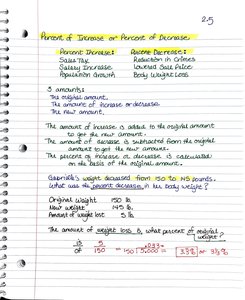
Percent increase and decrease are used to describe changes in quantities such as sales, salary, population, or body weight.
Percent Increase:
Percent Decrease:
Example: If Gabriella's weight decreased from 150 to 135 pounds, the percent decrease is .
Solving Inequalities
Basic Inequality Concepts
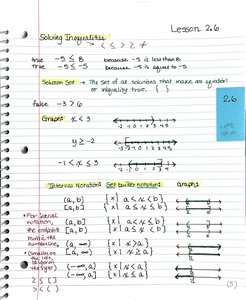
Inequalities are mathematical statements that compare two values using symbols such as <, >, ≤, or ≥. The solution set is the set of values that make the inequality true.
Example: means all values less than 2.
Graphing: Use a number line to visually represent the solution set.
Interval Notation and Set Builder Notation
Solutions to inequalities can be expressed in different notations:
Interval Notation: represents all values between a and b, not including endpoints.
Set Builder Notation: represents all x such that x is between a and b.
Example: is written as in interval notation and in set builder notation.
Solving and Graphing Compound Inequalities
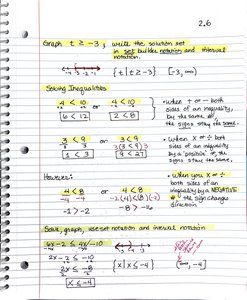
Compound inequalities involve two inequalities joined by "and" or "or". Solve each part and find the intersection or union of the solution sets.
Example: means x is greater than -3 and less than 6.
Solving Applications with Inequalities
Real-World Applications
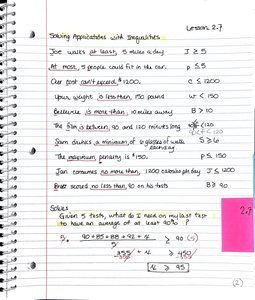
Inequalities are used to model real-world constraints, such as budgets, minimum requirements, or maximum limits.
Example: If Joe walks at least 5 miles a day, the inequality is .
Example: If tuition cannot exceed .
Complementary and Supplementary Angles
Definitions
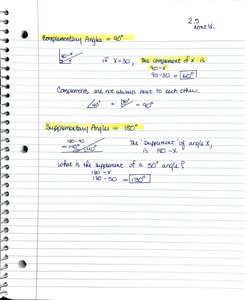
Complementary angles add up to 90°, while supplementary angles add up to 180°.
Complement of x:
Supplement of x:
Example: The supplement of a 50° angle is .
Perimeter and Angle Problems
Perimeter of a Rectangle
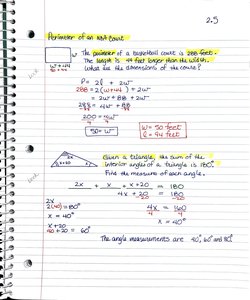
The perimeter of a rectangle is the sum of all its sides. If the length is twice the width, set up an equation to solve for the dimensions.
Formula:
Example: If feet and , then feet.
Triangle Angle Sum
The sum of the interior angles of a triangle is always 180°. If the angles are expressed in terms of x, set up an equation and solve for x.
Formula:
Example:
Review of Real Numbers and Expressions
Evaluating Expressions
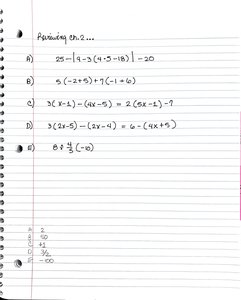
Review problems involve evaluating expressions and simplifying using order of operations.
Example:
Example:
Solving Equations with Tax and Percent
Tax Calculations
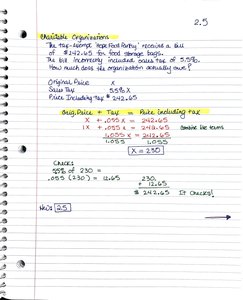
Problems involving tax require setting up equations to solve for the original price or total price including tax.
Formula:
Example: If the original price is x and tax is 5.5%, then
Summary Table: Notation for Inequalities
Comparison of Notations
The following table summarizes the different ways to express solution sets for inequalities:
Interval Notation | Set Builder Notation | Graph |
|---|---|---|
(a, b) | {x | a < x < b} | Open interval on number line |
[a, b] | {x | a ≤ x ≤ b} | Closed interval on number line |
(a, b] | {x | a < x ≤ b} | Half-open interval |
[a, b) | {x | a ≤ x < b} | Half-open interval |
(-∞, b) | {x | x < b} | Arrow to the left |
(a, ∞) | {x | x > a} | Arrow to the right |
Additional info:
These notes cover key concepts from Beginning Algebra, including solving word problems, inequalities, applications, and basic geometry. The examples and step-by-step solutions are designed to reinforce foundational algebraic skills.
