 뒤로
Linear Equations of the First Degree: Structure and Solution Steps
스터디 가이드 - 스마트 노트
 자료에 맞춘 맞춤형 노트, 핵심 정의, 예시, 맥락을 확장해 제공합니다.
Linear Equations and Inequalities
Linear Equations of the First Degree
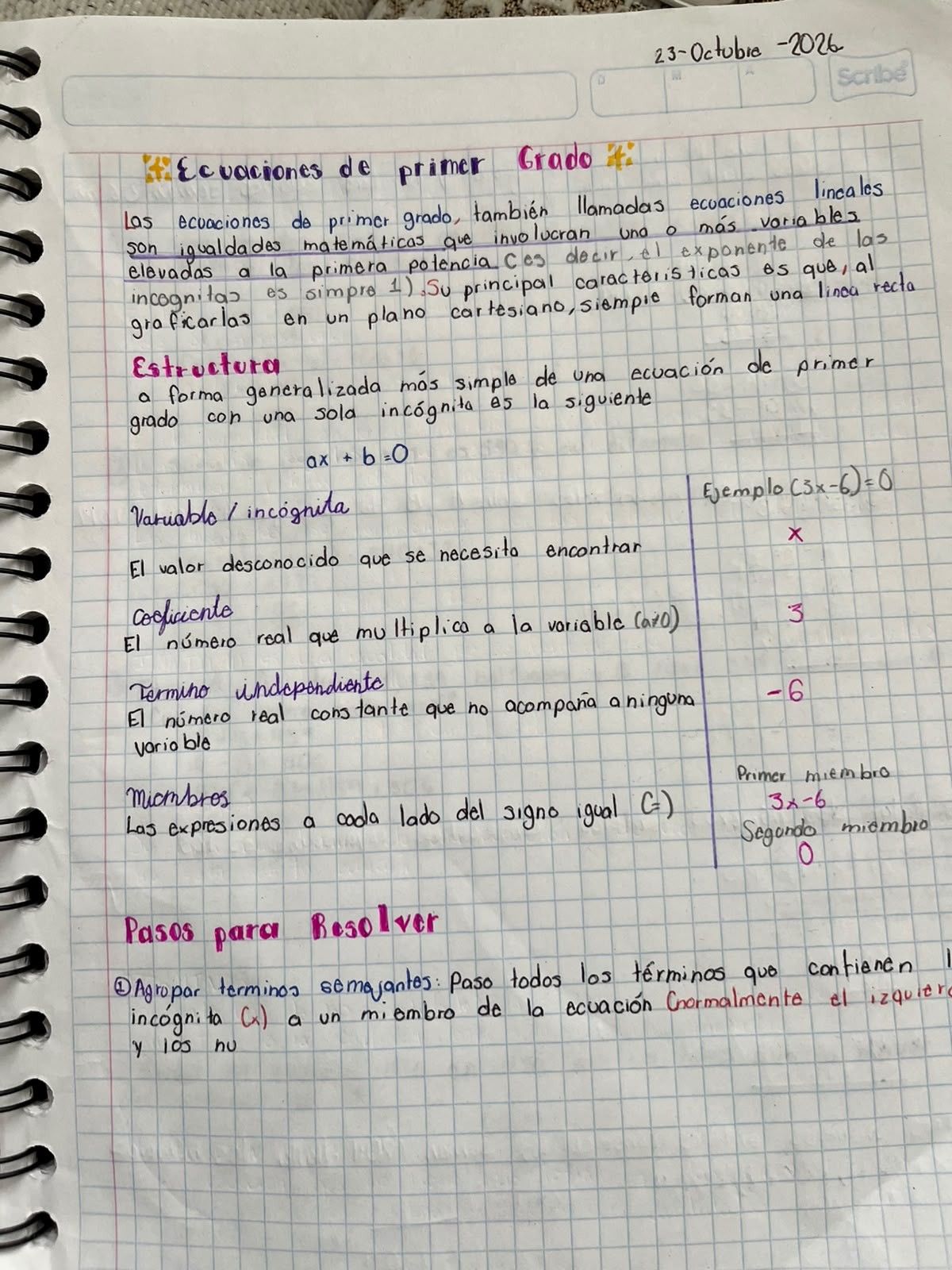
Linear equations of the first degree, also known as linear equations, are mathematical equalities involving one or more variables raised to the first power. The exponent of the variable is always 1. Their main characteristic is that, when graphed on a Cartesian plane, they always form a straight line.
Definition: A linear equation of the first degree is an equation where the highest power of the variable is 1.
General Form:
Graphical Representation: The solution forms a straight line on the Cartesian plane.
Structure of a Linear Equation
The most simplified generalized form of a first-degree equation with a single unknown is:
Variable (Incógnita): The unknown value to be found, usually represented by x.
Coefficient: The real number that multiplies the variable, denoted as a in the general form. Example: In , the coefficient is 3.
Independent Term: The real constant not attached to any variable, denoted as b. Example: In , the independent term is -6.
Members: The expressions on each side of the equality sign (=). Example: In , the first member is , and the second member is 0.
Example: For the equation :
Variable: x
Coefficient: 3
Independent Term: -6
First Member:
Second Member: 0
Steps to Solve Linear Equations
Solving a linear equation involves isolating the variable to find its value. The first step is to group like terms.
Step 1: Group Like Terms Move all terms containing the variable (x) to one side of the equation, usually the left side, and all constants to the other side.
Step 2: Simplify Combine like terms and solve for the variable.
Example: Solve :
Add 6 to both sides:
Divide both sides by 3:
Key Formula:
Additional info: The notes provide the first step for solving linear equations, which is grouping like terms. Further steps typically include isolating the variable and solving for its value.
