 뒤로
뒤로Atomic Structure and Quantum Numbers: Foundations for Biochemistry
스터디 가이드 - 스마트 노트
 자료에 맞춘 맞춤형 노트, 핵심 정의, 예시, 맥락을 확장해 제공합니다.
Atomic Structure and Quantum Numbers
Overview of Atomic Orbitals
Atomic orbitals describe the regions in an atom where electrons are most likely to be found. The four main types of atomic orbitals—s, p, d, and f—differ in shape and energy, and are fundamental to understanding chemical bonding and molecular structure, which are essential in biochemistry.
s orbital: Spherical in shape; can hold up to 2 electrons.
p orbital: Dumbbell-shaped; three orientations (px, py, pz); can hold up to 6 electrons.
d orbital: Cloverleaf-shaped; five orientations; can hold up to 10 electrons.
f orbital: Complex shapes; seven orientations; can hold up to 14 electrons.
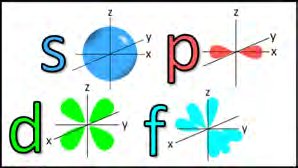
Key Point: The arrangement of electrons in these orbitals determines the chemical properties and reactivity of elements, which is foundational for understanding biomolecules.
Electron Configuration and the Periodic Table
Electron configuration refers to the distribution of electrons among the various atomic orbitals. The periodic table is organized to reflect the filling order of these orbitals, which follows the Aufbau principle (electrons fill lower-energy orbitals first).
Aufbau Principle: Electrons occupy the lowest energy orbital available.
Pauli Exclusion Principle: No two electrons in an atom can have the same set of four quantum numbers.
Hund’s Rule: Every orbital in a subshell is singly occupied before any orbital is doubly occupied.
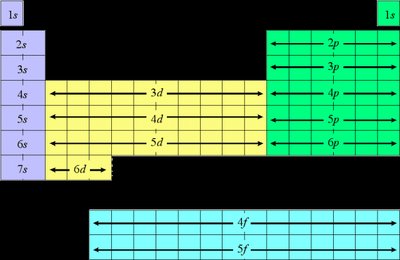
Example: The 1s orbital is filled first, followed by 2s, then 2p, and so on, as shown by the periodic table blocks.
Order of Orbital Filling
The order in which atomic orbitals are filled is determined by the sum of the principal quantum number (n) and the azimuthal quantum number (l). Orbitals with lower (n + l) values are filled first; if two orbitals have the same (n + l) value, the one with the lower n is filled first.
Filling Order: 1s → 2s → 2p → 3s → 3p → 4s → 3d → 4p → 5s → 4d → 5p → 6s → 4f → 5d → 6p → 7s → 5f → 6d → 7p
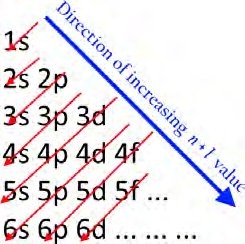
Key Point: This order is crucial for predicting the chemical behavior of elements, including those central to biochemistry (e.g., C, N, O, P, S).
Periodic Table and Electron Configuration
The periodic table is divided into blocks (s, p, d, f) that correspond to the type of atomic orbital being filled by electrons. This organization helps predict the valence electron configuration of elements, which is essential for understanding their roles in biological molecules.
s-block: Groups 1 and 2, plus Helium
p-block: Groups 13–18
d-block: Transition metals (Groups 3–12)
f-block: Lanthanides and actinides
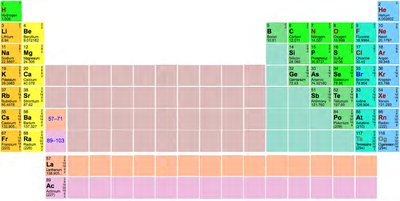
Example: Carbon (C) is in the 2p block, so its electron configuration ends in 2p2.
Relevance to Biochemistry
Understanding atomic structure and electron configuration is foundational for biochemistry because:
It explains the bonding and structure of biomolecules (proteins, nucleic acids, carbohydrates, lipids).
It underpins the reactivity and interaction of elements essential for life (e.g., C, H, O, N, S, P, Mg, Fe, Zn).
It is critical for understanding enzyme active sites, metal cofactors, and the behavior of ions in biological systems.
Additional info: Mastery of these concepts is essential for further study of protein structure, enzyme mechanisms, and metabolic pathways in biochemistry.
