 뒤로
뒤로Basic Concepts of Metabolism: Biochemistry Study Guide
스터디 가이드 - 스마트 노트
 자료에 맞춘 맞춤형 노트, 핵심 정의, 예시, 맥락을 확장해 제공합니다.
Basic Concepts of Metabolism
Energy Requirements of Living Organisms
Living organisms require a constant input of free energy to perform essential functions such as mechanical work, active transport, and biosynthesis. This energy is obtained from the environment, either through sunlight (phototrophs) or oxidation of carbon fuels (chemotrophs). - Mechanical Work: Includes muscle contraction and cellular movements. - Active Transport: Movement of ions and molecules against concentration gradients. - Synthesis: Formation of macromolecules from simple precursors. 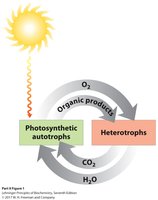
Entropy and Energy in Biological Systems
Biological systems are highly ordered and low in entropy, which is only possible through the expenditure of energy. The ultimate source of this energy on Earth is sunlight, which drives the formation of complex structures in living organisms.
Overview of Metabolic Pathways
Metabolism consists of a network of interconnected reactions, divided into energy-yielding (catabolic) and energy-requiring (anabolic) processes. - Catabolism: Breakdown of complex molecules to simpler ones, releasing energy (usually via oxidation). - Anabolism: Construction of larger molecules from smaller units, requiring energy input. 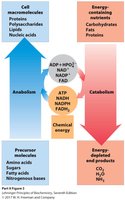
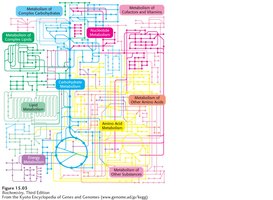
Catabolism: Stages of Energy Extraction
The extraction of energy from fuels occurs in three stages: 1. Stage 1: Large molecules are broken into smaller units (preparation stage; no useful energy captured). 2. Stage 2: Small molecules are degraded to central metabolic intermediates (e.g., acetyl CoA); some ATP is generated. 3. Stage 3: Complete oxidation of acetyl CoA via the citric acid cycle and oxidative phosphorylation produces ATP. 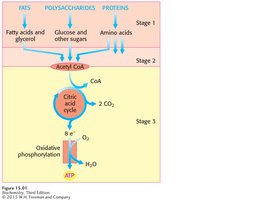
Thermodynamics of Metabolic Pathways
Metabolic pathways must meet two criteria: 1. Specificity: Each reaction must be specific for its substrate. 2. Thermodynamic Favorability: The overall pathway must be thermodynamically favorable. Unfavorable reactions can be driven by coupling to favorable reactions, often involving ATP hydrolysis.
ATP: The Universal Energy Currency
ATP (adenosine triphosphate) is the universal currency of free energy in cells. Its triphosphate unit contains two phosphoanhydride linkages, making it energy-rich. Energy from fuels or light is converted into ATP, which then powers cellular processes. 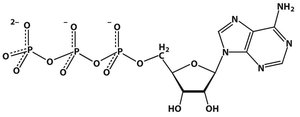
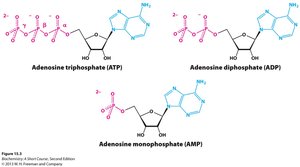
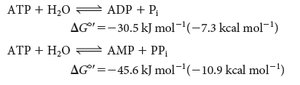
ATP–ADP Cycle
The ATP–ADP cycle is the fundamental mode of energy exchange in biological systems. ATP is hydrolyzed to ADP, releasing energy for cellular work, and is regenerated from ADP by oxidation of fuels or photosynthesis. 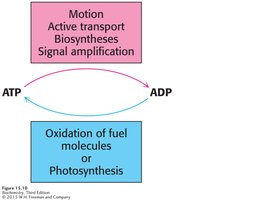
Phosphoryl Transfer and Free Energy
ATP is intermediate in energy of phosphoryl transfer. Phosphate groups can be transferred from compounds with higher standard free energy of hydrolysis (ΔG°') to those with lower values. 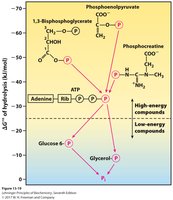
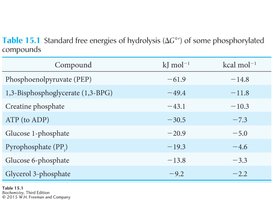
Compound | kJ mol-1 | kcal mol-1 |
|---|---|---|
Phosphoenolpyruvate (PEP) | -61.9 | -14.8 |
1,3-Bisphosphoglycerate (1,3-BPG) | -49.4 | -11.8 |
Creatine phosphate | -43.1 | -10.3 |
ATP (to ADP) | -30.5 | -7.3 |
Glucose 1-phosphate | -20.9 | -5.0 |
Pyrophosphate (PPi) | -19.3 | -4.6 |
Glucose 6-phosphate | -13.8 | -3.3 |
Glycerol 3-phosphate | -9.2 | -2.2 |
Exercise and ATP Generation
Muscle contains only enough ATP for less than a second of contraction. Creatine phosphate regenerates ATP from ADP for short bursts of activity. Once depleted, ATP must be generated by metabolic pathways. 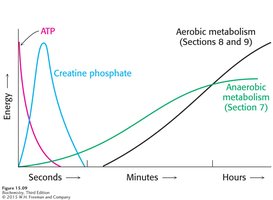
Activated Carriers in Metabolism
Activated carriers are small molecules that carry functional groups or electrons for metabolic reactions. - ATP: Carrier of phosphate groups. - Coenzyme A: Carrier of acyl groups (two-carbon fragments). - NAD+ and FAD: Carriers of electrons for fuel oxidation. - NADPH: Carrier of electrons for biosynthetic reactions.
Oxidation-Reduction Reactions
Reduced organic compounds serve as fuels, and their oxidation releases electrons. The carbon atoms in fuels are oxidized to CO2, and electrons are accepted by oxygen to form H2O. The more reduced a carbon atom, the more free energy is released upon oxidation. Fats are more efficient food sources than glucose because they are more reduced. 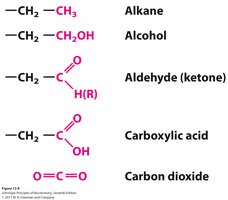
Redox Cofactors: NAD+, NADP+, and FAD
- NAD+ and NADP+: Pyridine nucleotides that dissociate from enzymes after reactions. NADP+ provides electrons for biosynthetic purposes. - FAD: Flavin adenine dinucleotide, another common redox cofactor.
Coenzyme A and Acyl Group Transfers
Coenzyme A (CoA-SH) is an activated carrier of acyl groups. Hydrolysis of thioesters (such as acetyl-CoA) is strongly favorable, and acetyl-CoA is an important donor of acyl groups in metabolic pathways, including fatty acid synthesis. 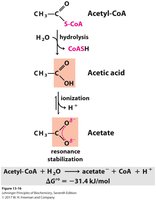
Summary Table: Key Metabolic Concepts
Concept | Definition | Example |
|---|---|---|
Catabolism | Breakdown of molecules, energy release | Glycolysis |
Anabolism | Synthesis of molecules, energy consumption | Protein synthesis |
ATP | Universal energy currency | ATP hydrolysis powers muscle contraction |
Activated Carrier | Molecule carrying functional group/electrons | NAD+, CoA |
Redox Reaction | Electron transfer, energy release | Oxidation of glucose |
Additional info: Academic context was added to clarify definitions, examples, and the importance of metabolic pathway thermodynamics, as well as to expand on the role of activated carriers and redox cofactors.
