뒤로
뒤로Basic Concepts of Metabolism in Biochemistry
스터디 가이드 - 스마트 노트
 자료에 맞춘 맞춤형 노트, 핵심 정의, 예시, 맥락을 확장해 제공합니다.
Basic Concepts of Metabolism
Introduction to Metabolism
Metabolism encompasses all chemical reactions that occur within living organisms to sustain life. These reactions are organized into metabolic pathways, which are interconnected and tightly regulated to ensure efficient energy use and biosynthesis.
Purpose of Metabolism: Provides energy for mechanical work, active transport, and biosynthesis of macromolecules.
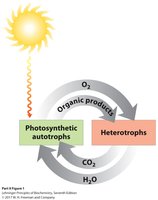
Energy Source: The ultimate source of energy for life on Earth is sunlight, which is harnessed by phototrophs, while chemotrophs obtain energy by oxidizing carbon fuels.
Organization of Metabolic Pathways
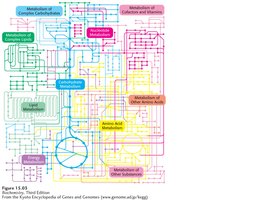
Metabolic pathways are highly interconnected, allowing for the integration of various biochemical processes such as carbohydrate, amino acid, nucleotide, and lipid metabolism.
Complexity: Living organisms are composed of complex structures that require energy input to maintain low entropy states.
Interconnectedness: Pathways are linked, enabling the flow of metabolites between different biochemical processes.
Catabolism and Anabolism
Definitions and Key Features
Metabolism is divided into two main categories: catabolism and anabolism.
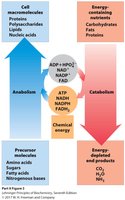
Catabolism: The breakdown of complex molecules into simpler ones, releasing energy (often as ATP and ion gradients). Usually involves oxidation reactions.
Anabolism: The synthesis of complex molecules from simpler precursors, requiring energy input.
Reduced vs. Oxidized Molecules: Reduced molecules (e.g., fats) are energy-rich, while oxidized molecules are energy-poor.
Stages of Catabolism
The extraction of energy from fuels occurs in three main stages:
Stage 1: Large molecules are broken down into smaller units (preparatory phase; no useful energy captured).
Stage 2: Small molecules are degraded to a few simple units, mainly acetyl CoA. Some ATP is generated.
Stage 3: Complete oxidation of acetyl CoA via the citric acid cycle and oxidative phosphorylation produces the majority of ATP.
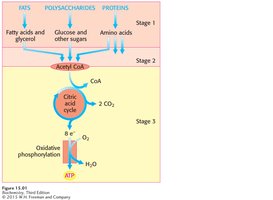
Thermodynamics and ATP in Metabolism
Driving Metabolic Reactions
Thermodynamically unfavorable reactions can proceed by coupling them to favorable reactions, most commonly the hydrolysis of ATP.
ATP: The universal currency of free energy in cells. Its hydrolysis shifts the equilibrium of coupled reactions, making them favorable.
Criteria for Metabolic Pathways: Each reaction must be specific, and the overall pathway must be thermodynamically favorable.
Structure and Properties of ATP
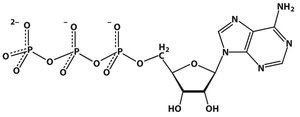
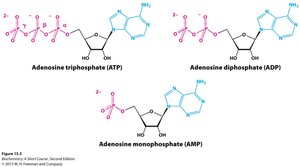
ATP (adenosine triphosphate) is an energy-rich molecule due to its two phosphoanhydride bonds. Energy from fuel oxidation or light is stored in ATP, which is then used to power cellular processes.
ATP Hydrolysis and Energy Transfer
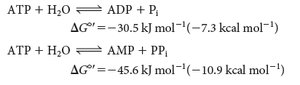
The hydrolysis of ATP to ADP or AMP releases significant free energy, which is harnessed to drive endergonic reactions.
Equations:
The ATP–ADP Cycle
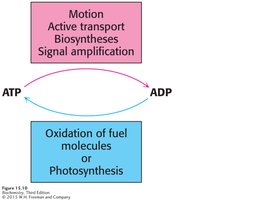
The ATP–ADP cycle is the central mechanism for energy exchange in biological systems. ATP is continuously regenerated from ADP using energy derived from fuel oxidation or photosynthesis.
Phosphoryl Transfer Potential
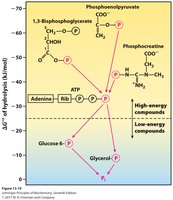
ATP is intermediate in terms of phosphoryl transfer potential, allowing it to accept and donate phosphate groups efficiently. Compounds with higher free energy of hydrolysis than ATP can phosphorylate ADP to ATP.
Example Reaction:
Standard Free Energies of Hydrolysis
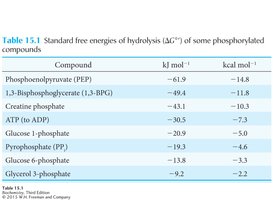
The table below lists the standard free energies of hydrolysis for several phosphorylated compounds, illustrating ATP's intermediate position.
Compound | kJ mol-1 | kcal mol-1 |
|---|---|---|
Phosphoenolpyruvate (PEP) | -61.9 | -14.8 |
1,3-Bisphosphoglycerate (1,3-BPG) | -49.4 | -11.8 |
Creatine phosphate | -43.1 | -10.3 |
ATP (to ADP) | -30.5 | -7.3 |
Glucose 1-phosphate | -20.9 | -5.0 |
Pyrophosphate (PPi) | -19.2 | -4.6 |
Glucose 6-phosphate | -13.8 | -3.3 |
Glycerol 3-phosphate | -9.2 | -2.2 |
ATP Generation During Exercise
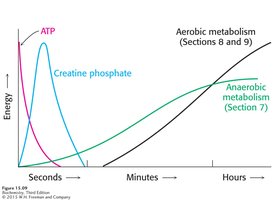
Muscle contains limited ATP, sufficient for less than a second of contraction. Creatine phosphate regenerates ATP for short bursts, while longer activity relies on metabolic pathways for ATP production.
Activated Carriers in Metabolism
Types and Functions
Activated carriers are small molecules that carry activated functional groups for transfer in metabolic reactions.
ATP: Carrier of phosphate groups.
Coenzyme A (CoA): Carrier of acyl groups (two-carbon fragments).
NAD+ and FAD: Carriers of electrons for fuel oxidation.
NADPH: Carrier of electrons for biosynthetic reactions.
Oxidation-Reduction Reactions in Metabolism
Role of Redox Reactions
Reduced organic compounds serve as fuels, with electrons stripped during oxidation. The more reduced a carbon atom, the more free energy is released upon oxidation. Fats are more efficient energy sources than carbohydrates due to their higher reduction state.
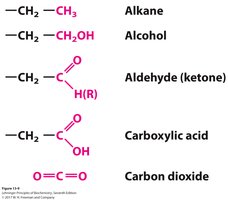
Common Redox Cofactors
NAD+ and NADP+ (pyridine nucleotides) are common redox cofactors. They can dissociate from enzymes after reactions. In typical biological oxidations, a hydride is transferred from an alcohol to NAD+, forming NADH. FAD is another important redox cofactor.
Coenzyme A and Thioester Hydrolysis
Structure and Function of Coenzyme A
Coenzyme A (CoA-SH) is an activated carrier of acyl groups, essential for feeding two-carbon units into metabolic pathways and for fatty acid synthesis.
Hydrolysis of Acetyl-CoA
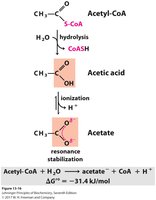
Hydrolysis of thioesters, such as acetyl-CoA, is strongly favorable and provides energy for acyl group transfer reactions. In these transfers, molecules other than water accept the acyl group.
Equation: