 뒤로
뒤로Chapter 2: Water – Structure, Properties, and Biological Significance
스터디 가이드 - 스마트 노트
 자료에 맞춘 맞춤형 노트, 핵심 정의, 예시, 맥락을 확장해 제공합니다.
Water: Structure and Properties
Introduction to Water in Biochemistry
Water is the most abundant molecule in living cells and is essential for life. Its unique physical and chemical properties arise from its molecular structure and ability to form hydrogen bonds, making it a critical solvent and participant in biochemical reactions.
Polarity: Water is a polar molecule, with a bent structure and partial charges on oxygen and hydrogen atoms.
Hydrogen Bonding: Each water molecule can form up to four hydrogen bonds, leading to high cohesion and surface tension.
Solvent Properties: Water dissolves a wide range of polar and ionic substances, facilitating biochemical processes.
Physical Properties of Water
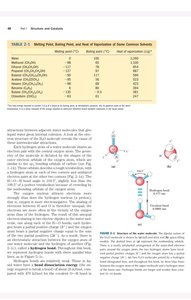
Water exhibits unusual melting and boiling points compared to other molecules of similar size, due to extensive hydrogen bonding.
High Heat Capacity: Water absorbs and releases heat slowly, stabilizing temperatures in organisms.
High Heat of Vaporization: Significant energy is required to convert water from liquid to gas.
Comparison Table: Water's melting and boiling points are much higher than those of similar molecules.
Substance | Melting Point (°C) | Boiling Point (°C) | Heat of Vaporization (kJ/mol) |
|---|---|---|---|
Water (H2O) | 0 | 100 | 40.7 |
Ammonia (NH3) | -77.7 | -33.4 | 23.3 |
Methane (CH4) | -182.5 | -161.5 | 8.2 |
Additional info: Table includes other common solvents for comparison. |
Hydrogen Bonding and Solubility
Hydrogen Bonding in Water
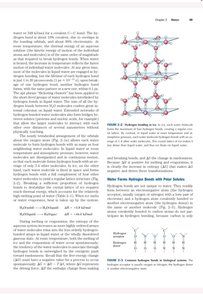
Hydrogen bonds are weak interactions but collectively provide water with its unique properties. In ice, water molecules form a regular lattice, while in liquid water, the structure is less ordered but still highly cohesive.
Ice Structure: Each water molecule forms four hydrogen bonds, creating a tetrahedral arrangement.
Liquid Water: Hydrogen bonds are transient, breaking and reforming rapidly.
Water as a Solvent for Polar and Ionic Substances
Water dissolves polar and ionic compounds by forming hydration shells around ions and polar molecules, stabilizing them in solution.
Hydration Shells: Water molecules surround ions, reducing electrostatic interactions.
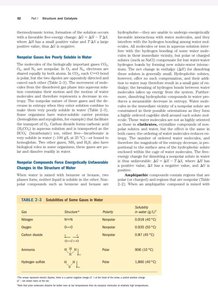
Solubility Table: Shows solubility of gases and salts in water.
Compound | Solubility (g/100g H2O) |
|---|---|
Oxygen | 0.009 |
Carbon dioxide | 0.145 |
Ammonia | 51.0 |
Sodium chloride | 36.0 |
Additional info: Table includes other gases and salts. |
Amphipathic Molecules and the Hydrophobic Effect
Amphipathic Compounds in Water
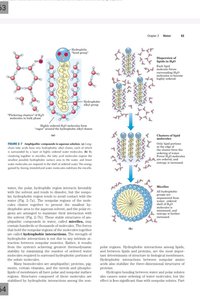
Amphipathic molecules contain both hydrophilic and hydrophobic regions. In water, they self-assemble into structures such as micelles and bilayers, minimizing the exposure of hydrophobic regions to water.
Micelles: Spherical structures formed by amphipathic molecules in water.
Bilayers: Double-layered structures, fundamental to biological membranes.
Hydrophobic Effect: Drives the folding of proteins and formation of membranes.
Weak Interactions in Aqueous Solutions
Types of Weak Interactions
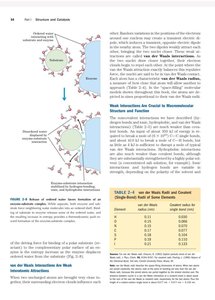
Biological macromolecules rely on weak interactions for structure and function. These include hydrogen bonds, ionic interactions, van der Waals forces, and hydrophobic interactions.
Hydrogen Bonds: Occur between polar groups.
Ionic Interactions: Occur between charged groups.
Van der Waals Forces: Weak attractions between all atoms.
Hydrophobic Interactions: Nonpolar groups cluster to minimize contact with water.
Interaction Type | Example | Relative Strength |
|---|---|---|
Hydrogen bond | O-H...O | Moderate |
Ionic interaction | Na+...Cl- | Strong |
Van der Waals | CH4...CH4 | Weak |
Hydrophobic interaction | Nonpolar side chains | Variable |
Colligative Properties of Water
Solutes and Colligative Properties
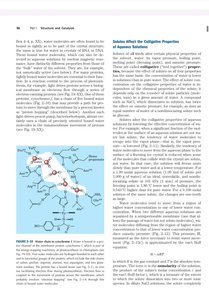
Colligative properties depend on the number of solute particles in solution, not their identity. These include boiling point elevation, freezing point depression, osmotic pressure, and vapor pressure lowering.
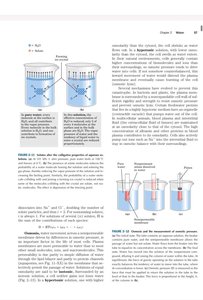
Osmosis: Movement of water across a semipermeable membrane from low to high solute concentration.
Osmotic Pressure: Pressure required to prevent osmosis.
Applications: Important in maintaining cell volume and function.
Ionization of Water, Acids, and Bases
Ionization of Water
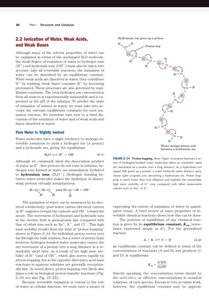
Water undergoes slight ionization to form hydronium (H3O+) and hydroxide (OH-) ions. The equilibrium constant for this reaction is known as the ionization constant of water.
Equilibrium Equation:
Ion Product: at 25°C
pH and the pH Scale
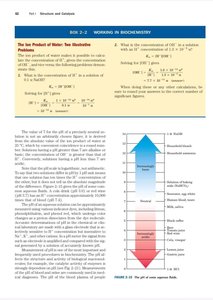
pH is a measure of the hydrogen ion concentration in solution. It is defined as the negative logarithm of [H+].
pH Equation:
pH Scale: Ranges from 0 (acidic) to 14 (basic).
pH | [H+] (M) |
|---|---|
0 | 1 |
7 | 1.0 × 10⁻⁷ |
14 | 1.0 × 10⁻¹⁴ |
Acids, Bases, and Buffers
Acid and Base Equilibria
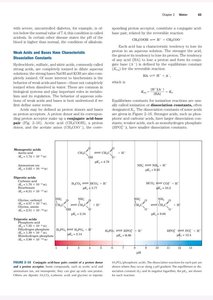
Acids donate protons (H+), while bases accept protons. The strength of an acid is measured by its dissociation constant (Ka), and the pKa is the negative logarithm of Ka.
Acid Dissociation Equation:
pKa Equation:
Titration Curves and Buffering
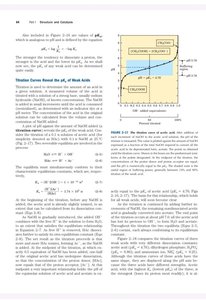
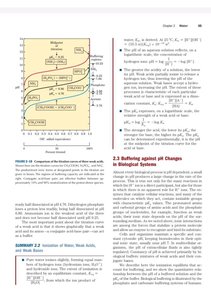
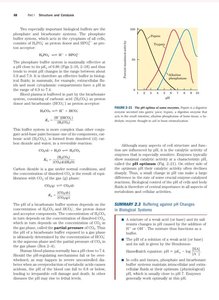
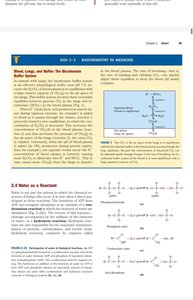
Titration curves show how pH changes as acid or base is added to a solution. Buffers resist changes in pH by absorbing excess H+ or OH-.
Buffer Systems: Mixtures of weak acids and their conjugate bases.
Henderson-Hasselbalch Equation:
Biological Buffers: Phosphate and bicarbonate systems are crucial in cells and blood.
Water as a Reactant
Role of Water in Biochemical Reactions
Water participates directly in many biochemical reactions, including hydrolysis and condensation reactions. It is essential for the breakdown and synthesis of biomolecules.
Hydrolysis: Water splits molecules into smaller units.
Condensation: Water is released when molecules are joined.
The Fitness of the Aqueous Environment for Living Organisms
Biological Importance of Water
The properties of water make it uniquely suited to support life. Its solvent capabilities, thermal stability, and role in biochemical reactions are essential for cellular function and organismal survival.
Cellular Environment: Water provides a medium for biochemical reactions.
Thermal Regulation: Water stabilizes temperature in organisms.
Structural Support: Water maintains cell shape and turgor.
Summary
Water's unique structure and properties are fundamental to biochemistry.
Hydrogen bonding, solubility, and weak interactions underpin biological processes.
Acids, bases, and buffers regulate pH in biological systems.
Water acts as a reactant and provides a suitable environment for life.
