 뒤로
뒤로Comprehensive Study Notes on Enzyme Kinetics and Inhibition
스터디 가이드 - 스마트 노트
 자료에 맞춘 맞춤형 노트, 핵심 정의, 예시, 맥락을 확장해 제공합니다.
Enzyme Kinetics
Introduction to Enzyme Kinetics
Enzyme kinetics is the study of the rates at which enzyme-catalyzed reactions proceed and the factors affecting these rates. Understanding enzyme kinetics is crucial for elucidating enzyme mechanisms and for applications in biotechnology and medicine.
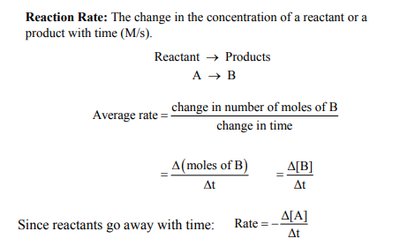
Reaction Rate: The change in concentration of a reactant or product per unit time, typically measured in M/s.
General Reaction: A → B
Average Rate Formula:
Key Parameters in Enzyme Kinetics
Three primary parameters are used to characterize enzyme-catalyzed reactions:
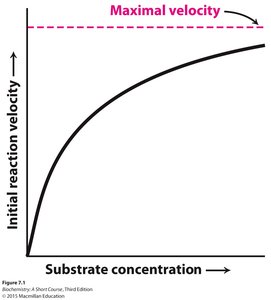
Vmax (Maximum Velocity): The maximum rate of the reaction when the enzyme is saturated with substrate.
Kcat (Turnover Number): The number of substrate molecules converted to product per enzyme molecule per second under saturating substrate conditions.
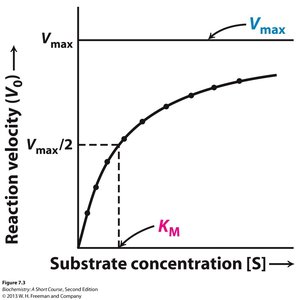
KM (Michaelis Constant): The substrate concentration at which the reaction velocity is half of Vmax.
These parameters are fundamental for comparing enzyme efficiency and substrate affinity.
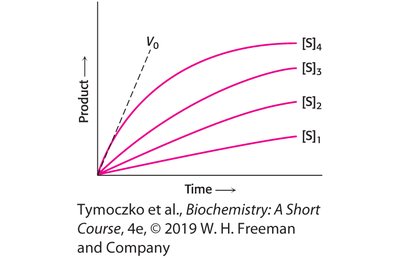
Initial Velocity (V0)
The initial velocity (V0) is determined by measuring the rate of product formation immediately after the reaction begins, before significant substrate depletion or product accumulation occurs.
Michaelis-Menten Equation
The Michaelis-Menten equation describes the relationship between substrate concentration and reaction velocity for many enzymes:
At low [S], the reaction rate increases linearly with [S].
At high [S], the rate approaches Vmax asymptotically.
When V0 = ½ Vmax, [S] = KM.
Significance of KM and Vmax
KM: Indicates the substrate concentration required to reach half-maximal velocity. It is inversely related to enzyme-substrate affinity (lower KM means higher affinity).
Vmax: Reflects the catalytic capacity of the enzyme when fully saturated with substrate. It is directly proportional to the total enzyme concentration.
Kcat (Turnover Number)
Kcat is calculated as:
Represents the maximum number of substrate molecules converted to product per enzyme active site per second.
It is a constant for a given enzyme under specific conditions.
Experimental Determination of Kinetic Parameters
Parameters such as [S], V0, Vmax, and KM are measured experimentally. Modern curve-fitting software is commonly used, but historically, linear transformations like the Lineweaver-Burk plot were employed for easier analysis.
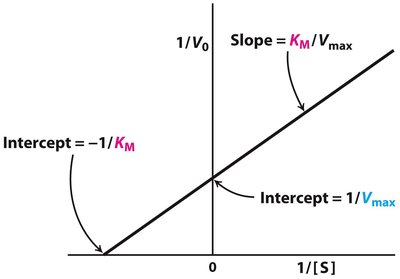
Lineweaver-Burk equation (double reciprocal):
X-intercept:
Y-intercept:
Examples of KM Values
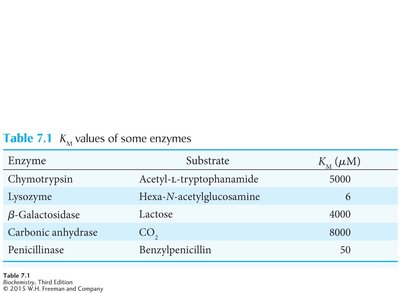
KM values vary widely among enzymes and often approximate the physiological substrate concentration.
Enzyme | Substrate | KM (μM) |
|---|---|---|
Chymotrypsin | Acetyl-L-tryptophanamide | 5000 |
Lysozyme | Hexa-N-acetylglucosamine | 6 |
β-Galactosidase | Lactose | 4000 |
Carbonic anhydrase | CO2 | 8000 |
Penicillinase | Benzylpenicillin | 50 |
Factors Affecting Enzyme Activity
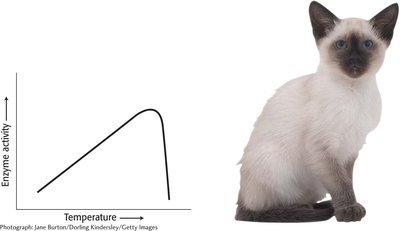
Temperature: Enzyme activity increases with temperature up to an optimum, after which denaturation causes activity to decrease.
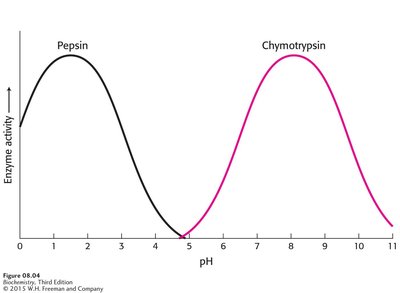
pH: Each enzyme has an optimal pH range for activity.
Specific Molecules: Inhibitors can decrease enzyme activity.
Enzyme Inhibition
Types of Enzyme Inhibitors
Enzyme inhibitors are molecules that decrease or abolish enzyme activity. They are classified as irreversible or reversible inhibitors.
Irreversible Inhibitors: Covalently modify the enzyme, permanently inactivating it. Often toxins or drugs.
Reversible Inhibitors: Bind non-covalently and can dissociate from the enzyme. Include competitive, uncompetitive, and noncompetitive inhibitors.
Competitive Inhibition
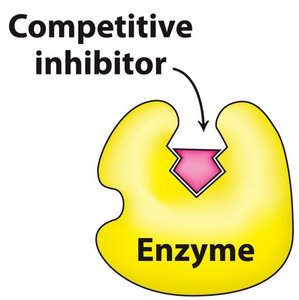
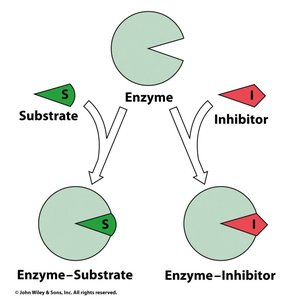
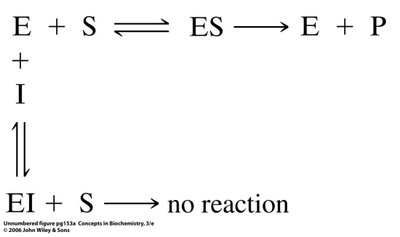
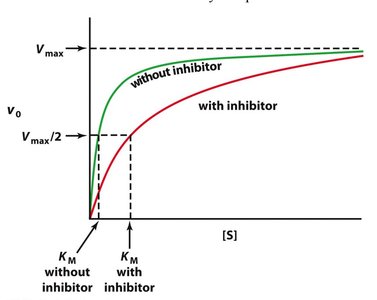
Competitive inhibitors resemble the substrate and bind to the enzyme's active site, preventing substrate binding. This type of inhibition can be overcome by increasing substrate concentration.
Effect on Kinetic Parameters: Vmax remains unchanged; KM increases.
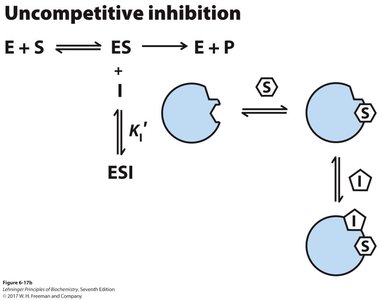
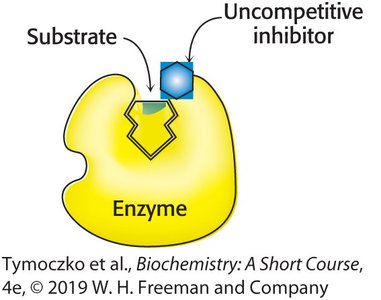
Uncompetitive Inhibition
Uncompetitive inhibitors bind only to the enzyme-substrate complex, not to the free enzyme. This binding inhibits catalytic activity without affecting substrate binding.
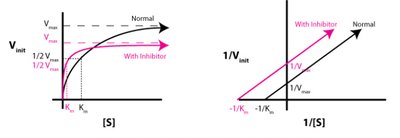
Effect on Kinetic Parameters: Both Vmax and KM decrease; the ratio KM/Vmax remains unchanged.
Noncompetitive Inhibition
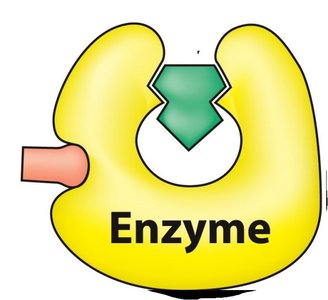
Noncompetitive inhibitors bind to a regulatory site distinct from the active site and can bind to either the free enzyme or the enzyme-substrate complex. This reduces the number of active enzyme molecules but does not affect substrate binding affinity.
Effect on Kinetic Parameters: Vmax decreases; KM remains unchanged.
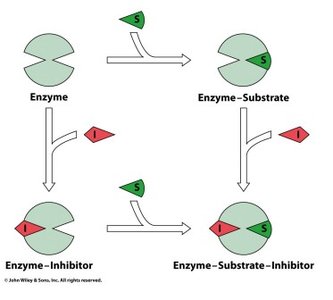
Summary Table: Effects of Reversible Inhibition
Type of Inhibition | KM | Vmax | KM/Vmax (Slope) |
|---|---|---|---|
Competitive | Higher | Same | Increase |
Uncompetitive | Lower | Lower | Same |
Noncompetitive (Pure) | Same | Lower | Increase |
Noncompetitive (Mixed) | Higher | Lower | Increase |
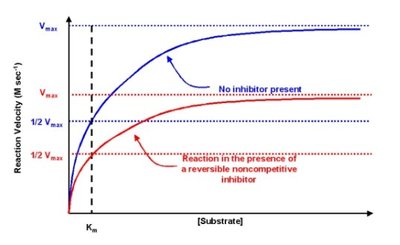
Allosteric Enzymes and Regulation
Allosteric Regulation
Allosteric enzymes are regulated by molecules that bind to sites other than the active site, causing conformational changes that affect enzyme activity. Their reaction velocity displays a sigmoidal (S-shaped) relationship to substrate concentration, differing from the hyperbolic curve of Michaelis-Menten enzymes.
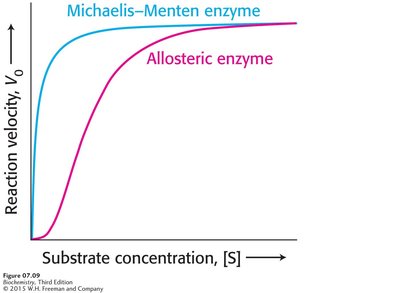
Additional info:
Allosteric regulation is a key mechanism for controlling metabolic pathways in cells.
Allosteric effectors can be activators or inhibitors, modulating enzyme activity in response to cellular needs.
