 뒤로
뒤로Comprehensive Study Notes on Enzyme Structure, Mechanism, Kinetics, and Regulation
스터디 가이드 - 스마트 노트
 자료에 맞춘 맞춤형 노트, 핵심 정의, 예시, 맥락을 확장해 제공합니다.
Enzymes: General Properties and Mechanisms
Definition and General Properties
Enzymes are biological catalysts, primarily proteins, that accelerate chemical reactions without being consumed in the process. The molecule upon which an enzyme acts is called the substrate. Enzymes do not alter the equilibrium of a reaction but increase the rate at which equilibrium is reached.
Enhanced Rate: Enzymes can increase reaction rates by factors of 106 to 1012 compared to uncatalyzed reactions.
Mild Reaction Conditions: Enzymes function under physiological conditions (below 100°C, atmospheric pressure, neutral pH).
Reaction Specificity: Enzymes produce stereospecific products with minimal by-products.
Capacity for Regulation: Enzyme activity can be regulated to meet cellular needs.
Energetics of Enzyme Action
Enzymes lower the activation energy (ΔG‡) required for a reaction, thereby increasing the reaction rate. However, they do not change the overall free energy change (ΔG) or the equilibrium constant (Keq).
ΔG < 0: Indicates a spontaneous reaction.
ΔG = ΔH − TΔS: The change in Gibbs free energy is determined by enthalpy and entropy changes.
Active Site and Specificity
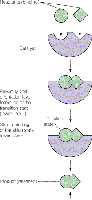
The active site of an enzyme is a specialized region where substrate binding and catalysis occur. Specificity arises from the precise arrangement of amino acid residues in the active site, allowing selective substrate recognition and product formation.
General Catalytic Strategies
Enzymes employ several strategies to catalyze reactions:
Proximity and Orientation: Enzyme binding brings substrates into close proximity and correct orientation, lowering entropy and facilitating reaction.
Transition State Stabilization: Enzymes bind the transition state more tightly than the substrate, lowering the activation energy.
Induced Fit: Substrate binding induces conformational changes in the enzyme, optimizing interactions for catalysis.
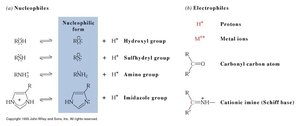
Acid-Base Catalysis: Amino acid side chains (e.g., His, Cys, Tyr, Asp, Glu, Lys) act as proton donors or acceptors.
Covalent Catalysis: A transient covalent bond forms between the enzyme and substrate (e.g., Ser, Tyr, Cys, Lys, His).
Cofactors: Non-protein molecules (e.g., Zn2+) assist in catalysis.
Nucleophilic and Electrophilic Catalysis: Enzyme side chains act as nucleophiles or electrophiles to facilitate bond formation or cleavage.
Enzyme Mechanisms: Case Studies
Aconitase Mechanism
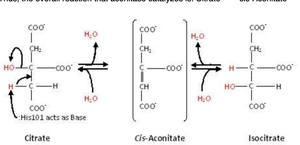
Aconitase catalyzes the isomerization of citrate to isocitrate via a two-step process involving dehydration and rehydration, utilizing a [4Fe–4S] cluster as a Lewis acid to activate the substrate.
Step 1 (Dehydration): Removal of H from C2 and OH from C3 forms cis-aconitate.
Step 2 (Rehydration): Water adds across the double bond, moving the OH group from C3 to C2.
Condensation and Hydrolysis Reactions
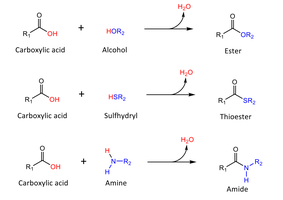
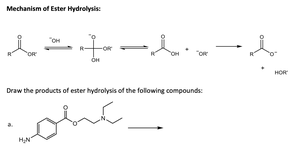
Condensation reactions join two molecules with the release of water, while hydrolysis reactions break bonds by adding water.
Proteolytic Enzymes: Serine Proteases
Chymotrypsin, Trypsin, and Elastase
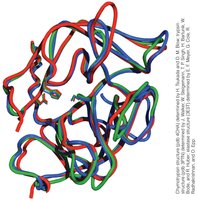
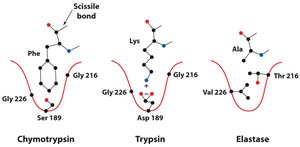
These enzymes share a similar structure and catalytic triad but differ in substrate specificity due to differences in their specificity pockets.
Chymotrypsin: Prefers bulky aromatic residues (Phe, Trp, Tyr).
Trypsin: Prefers basic residues (Lys, Arg) due to Asp 189 at the pocket base.
Elastase: Prefers small residues (Ala, Gly).
Catalytic Triad and Mechanism
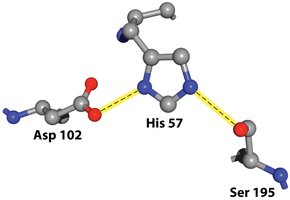
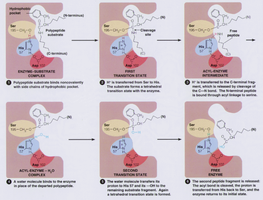
The catalytic triad (Ser195, His57, Asp102) is essential for the hydrolytic activity of serine proteases. The mechanism involves two phases: acylation and deacylation, both passing through a tetrahedral intermediate.
Ser195: Acts as a nucleophile, attacking the peptide bond.
His57: Functions as a general acid/base.
Asp102: Stabilizes His57 and orients it for catalysis.
Enzyme Kinetics
Michaelis-Menten Model
The Michaelis-Menten equation describes the rate of enzyme-catalyzed reactions as a function of substrate concentration:
KM: Substrate concentration at which the reaction rate is half-maximal; reflects enzyme affinity for substrate.
Vmax: Maximum reaction velocity at saturating substrate concentration.
kcat: Turnover number; number of substrate molecules converted to product per enzyme per second.
kcat/KM: Catalytic efficiency; higher values indicate more efficient enzymes.
Lineweaver-Burk Plot
The Lineweaver-Burk plot linearizes the Michaelis-Menten equation by plotting 1/v versus 1/[S]:
Y-intercept: 1/Vmax
X-intercept: -1/KM
Enzyme Inhibition
Competitive Inhibition
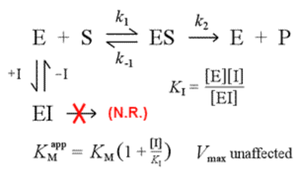
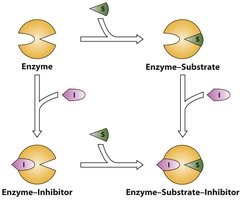
Competitive inhibitors bind to the active site, preventing substrate binding. This increases apparent KM but does not affect Vmax.
Non-Competitive and Mixed Inhibition
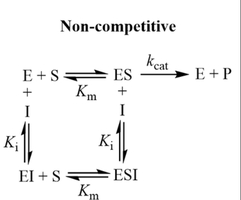
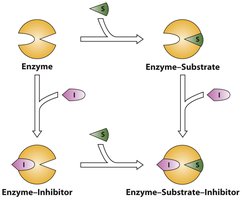
Non-competitive inhibitors bind to an allosteric site, affecting enzyme activity regardless of substrate binding. Vmax decreases, but KM remains unchanged. Mixed inhibition alters both KM and Vmax.
Uncompetitive Inhibition
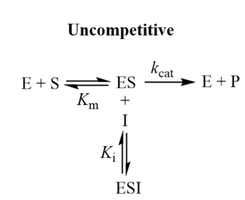
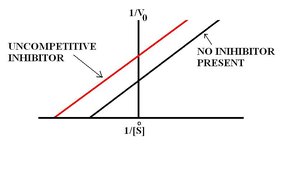
Uncompetitive inhibitors bind only to the enzyme-substrate complex, decreasing both KM and Vmax.
Irreversible Inhibition
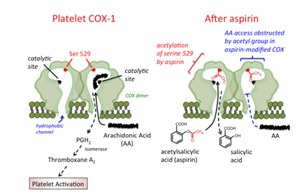
Irreversible inhibitors covalently modify the enzyme, permanently inactivating it. Examples include aspirin's inhibition of COX-1.
Non-Michaelis-Menten Kinetics and Allostery
Allosteric Enzymes
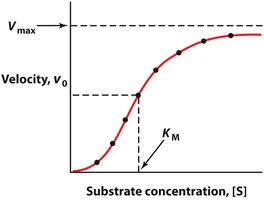
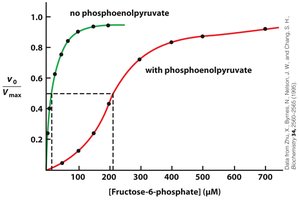
Allosteric enzymes do not follow Michaelis-Menten kinetics. They often display sigmoidal (S-shaped) velocity versus substrate concentration curves due to cooperative substrate binding. Allosteric regulation allows fine-tuned control of metabolic pathways.
Metabolic Regulation of Enzyme Activity
Mechanisms of Regulation
Changes in enzyme synthesis and degradation rates
Subcellular localization changes
Allosteric regulation by metabolites
Covalent modification (e.g., phosphorylation)
Feedback inhibition
Summary Table: Types of Enzyme Inhibition
Type | Effect on Vmax | Effect on KM | Reversibility |
|---|---|---|---|
Competitive | Unchanged | Increases | Reversible |
Non-competitive | Decreases | Unchanged | Reversible |
Uncompetitive | Decreases | Decreases | Reversible |
Irreversible | Decreases | Unchanged or decreases | Irreversible |
Key Equations
Michaelis-Menten:
Lineweaver-Burk:
Turnover number:
Catalytic efficiency:
Additional info: These notes integrate foundational concepts in enzyme structure, function, kinetics, and regulation, providing a comprehensive overview suitable for biochemistry students preparing for exams.
