 뒤로
뒤로DNA Replication: Mechanisms, Enzymes, and Laboratory Applications
스터디 가이드 - 스마트 노트
 자료에 맞춘 맞춤형 노트, 핵심 정의, 예시, 맥락을 확장해 제공합니다.
DNA Replication: Main Goals and Mechanism
The Meselson-Stahl Experiment: Evidence for Semiconservative Replication
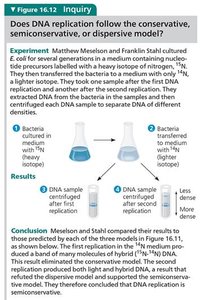
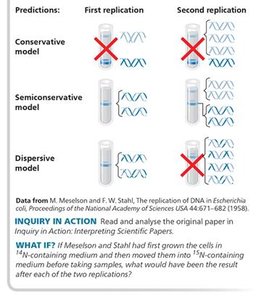
The Meselson-Stahl experiment provided definitive evidence that DNA replication is semiconservative, meaning each daughter DNA molecule consists of one parental and one newly synthesized strand.
Bacteria were grown in heavy (15N) and then light (14N) nitrogen media.
After one replication, DNA had intermediate density; after two, both intermediate and light DNA were observed.
This disproved conservative and dispersive models of replication.
Fundamental Rules and Features of DNA Replication
Universal Principles
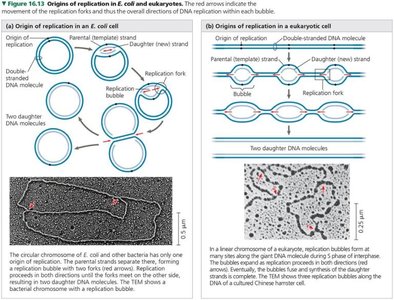
Replication starts at specific origins (AT-rich sequences).
Proceeds bidirectionally from each origin.
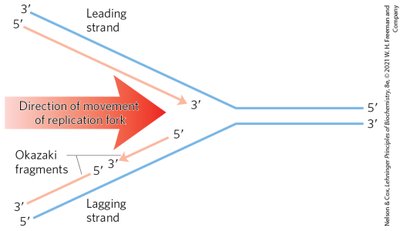
Template is read 3' to 5'; new strand synthesized 5' to 3'.
Requires a primer (usually RNA in vivo).
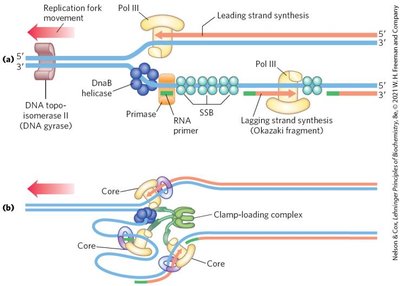
Replication is semi-discontinuous: leading strand is continuous, lagging strand is synthesized in Okazaki fragments.
Key Properties of DNA Polymerases
Primer Requirement and Catalytic Activity
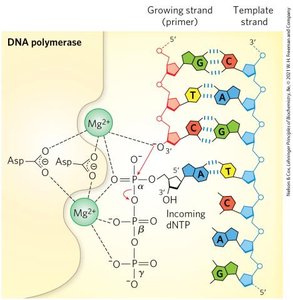
Primer Requirement: DNA polymerases cannot initiate synthesis de novo; they extend from a free 3' OH group of a primer.
Catalytic Activity: DNA polymerases catalyze the addition of dNTPs to the growing DNA strand in the 5' to 3' direction, using Mg2+ ions and conserved aspartate residues to stabilize the transition state.
Structure and Fidelity of DNA Polymerases
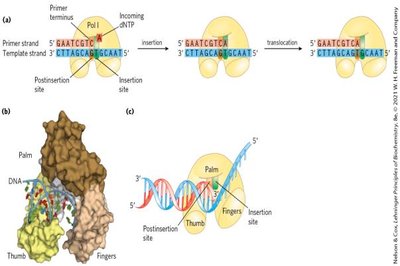
DNA polymerase structure resembles a hand with palm, thumb, and fingers domains.
Active site has two pockets: insertion site (incoming nucleotide) and post-insertion site (newly formed base pair).
High fidelity: Only correct base pairs fit properly in the active site; incorrect pairs are excluded.
Proofreading and Exonuclease Activities
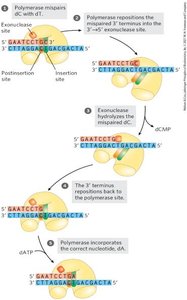
Most DNA polymerases possess 3'→5' exonuclease activity for proofreading, removing mismatched nucleotides.
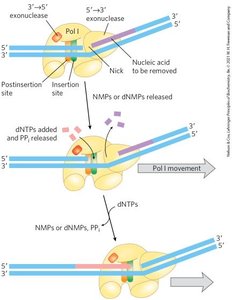
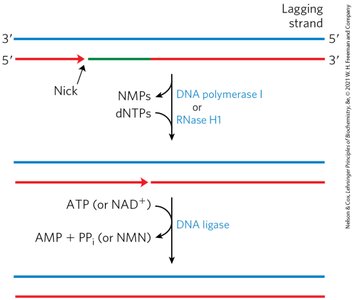
Some (e.g., E. coli DNA pol I) also have 5'→3' exonuclease activity for removing RNA primers (nick translation).
DNA Replication in E. coli: Model System
Initiation and Termination
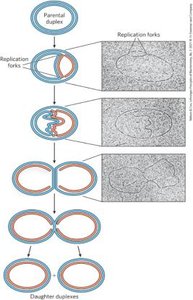
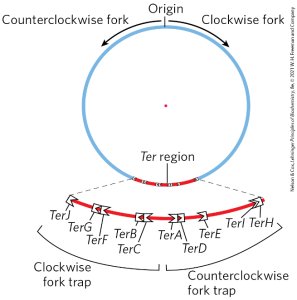
Replication in E. coli begins at a single origin (oriC) and terminates at the ter region, producing two daughter DNA circles.
Key Enzymes and Proteins in E. coli Replication
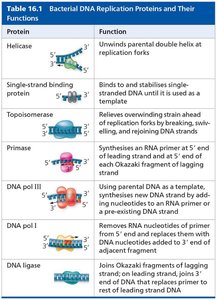
Protein | Function |
|---|---|
Helicase | Unwinds parental double helix at replication forks |
Single-strand binding protein | Stabilizes single-stranded DNA |
Topoisomerase | Relieves overwinding ahead of replication forks |
Primase | Synthesizes RNA primers |
DNA pol III | Main replication enzyme; synthesizes new DNA |
DNA pol I | Removes RNA primers and replaces with DNA |
DNA ligase | Joins Okazaki fragments |
DNA Polymerase III Holoenzyme
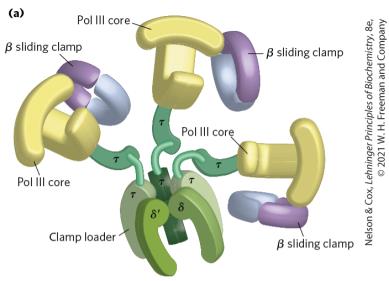
Composed of three core units, each with its own catalytic domain.
Each core interacts with a sliding clamp (β subunit dimer) for high processivity.
Clamp loader complex (γ complex) links the cores and loads the clamps onto DNA.
Proofreading and Nick Translation
DNA pol III proofreads via 3'→5' exonuclease activity, ensuring high fidelity (1 error per 109–1010 bp).
DNA pol I removes RNA primers and replaces them with DNA (nick translation), also possessing proofreading activity.
DNA Ligase Function
DNA ligase seals nicks between Okazaki fragments, forming a continuous lagging strand by creating new phosphodiester bonds.
DNA Replication in Eukaryotes: Special Features
Multiple Origins and Slower Polymerases
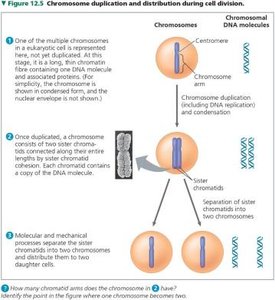
Eukaryotic chromosomes are linear and much larger, requiring multiple origins of replication (ARS) per chromosome.
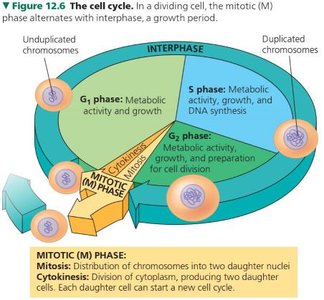
Replication occurs in S phase of the cell cycle and proceeds at a slower rate (~50 nt/sec).
Replication forks from adjacent origins meet to complete replication.
Eukaryotic Replication Enzymes
Polymerase α (primase activity), polymerase δ (main replication), polymerase ε (repair and replication).
Other enzymes (ligases, helicases, topoisomerases, SSBs) have eukaryotic counterparts.
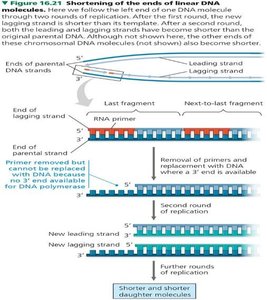
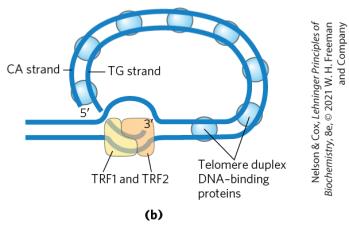
Linear chromosomes face the end-replication problem: after removal of theThe End-Replication Problem and Telomerase
last RNA primer, there is no 3' OH for DNA polymerase to extend, resulting in progressive shortening of chromosome ends (telomeres) with each cell division.
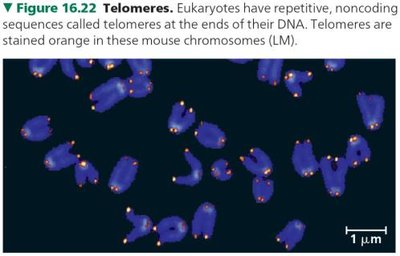
Telomeres: Repetitive, noncoding sequences at chromosome ends (e.g., TTAGGG in humans) protect coding DNA from loss.
Telomerase: A ribonucleoprotein enzyme with reverse transcriptase activity that extends telomeres using its own RNA template.
Organism | Telomere Repeat Sequence |
|---|---|
Homo sapiens | (TTAGGG)n |
Tetrahymena thermophila | (TTGGGG)n |
Saccharomyces cerevisiae | (T(G)1–3(TG)2–3)n |
Arabidopsis thaliana | (TTTAGGG)n |

Mechanism of Telomerase Action
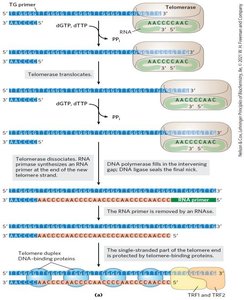
Telomerase binds to the 3' overhang of the parental strand and extends it by adding telomeric repeats.
Allows primase and DNA polymerase to fill in the complementary strand, preventing loss of genetic material.
Telomerase activity is present in germline and cancer cells, but not in most somatic cells, linking telomere shortening to cellular aging.
Laboratory Techniques Based on DNA Structure and Replication
Quantification of DNA and RNA
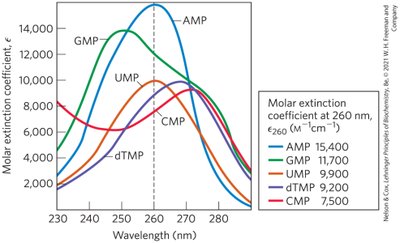
Nucleic acid bases absorb UV light maximally at 260 nm (A260).
Concentration can be calculated using the molar extinction coefficient.
Double-stranded DNA shows lower absorbance (hypochromic effect) compared to single-stranded DNA or RNA.
Thermal Denaturation and Annealing
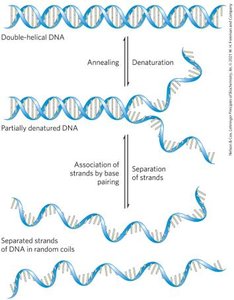
Heating DNA separates strands (denaturation); cooling allows reannealing.
Applications include hybridization assays, gene identification, and evolutionary studies.
Polymerase Chain Reaction (PCR)
PCR amplifies specific DNA sequences using cycles of denaturation, primer annealing, and extension by a thermostable DNA polymerase (e.g., Taq polymerase).
Applications: gene cloning, DNA sequencing, diagnostics, forensics, and ancient DNA analysis.
Summary Table: Comparison of E. coli DNA Polymerases
DNA Polymerase | Main Function | Proofreading (3'→5') | 5'→3' Exonuclease | Polymerization Rate (nt/s) | Processivity |
|---|---|---|---|---|---|
Pol I | Primer removal, nick translation | Yes | Yes | 10–20 | 3–200 |
Pol III | Main replication | Yes | No | 250–1,000 | ≥500,000 |
Pol II, IV, V | DNA repair | Varies | No | Low | Low |
Additional info: Eukaryotic DNA polymerases have similar roles but are more numerous and complex.
