뒤로
뒤로Membrane Structure, Micelle Formation, and Osmosis
스터디 가이드 - 스마트 노트
 자료에 맞춘 맞춤형 노트, 핵심 정의, 예시, 맥락을 확장해 제공합니다.
Membrane Structure and Lipid Aggregation
Formation of Micelles
Micelles are spherical aggregates of amphipathic lipid molecules in aqueous solution, crucial for understanding membrane structure and lipid behavior in biochemistry.
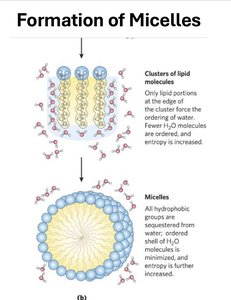
Clusters of Lipid Molecules: At the edge of a lipid cluster, only the outermost lipid portions interact with water, causing water molecules to become more ordered. This ordering decreases entropy locally, but fewer water molecules are affected compared to dispersed lipids.
Micelles: When lipids form a micelle, all hydrophobic groups are sequestered away from water. The ordered shell of water molecules is minimized, maximizing entropy and stabilizing the structure.
Biological Relevance: Micelle formation is a key principle in the self-assembly of biological membranes and the action of detergents.
Example: Fatty acids and detergents in water spontaneously form micelles due to the hydrophobic effect.
Membrane Transport and Water Movement
Osmosis
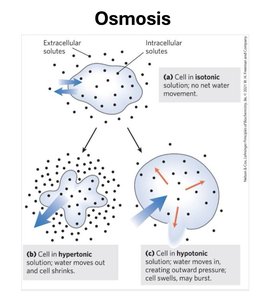
Osmosis is the movement of water across a semipermeable membrane from a region of lower solute concentration to a region of higher solute concentration. It is fundamental to cell volume regulation and membrane transport in biochemistry.
Isotonic Solution: The concentration of solutes is equal inside and outside the cell, resulting in no net movement of water.
Hypertonic Solution: The external solution has a higher solute concentration than the cell interior. Water moves out of the cell, causing it to shrink (crenate).
Hypotonic Solution: The external solution has a lower solute concentration than the cell interior. Water moves into the cell, which may swell and potentially burst (lyse).
Equation: The osmotic pressure (\( \Pi \)) can be described by the van 't Hoff equation: where i is the van 't Hoff factor, M is molarity, R is the gas constant, and T is temperature in Kelvin.
Biological Application: Osmosis is critical for maintaining cell shape, nutrient uptake, and waste removal.