 뒤로
뒤로The Energetics of Life: Thermodynamics and Free Energy in Biochemistry
스터디 가이드 - 스마트 노트
 자료에 맞춘 맞춤형 노트, 핵심 정의, 예시, 맥락을 확장해 제공합니다.
Chapter 3 – The Energetics of Life
Introduction to Thermodynamics in Biochemistry
Understanding the energetics of life is essential for biochemistry, as it explains how energy transformations govern biological processes. This chapter covers the laws of thermodynamics, enthalpy, entropy, Gibbs free energy, chemical equilibrium, and the coupling of reactions in living systems.
Thermodynamic Systems
Types of Systems
System: The part of the universe chosen for study; everything else is the surroundings.
Isolated System: Exchanges neither matter nor energy with surroundings.
Closed System: Exchanges energy (heat or work) but not matter with surroundings.
Open System: Exchanges both matter and energy with surroundings. Living systems are open systems, typically operating at constant temperature and pressure.
The First Law of Thermodynamics and Enthalpy
Energy Conservation
First Law: The total energy of an isolated system is constant; energy can be transferred or transformed but not created or destroyed.
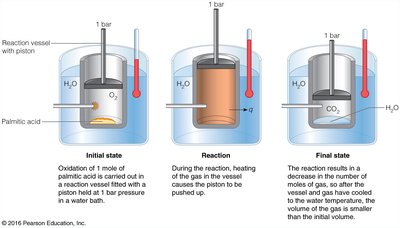
Enthalpy (H): The heat exchanged between the system and surroundings at constant pressure, a common condition for biological systems.
State Functions
State functions depend only on the initial and final states, not the path taken (e.g., temperature, pressure, free energy, enthalpy, entropy).
Change in enthalpy:
The Second Law of Thermodynamics and Entropy
Entropy and Spontaneity
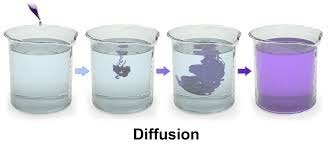
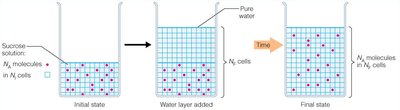
Second Law: The entropy (S) of an isolated system tends to increase; systems naturally progress toward greater disorder.
Entropy (S): A measure of randomness or disorder in a system.
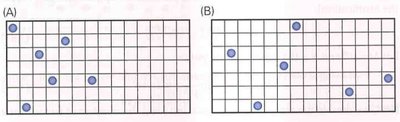
Systems tend to maximize the number of possible arrangements (microstates).
Boltzmann equation: (where is Boltzmann's constant, is the number of microstates).

Gibbs Free Energy and Biological Systems
Gibbs Free Energy (G)
For open systems (like cells), the second law is expressed using Gibbs free energy:
ΔG represents the energy available to do work at constant temperature and pressure.
If , the process is exergonic (spontaneous/favorable).
If , the process is endergonic (non-spontaneous/unfavorable).
If , the system is at equilibrium.
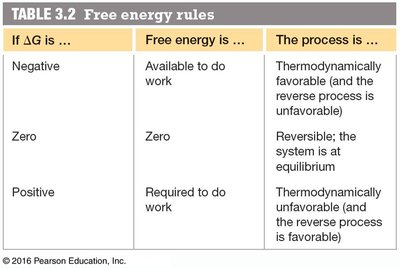
If ΔG is … | Free energy is … | The process is … |
|---|---|---|
Negative | Available to do work | Thermodynamically favorable |
Zero | Zero | Reversible; system at equilibrium |
Positive | Required to do work | Thermodynamically unfavorable |
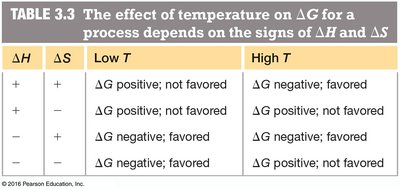
Effect of Temperature on ΔG
ΔH | ΔS | Low T | High T |
|---|---|---|---|
+ | + | ΔG positive; not favored | ΔG negative; favored |
+ | - | ΔG positive; not favored | ΔG positive; not favored |
- | + | ΔG negative; favored | ΔG negative; favored |
- | - | ΔG negative; favored | ΔG positive; not favored |
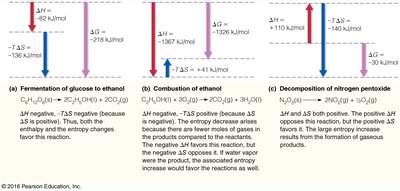
Examples of Enthalpy and Entropy Interplay
Melting of ice at different temperatures demonstrates how ΔH and ΔS determine spontaneity.
At low T, ΔG is positive (unfavorable); at high T, ΔG is negative (favorable).
Chemical Equilibrium and Free Energy
Equilibrium Constant (K) and Reaction Quotient (Q)
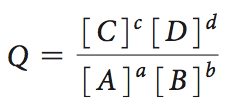
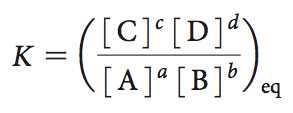
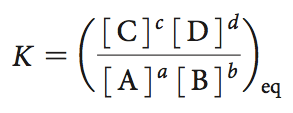
Equilibrium constant (K): Describes the ratio of product and reactant concentrations at equilibrium.
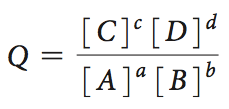
Reaction quotient (Q): Same form as K, but for any set of concentrations.
Relationship Between ΔG, ΔG°, and Concentrations
Standard free energy change () is measured under standard conditions (1 bar, 25°C, 1 M solute).
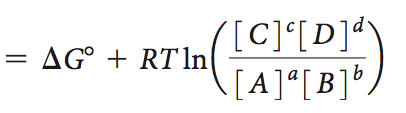
Actual free energy change () depends on concentrations:
At equilibrium, and :
Value of Q | Value of ΔG | Favored Direction |
|---|---|---|
< K | < 0 | Forward reaction (formation of products) |
= K | = 0 | Neither (system at equilibrium) |
> K | > 0 | Reverse reaction (formation of reactants) |
Coupled Reactions in Biochemistry
Driving Unfavorable Reactions
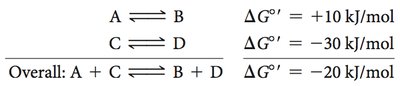
Cells couple unfavorable (endergonic) reactions with favorable (exergonic) ones to drive essential processes.
Examples: ATP hydrolysis drives muscle contraction, active transport, and biosynthesis.
Calculating ΔG for Coupled Reactions
Reverse the sign of ΔG when reversing a reaction.
Add ΔG values for the overall reaction.


ATP: The Energy Currency of the Cell
ATP Hydrolysis and Energy Release
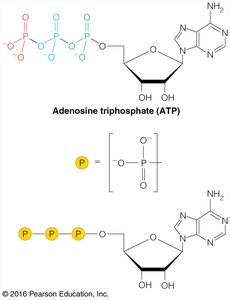
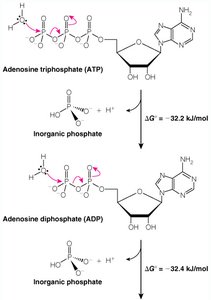
ATP hydrolysis is highly exergonic and provides energy for cellular work.
Standard free energy change for ATP hydrolysis: kJ/mol.
Actual ΔG depends on cellular concentrations of ATP, ADP, and Pi.
Why Are Some Compounds Energy-Rich?
Resonance stabilization of products
Electrostatic repulsion in reactants
Tautomerization of products
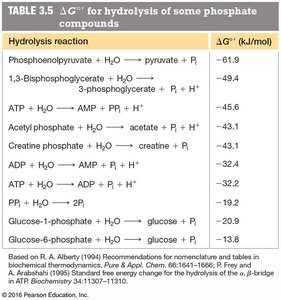
Hydrolysis Reactions of Phosphate-Containing Metabolites
Hydrolysis Reaction | ΔG°' (kJ/mol) |
|---|---|
Phosphoenolpyruvate + H2O → pyruvate + Pi | -61.9 |
1,3-Bisphosphoglycerate + H2O → 3-phosphoglycerate + Pi | -49.4 |
ATP + H2O → AMP + PPi + H+ | -45.6 |
Acetyl phosphate + H2O → acetate + Pi | -43.1 |
Creatine phosphate + H2O → creatine + Pi | -43.1 |
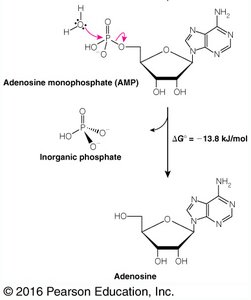
ADP + H2O → AMP + Pi + H+ | -32.4 |
ATP + H2O → ADP + Pi + H+ | -32.2 |
PPi + H2O → 2 Pi | -19.2 |
Glucose-1-phosphate + H2O → glucose + Pi | -13.8 |
Equilibration and Transport Across Membranes
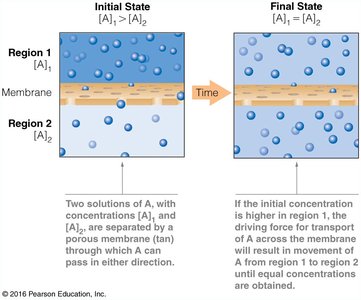
Diffusion and Free Energy
Movement of solutes across membranes is driven by concentration gradients.
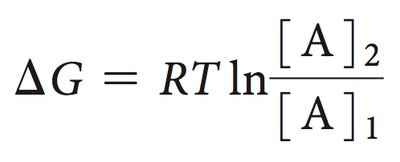
Free energy change for transport:
Oxidation-Reduction (Redox) Reactions
Redox Chemistry in Biochemistry
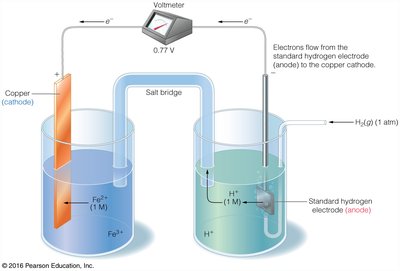
Redox reactions involve electron transfer between donor (reductant) and acceptor (oxidant).
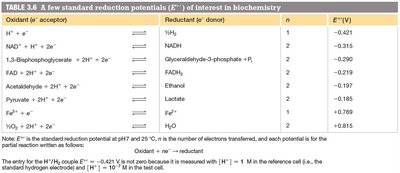
Standard reduction potential () measures the tendency to gain electrons; higher means stronger oxidant.
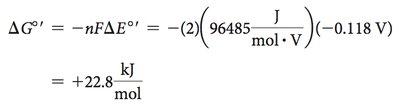
Standard free energy change for redox reactions:
n = number of electrons transferred; F = Faraday's constant (96.5 kJ/mol·V).

Oxidant (e- acceptor) | Reductant (e- donor) | n | E°'(V) |
|---|---|---|---|
H+ + e- | H2 | 2 | -0.421 |
NAD+ | NADH | 2 | -0.315 |
1,3-Bisphosphoglycerate | Glyceraldehyde-3-phosphate + Pi | 2 | -0.290 |
FAD | FADH2 | 2 | -0.219 |
Acetoacetate | Ethanol | 2 | -0.185 |
Pyruvate | Lactate | 2 | -0.187 |
H2O2 | H2O | 2 | +0.815 |
Example Calculation
For the oxidation of ethanol by NAD+, combine the half-reactions, reverse as needed, sum E°' values, and calculate ΔG°'.
Summary
Thermodynamics provides the framework for understanding energy flow in biological systems.
ΔG determines reaction spontaneity and direction.
Cells use coupling and redox reactions to drive essential processes far from equilibrium.
