 뒤로
뒤로The Genetic Code and Translation: Structure, Function, and Fidelity
스터디 가이드 - 스마트 노트
 자료에 맞춘 맞춤형 노트, 핵심 정의, 예시, 맥락을 확장해 제공합니다.
The Central Dogma and Flow of Genetic Information
Overview of Information Transfer
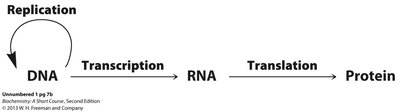
The central dogma of molecular biology describes the directional flow of genetic information within a biological system. Information is stored in DNA, transcribed into RNA, and then translated into protein. DNA can also be replicated to pass genetic information to new cells.
Replication: DNA is copied to produce identical DNA molecules.
Transcription: DNA is used as a template to synthesize RNA.
Translation: RNA serves as a template for protein synthesis.
The Genetic Code
Structure and Properties of the Genetic Code
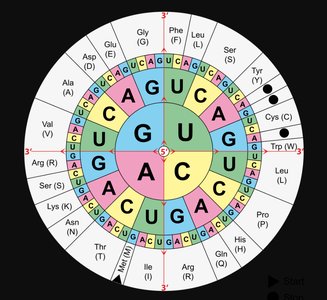
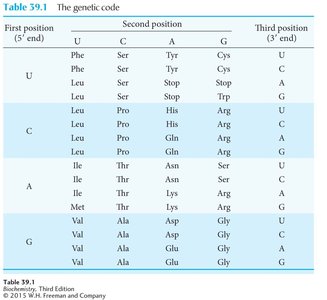
The genetic code is the set of rules by which nucleotide sequences in mRNA are translated into the amino acid sequences of proteins. It is nearly universal among living organisms and is based on triplets of nucleotides called codons.
Codons: Groups of three nucleotides in mRNA that specify amino acids.
Number of Codons: 64 possible codons (43 combinations of A, U, G, C).
Amino Acids: 61 codons code for 20 amino acids; 3 codons are stop signals (UAA, UAG, UGA).
Initiation Codon: AUG codes for methionine and signals the start of translation.
Nonoverlapping: Codons are read sequentially, without overlap.
Reading Frame: The first codon establishes the reading frame; shifting the frame alters the entire sequence.
Directionality: The code is read in the 5' to 3' direction on mRNA.
Degeneracy and Universality of the Genetic Code
The genetic code is degenerate, meaning that most amino acids are encoded by more than one codon. This property provides resilience against mutations and is a key feature of the code's universality.
Degeneracy: Multiple codons can specify the same amino acid.
Silent Mutations: Changes in the third base of a codon often do not alter the amino acid (silent mutation).
Conservative Substitutions: Mutations in the first base may result in an amino acid with similar properties.
Universality: The genetic code is nearly universal across all organisms.
Amino Acid | Number of Codons | Amino Acid | Number of Codons |
|---|---|---|---|
Met | 1 | Tyr | 2 |
Trp | 1 | Ile | 3 |
Asn | 2 | Ala | 4 |
Asp | 2 | Gly | 4 |
Cys | 2 | Pro | 4 |
Gln | 2 | Thr | 4 |
Glu | 2 | Val | 4 |
His | 2 | Arg | 6 |
Lys | 2 | Leu | 6 |
Phe | 2 | Ser | 6 |
tRNA: The Adaptor Molecule
Structure and Function of tRNA
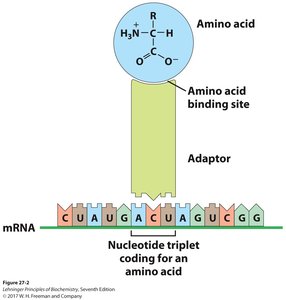
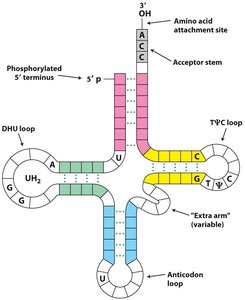
Transfer RNAs (tRNAs) are adaptor molecules that translate the nucleotide language of mRNA into the amino acid language of proteins. Each tRNA carries a specific amino acid and recognizes codons in mRNA through its anticodon loop.
Size: 73–93 nucleotides in length.
Structure: Cloverleaf secondary structure; L-shaped tertiary structure.
Acceptor Stem: The 3' CCA terminus is the site of amino acid attachment.
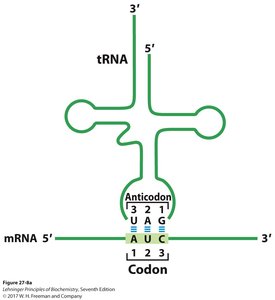
Anticodon Loop: Contains a triplet sequence complementary to the mRNA codon.
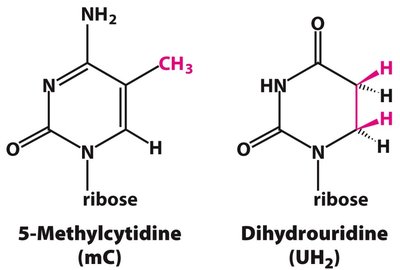
Unusual Bases: tRNAs contain modified bases such as inosine, 5-methylcytidine, and dihydrouridine.
Codon-Anticodon Interaction and the Wobble Hypothesis
The codon in mRNA pairs with the anticodon in tRNA via hydrogen bonds, and the alignment is antiparallel. The third base of the codon (wobble position) allows for non-standard pairing, enabling some tRNAs to recognize multiple codons.
Wobble: Flexibility in base pairing at the third codon position.
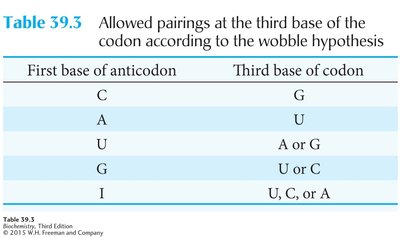
Inosine: A modified base in tRNA that can pair with U, C, or A in the codon.
Generalization: Codons differing in the first two bases require different tRNAs; the first base of the anticodon determines wobble capacity.
First base of anticodon | Third base of codon |
|---|---|
C | G |
A | U |
U | A or G |
G | U or C |
I | U, C, or A |
Protein Synthesis: The Five Stages
Stages of Translation
Protein synthesis (translation) is a complex process divided into five stages, each requiring specific factors and energy input.
Activation of Amino Acids: Amino acids are attached to tRNAs (aminoacylation).
Initiation: Assembly of the ribosome, mRNA, and initiator aminoacyl-tRNA.
Elongation: Sequential addition of amino acids to the growing polypeptide chain.
Termination and Ribosome Recycling: Release of the completed polypeptide and dissociation of the translation complex.
Folding and Posttranslational Processing: Newly synthesized proteins fold and may undergo modifications.
Amino Acid Activation and Aminoacyl-tRNA Synthetases
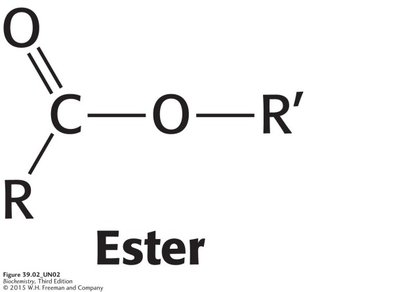
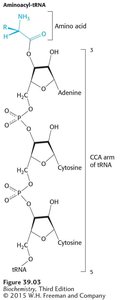
Amino acids are activated by attachment to tRNA via an ester linkage, forming aminoacyl-tRNA (charged tRNA). This reaction is catalyzed by aminoacyl-tRNA synthetases, which are highly specific enzymes that ensure the correct amino acid is attached to its corresponding tRNA.
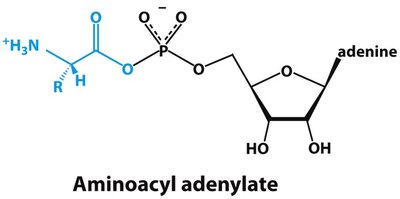
Step 1: Formation of aminoacyl adenylate (amino acid + ATP → aminoacyl-AMP + PPi).
Step 2: Transfer of the aminoacyl group to the 2' or 3' hydroxyl of the tRNA's terminal adenosine.
Specificity: Each synthetase recognizes specific tRNA(s) and amino acid(s).
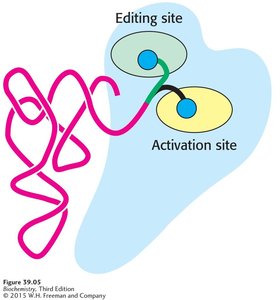
Editing Site: Some synthetases have an editing site to remove incorrectly attached amino acids, increasing fidelity.
Fidelity of Aminoacyl-tRNA Synthetases
Aminoacyl-tRNA synthetases are the true translators of the genetic code, as they assign specific amino acids to their corresponding tRNAs. The accuracy of protein synthesis depends on the specificity and proofreading ability of these enzymes.
Double Sieve Mechanism: The active site excludes amino acids larger than the correct one, while the editing site removes smaller, incorrect amino acids.
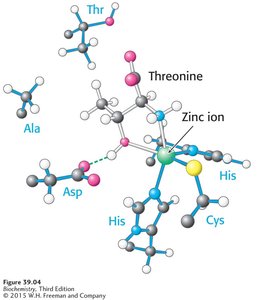
Example: Threonyl-tRNA synthetase uses a zinc ion to distinguish threonine from serine and valine.
Summary Table: Key Features of the Genetic Code and Translation
Feature | Description |
|---|---|
Codon | Triplet of nucleotides in mRNA specifying an amino acid |
Degeneracy | Most amino acids encoded by multiple codons |
Start Codon | AUG (methionine) |
Stop Codons | UAA, UAG, UGA |
Adaptor Molecule | tRNA |
Aminoacyl-tRNA Synthetase | Enzyme that attaches amino acid to tRNA |
Wobble | Non-standard base pairing at third codon position |
Fidelity Mechanism | Editing site in synthetase removes incorrect amino acids |
