 뒤로
뒤로The Preparation (Energy Investment) Phase of Glycolysis
스터디 가이드 - 스마트 노트
 자료에 맞춘 맞춤형 노트, 핵심 정의, 예시, 맥락을 확장해 제공합니다.
The Preparation (Energy Investment) Phase of Glycolysis
Introduction to Glycolysis and the Preparation Phase
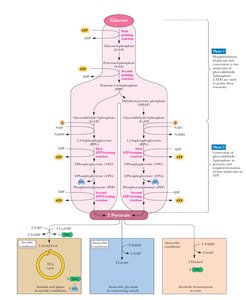
Glycolysis is the first stage of glucose catabolism, converting one molecule of glucose into two molecules of pyruvate through a series of ten enzyme-catalyzed reactions. This process is divided into two phases: the preparation (energy investment) phase and the payoff (energy generation) phase. The preparation phase encompasses the first five reactions, during which the cell invests ATP to modify glucose, making it more reactive and ready for efficient energy extraction in the subsequent steps.
Purpose: To chemically activate glucose for subsequent breakdown and energy extraction.
ATP Investment: Two ATP molecules are consumed in this phase.
Outcome: Glucose is converted into two molecules of glyceraldehyde-3-phosphate (G3P).
Why Does the Cell Invest ATP Before Producing ATP?
Cells often require an initial energy input to make later reactions energetically favorable. In glycolysis, ATP is invested to:
Increase the chemical reactivity of glucose.
Trap glucose inside the cell by phosphorylation.
Prepare glucose for efficient cleavage and energy extraction.
This investment is analogous to building a foundation before constructing a house—initial resources are required for greater long-term benefit.
Overview of the Preparation Phase: The Five Reactions
The preparation phase consists of five enzyme-catalyzed reactions:
Reaction | Major Event | Enzyme |
|---|---|---|
1 | Glucose is phosphorylated to glucose-6-phosphate | Hexokinase (or glucokinase) |
2 | Glucose-6-phosphate is rearranged to fructose-6-phosphate | Phosphoglucose isomerase |
3 | Fructose-6-phosphate is phosphorylated to fructose-1,6-bisphosphate | Phosphofructokinase-1 (PFK-1) |
4 | Fructose-1,6-bisphosphate is split into two three-carbon sugars | Aldolase |
5 | Dihydroxyacetone phosphate is converted to glyceraldehyde-3-phosphate | Triose phosphate isomerase |
By the end of this phase, glucose is transformed into two activated three-carbon molecules (G3P), ready for the payoff phase.
Reaction 1: Phosphorylation of Glucose
The first reaction involves the transfer of a phosphate group from ATP to glucose, producing glucose-6-phosphate (G6P).
Enzyme: Hexokinase (most tissues) or Glucokinase (liver and pancreatic β-cells)
Reaction type: Phosphorylation
Equation:
Purposes of Phosphorylation:
Traps glucose inside the cell (G6P cannot cross the plasma membrane).
Increases chemical reactivity, raising the free energy of the molecule.
Directs glucose toward metabolism (glycolysis, glycogen synthesis, or pentose phosphate pathway).
Hexokinase and the Induced-Fit Mechanism
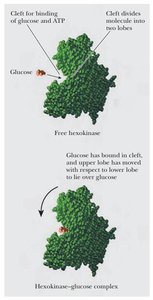
Hexokinase catalyzes the phosphorylation of glucose. Upon glucose binding, the enzyme undergoes a conformational change (induced fit), which:
Positions glucose for efficient phosphate transfer.
Excludes water from the active site, preventing ATP hydrolysis by water.
Stabilizes the transition state, lowering activation energy.
Hexokinase vs. Glucokinase
Characteristic | Hexokinase | Glucokinase |
|---|---|---|
Tissue distribution | Most tissues | Liver and pancreatic β-cells |
Affinity for glucose | High | Lower than hexokinase |
Physiological role | Ensures continuous glucose utilization | Responds to elevated blood glucose after meals |
Glucokinase is most active when blood glucose is high, allowing the liver to remove excess glucose and regulate blood sugar levels.
Irreversibility of Reaction 1
The phosphorylation of glucose is essentially irreversible under physiological conditions due to a large negative change in Gibbs free energy (). This commits glucose to intracellular metabolism.
Reaction 2: Isomerization of Glucose-6-Phosphate
Glucose-6-phosphate is converted to fructose-6-phosphate by phosphoglucose isomerase.
Reaction type: Isomerization (aldose to ketose conversion)
Equation:
This rearrangement is necessary to prepare the molecule for subsequent phosphorylation and cleavage into two three-carbon molecules.
Reaction 3: Phosphorylation of Fructose-6-Phosphate (The Committed Step)
Fructose-6-phosphate is phosphorylated to fructose-1,6-bisphosphate by phosphofructokinase-1 (PFK-1), consuming one ATP.
Enzyme: Phosphofructokinase-1 (PFK-1)
Reaction type: Phosphorylation
Equation:
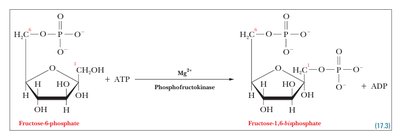
This is the committed step of glycolysis, meaning it is the first irreversible reaction that commits the substrate to the glycolytic pathway.
Regulation of PFK-1
ATP: Allosteric inhibitor (slows glycolysis when energy is abundant).
AMP: Allosteric activator (accelerates glycolysis when energy is needed).
Citrate: Allosteric inhibitor (signals sufficient energy from the citric acid cycle).
This regulation allows glycolysis to adjust to the cell's energy requirements.
Reaction 4: Cleavage of Fructose-1,6-Bisphosphate
Fructose-1,6-bisphosphate is split into two three-carbon molecules: glyceraldehyde-3-phosphate (G3P) and dihydroxyacetone phosphate (DHAP) by the enzyme aldolase.
Reaction type: Carbon–carbon bond cleavage (aldol cleavage)
Equation:
This step is only possible due to the prior phosphorylation and isomerization reactions.
Reaction 5: Interconversion of the Triose Phosphates
Only G3P can continue directly into the payoff phase. Triose phosphate isomerase converts DHAP into G3P, ensuring both three-carbon molecules proceed through glycolysis.
Enzyme: Triose phosphate isomerase
Reaction type: Isomerization
Equation:
This reaction is readily reversible and maximizes the energy yield from glucose.
Summary Table: Major Events of the Preparation Phase
Reaction | Enzyme | Major Event | Biological Significance |
|---|---|---|---|
1 | Hexokinase (or Glucokinase) | Glucose → Glucose-6-phosphate | Traps glucose inside the cell and activates it for metabolism |
2 | Phosphoglucose isomerase | Glucose-6-phosphate → Fructose-6-phosphate | Rearranges the sugar to facilitate later cleavage |
3 | Phosphofructokinase-1 (PFK-1) | Fructose-6-phosphate → Fructose-1,6-bisphosphate | Commits glucose to glycolysis and serves as the principal regulatory step |
4 | Aldolase | Fructose-1,6-bisphosphate → G3P + DHAP | Splits the six-carbon sugar into two three-carbon molecules |
5 | Triose phosphate isomerase | DHAP → G3P | Ensures that both three-carbon molecules proceed through glycolysis |
Key Terminology
Term | Definition |
|---|---|
Aldolase | Enzyme that cleaves fructose-1,6-bisphosphate into G3P and DHAP |
Committed step | First irreversible reaction committing a metabolite to a pathway (PFK-1 in glycolysis) |
DHAP | Three-carbon sugar phosphate converted to G3P |
Fructose-1,6-bisphosphate | Six-carbon intermediate formed after the second phosphorylation |
Fructose-6-phosphate | Isomer of glucose-6-phosphate, substrate for PFK-1 |
Glucokinase | Liver and pancreatic β-cell enzyme for glucose phosphorylation and sensing |
Glucose-6-phosphate | Phosphorylated product of glucose, first reaction of glycolysis |
Hexokinase | Enzyme catalyzing phosphorylation of glucose in most tissues |
Induced fit | Model of enzyme action involving conformational change upon substrate binding |
Phosphofructokinase-1 (PFK-1) | Enzyme catalyzing the committed and rate-limiting step of glycolysis |
Triose phosphate isomerase | Enzyme interconverting DHAP and G3P |
Clinical and Agricultural Connections
Hexokinase: Supports glucose metabolism in tissues with constant energy demand (e.g., brain, muscle).
Glucokinase: Functions as a glucose sensor in pancreatic β-cells, regulating insulin secretion and blood glucose.
PFK-1: Defects can impair ATP production; increased glycolysis is seen in rapidly proliferating cells.
Agricultural relevance: Understanding glycolytic enzyme regulation can improve crop energy efficiency and stress tolerance.
Review Questions
Multiple Choice:
Which enzyme catalyzes the first reaction of glycolysis in most tissues? (Answer: Hexokinase)
Which enzyme catalyzes the committed step of glycolysis? (Answer: Phosphofructokinase-1)
What is the primary purpose of phosphorylating glucose? (Answer: To trap glucose inside the cell and activate it for metabolism)
Which molecule activates phosphofructokinase-1? (Answer: AMP)
At the end of the preparation phase, one glucose molecule has been converted into: (Answer: Two glyceraldehyde-3-phosphate molecules)
Short Answer:
Explain why ATP is invested during the preparation phase of glycolysis.
Differentiate between hexokinase and glucokinase.
Why is Reaction 3 called the committed step of glycolysis?
Describe how ATP and AMP regulate phosphofructokinase-1.
Explain the importance of triose phosphate isomerase in glycolysis.
Application:
A mutation reduces the activity of phosphofructokinase-1 in skeletal muscle. Predict how this would affect glycolysis and ATP production during intense exercise.
Explain why glucokinase is well suited to its role in the liver after a carbohydrate-rich meal.
A researcher develops a compound that specifically inhibits triose phosphate isomerase. Explain how this inhibition would affect the overall efficiency of glycolysis.
