 뒤로
뒤로Water, Acids, Bases, and Buffers in Biochemistry
스터디 가이드 - 스마트 노트
 자료에 맞춘 맞춤형 노트, 핵심 정의, 예시, 맥락을 확장해 제공합니다.
Water and Basic Chemistry
Importance of Water in Biochemistry
Water is the most abundant molecule in living organisms and plays a critical role in biochemical processes due to its unique chemical and physical properties. Its polarity and ability to form hydrogen bonds are central to its function as a solvent and its involvement in molecular interactions.
Polarity: Water is a polar molecule, meaning it has an uneven distribution of electron density, resulting in partial positive (δ+) and partial negative (δ−) charges.
Hydrogen Bonding: The polarity of water allows it to form hydrogen bonds, which are essential for its high boiling point, surface tension, and solvent capabilities.
Emergent Properties: Hydrogen bonding leads to cohesion, adhesion, and the ability of water to moderate temperature.
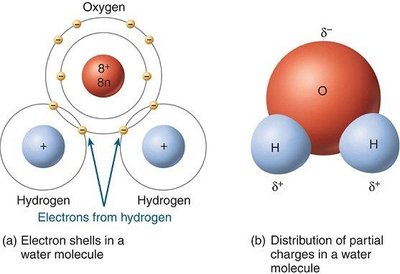
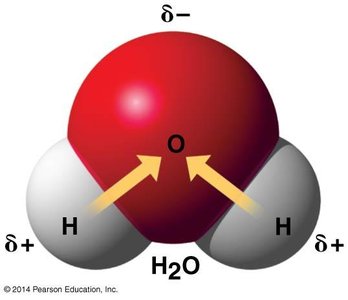
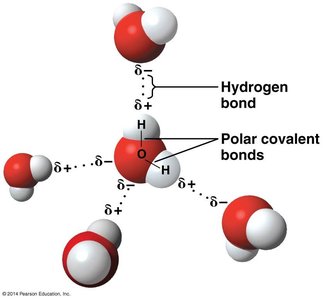
States of Water and Hydrogen Bonding
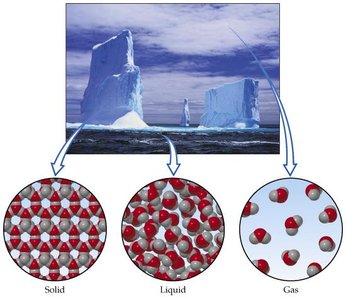
Water exists in three states—solid, liquid, and gas—each characterized by different arrangements and numbers of hydrogen bonds.
Solid (Ice): Water molecules form a crystalline lattice, maximizing hydrogen bonds and resulting in lower density than liquid water.
Liquid: Hydrogen bonds are constantly forming and breaking, allowing for fluidity and high density.
Gas: Molecules are far apart, with minimal hydrogen bonding.
Water as a Solvent
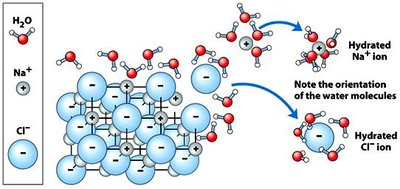
Water's polarity enables it to dissolve a wide range of substances, making it an excellent solvent for ionic and polar compounds but not for nonpolar substances.
Electrostatic Interactions: Water stabilizes ions and polar molecules through dipole interactions and hydrogen bonding.
Hydration Shells: Water molecules surround ions, reducing electrostatic attractions and facilitating dissolution.
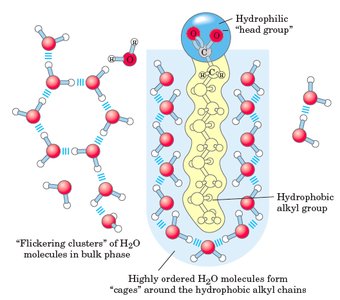
Hydrophobic Effect: Nonpolar molecules aggregate in water to minimize disruption of hydrogen bonding among water molecules.
Classification of Molecules by Polarity
Molecules can be classified as polar, nonpolar, or amphipathic based on their interaction with water.
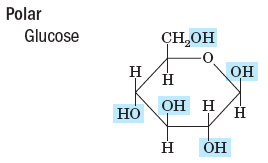
Polar: Molecules like glucose dissolve readily in water due to their many hydroxyl groups.
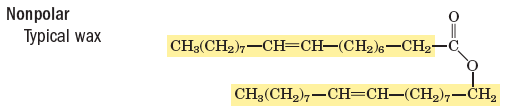
Nonpolar: Molecules such as waxes do not dissolve in water.
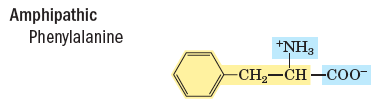
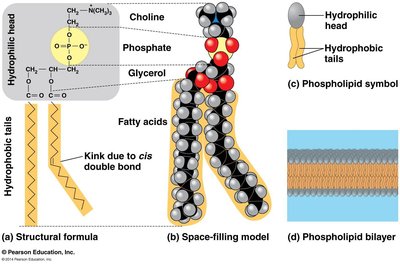
Amphipathic: Molecules like phospholipids contain both hydrophilic and hydrophobic regions, crucial for membrane structure.
Acids, Bases, and pH
Ionization of Water
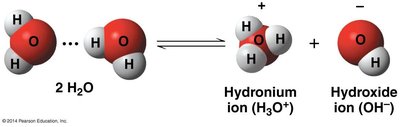
Water can undergo autoionization, producing hydronium (H3O+) and hydroxide (OH−) ions. This equilibrium is fundamental to understanding acids, bases, and pH in biological systems.
Equilibrium Expression:
Ionic Product of Water (Kw): at 25°C
pH Scale
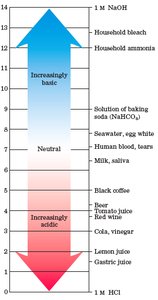
The pH scale quantifies the concentration of hydrogen ions in solution, providing a measure of acidity or alkalinity.
Definition:
Neutral Solution: [H+] = 1 × 10⁻⁷ M, pH = 7
Acidic Solution: pH < 7
Basic Solution: pH > 7
![Calculation of pH from [H+]](https://static.studychannel.pearsonprd.tech/study_guide_files/biochemistry/sub_images/0f07038e_image_30.png)
Acids, Bases, and Conjugate Pairs
Acids are proton donors, and bases are proton acceptors. Each acid has a conjugate base, and each base has a conjugate acid. The strength of an acid is given by its dissociation constant (Ka), and the tendency to lose a proton is reflected in its pKa value.
Acid Dissociation:
pKa:
Relationship: The lower the pKa, the stronger the acid.

Biological Importance of pH
Maintaining a stable pH is essential for proper cellular function. Deviations from normal pH can lead to conditions such as acidosis (low blood pH) or alkalosis (high blood pH), both of which can be life-threatening.
Diagnostic Tool: Measurement of blood and urine pH is commonly used in medical diagnostics.
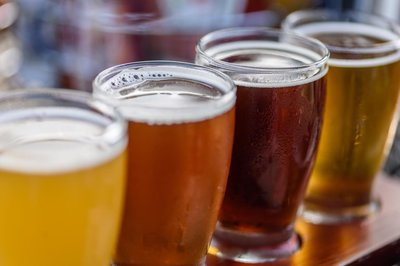
Examples: Lemon juice (pH 2) is much more acidic than beer (pH 4); a difference of 2 pH units means a 100-fold difference in [H+].



Buffers and pH Regulation
Buffer Systems
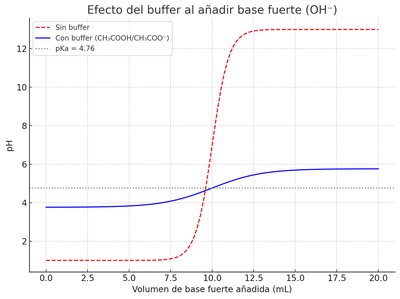
A buffer is an aqueous system that resists changes in pH when small amounts of acid or base are added. Buffers are typically composed of a weak acid and its conjugate base.
Mechanism: Buffers work by neutralizing added H+ or OH− ions, maintaining pH stability.
Biological Buffers: The bicarbonate buffer system in blood is a key example.

Henderson-Hasselbalch Equation
The Henderson-Hasselbalch equation relates the pH of a buffer solution to the concentration of acid and conjugate base and the acid's pKa value.
Equation:
Application: Used to calculate the pH of buffer solutions and to design buffers for specific pH ranges.
Example Calculation: For a buffer with 0.1 M acetic acid and 0.6 M acetate, :
pKa = 4.7
pH = 4.7 + log(0.6/0.1) = 4.7 + 0.78 = 5.48
Buffer Capacity and Titration Curves
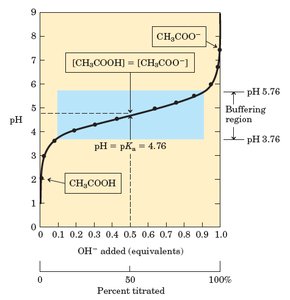
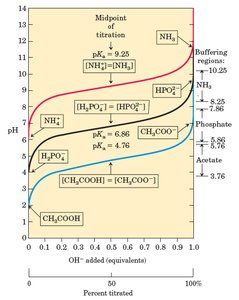
Buffer capacity is greatest when pH ≈ pKa. Titration curves illustrate how buffers resist changes in pH upon addition of acid or base.
Buffering Region: The flat region of a titration curve where the buffer is most effective.
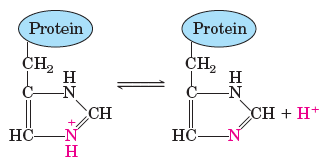
Biological Example: Histidine, an amino acid with a pKa near physiological pH, acts as a buffer in proteins.
Bicarbonate Buffer System in Blood
The bicarbonate buffer system is crucial for maintaining blood pH. It involves the equilibrium between carbonic acid (H2CO3), bicarbonate (HCO3−), and carbon dioxide (CO2).
Equilibrium:
Regulation: The lungs and kidneys help regulate blood pH by controlling CO2 and HCO3− levels.
Summary Table: The pH Scale
[H+] (M) | pH | [OH−] (M) | pOH |
|---|---|---|---|
100 (1) | 0 | 10−14 | 14 |
10−1 | 1 | 10−13 | 13 |
10−2 | 2 | 10−12 | 12 |
10−3 | 3 | 10−11 | 11 |
10−4 | 4 | 10−10 | 10 |
10−5 | 5 | 10−9 | 9 |
10−6 | 6 | 10−8 | 8 |
10−7 | 7 | 10−7 | 7 |
10−8 | 8 | 10−6 | 6 |
10−9 | 9 | 10−5 | 5 |
10−10 | 10 | 10−4 | 4 |
10−11 | 11 | 10−3 | 3 |
10−12 | 12 | 10−2 | 2 |
10−13 | 13 | 10−1 | 1 |
10−14 | 14 | 100 (1) | 0 |
Key Equations
Ionic Product of Water:
pH:
pOH:
Relationship:
Henderson-Hasselbalch Equation:
