 뒤로
Animal Diversity and Evolution: Body Plans, Development, and Phylogeny
스터디 가이드 - 스마트 노트
 자료에 맞춘 맞춤형 노트, 핵심 정의, 예시, 맥락을 확장해 제공합니다.
Overview of the Animal Kingdom
Animal Diversity and Characteristics
The animal kingdom encompasses a vast array of species, with estimates ranging from 1.5 to 2.2 million identified extant species and possibly 8–10 million in total. Most animals are mobile and utilize adaptations such as strength, speed, toxins, or camouflage to detect, capture, and consume other organisms. Animals are defined as multicellular, heterotrophic eukaryotes with tissues that develop from embryonic layers.
Heterotrophs: Animals ingest their food, unlike plants and fungi.
Mobility: Most animals are capable of movement at some stage of their life cycle.
Unique Tissues: Nervous and muscle tissues are defining features of animals.
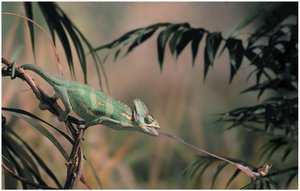
Example: The chameleon uses its long, sticky tongue to capture insect prey, demonstrating animal adaptations for predation.
Animal Cell Structure and Specialization
Cellular Features
Animal cells lack cell walls and are held together by structural proteins such as collagen. Tissues are groups of cells with a common structure or function, and their organization is a key feature distinguishing animals from other life forms.
Multicellularity: All animals are composed of multiple cells.
Structural Proteins: Collagen provides support and cohesion.
Tissues: Specialized groups of cells performing specific functions.
Reproduction and Development in Animals
Embryonic Development
Most animals reproduce sexually, with the diploid stage dominating the life cycle. Fertilization produces a zygote, which undergoes rapid cell division (cleavage), forming a multicellular, hollow blastula. The blastula then undergoes gastrulation, resulting in a gastrula with distinct embryonic tissue layers.
Cleavage: Rapid mitotic divisions of the zygote.
Blastula: Hollow ball of cells formed after cleavage.
Gastrulation: Formation of embryonic layers: ectoderm (outer), endoderm (inner).
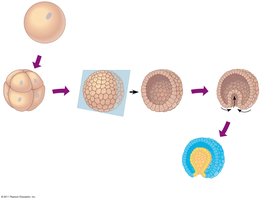
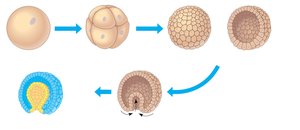
Additional info: The endoderm forms the lining of the digestive tract, while the ectoderm forms the outer covering and, in some animals, the nervous system.
Larval Stages and Metamorphosis
Many animals have a larval stage, which is sexually immature and morphologically distinct from the adult. Metamorphosis transforms the larva into a juvenile, which resembles the adult but is not yet sexually mature.
Hox Genes and Animal Morphology
All animals possess Hox genes, which regulate the development of body form. These highly conserved genes control the body plan along the head-tail axis and determine segmental identity, contributing to the diversity of animal morphology.
Hox Genes: Master regulators of body plan development.
Segmental Identity: Hox proteins specify appendages and vertebrae types.
History and Evolution of Animals
Origins and Fossil Evidence
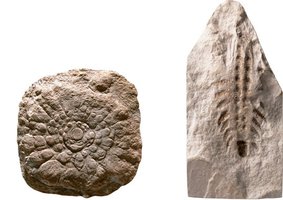
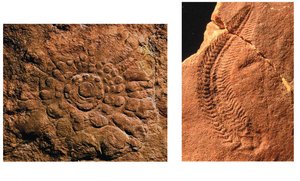
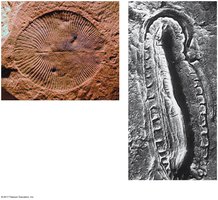
The animal kingdom includes both living and extinct species. The common ancestor of living animals likely arose around 770 million years ago, resembling modern choanoflagellates. Early animal fossils from the Neoproterozoic Era include the Ediacaran fauna, which were mostly radially symmetrical, sessile, and soft-bodied.
Choanoflagellates: Closest living relatives to animals.
Ediacaran Fauna: Early animal fossils with simple body forms.
Cambrian Explosion and Animal Diversification
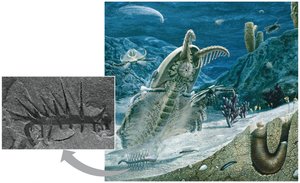
The Cambrian explosion (535–525 million years ago) marks the earliest fossil appearance of many major animal groups. Most Cambrian fossils are bilaterians, characterized by bilateral symmetry and a complete digestive tract. Adaptive radiation during this period led to rapid diversification.
Bilaterians: Animals with bilateral symmetry and a one-way digestive system.
Adaptive Radiation: Rapid diversification in response to environmental changes.
Major Eras in Animal Evolution
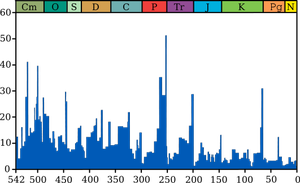
Animal diversity increased through the Paleozoic, Mesozoic, and Cenozoic eras, punctuated by mass extinctions. The Permian extinction eliminated over 95% of marine and 70% of terrestrial species. The Mesozoic era saw the rise of dinosaurs and mammals, while the Cenozoic era led to the diversification of modern mammals and insects.
Paleozoic Era: First land animals and vertebrates.
Mesozoic Era: Dominance of dinosaurs, emergence of mammals.
Cenozoic Era: Diversification of mammals and insects.
Animal Body Plans
Symmetry
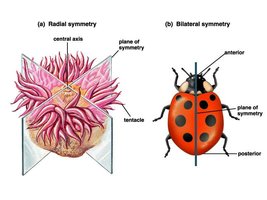
Animals are categorized by body symmetry, which often correlates with lifestyle. Radially symmetrical animals are typically sessile or planktonic, while bilaterally symmetrical animals are active movers with a central nervous system.
Radial Symmetry: Multiple planes of symmetry; suited for sessile or drifting lifestyles.
Bilateral Symmetry: Single plane of symmetry; associated with cephalization and active movement.
Tissues and Germ Layers
Animal body plans vary based on tissue organization. During development, three germ layers give rise to tissues and organs: ectoderm, endoderm, and mesoderm. Sponges lack true tissues, while diploblastic animals have two layers and triploblastic animals have three.
Ectoderm: Forms outer covering and nervous system.
Endoderm: Forms digestive tract and associated organs.
Mesoderm: Forms muscles and other internal organs.
Body Cavities
Most triploblastic animals possess a body cavity (coelom) derived from mesoderm. The presence and type of body cavity are used to classify animals as coelomates, pseudocoelomates, or acoelomates.
Coelom: True body cavity surrounded by mesoderm.
Pseudocoelom: Body cavity derived from mesoderm and endoderm.
Acoelomate: No body cavity.
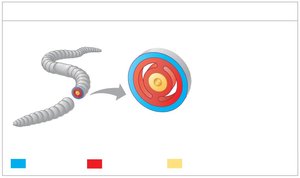
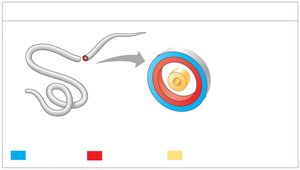
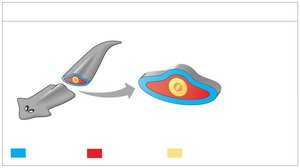
Additional info: Body cavities cushion organs, allow internal organs to grow independently, and can serve as hydrostatic skeletons.
Protostome and Deuterostome Development
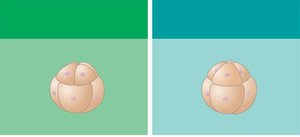
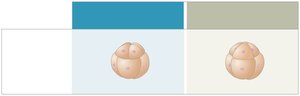
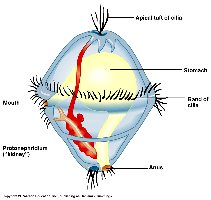
Animals are further classified by their developmental mode: protostome or deuterostome. These modes differ in cleavage patterns, coelom formation, and the fate of the blastopore.
Protostome: Spiral, determinate cleavage; coelom forms by splitting mesoderm (schizocoelous); blastopore becomes mouth.
Deuterostome: Radial, indeterminate cleavage; coelom forms from mesodermal outpocketings (enterocoelous); blastopore becomes anus.

Equation:
Animal Phylogeny and Classification
Modern Phylogenetic Views
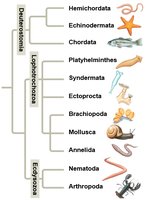
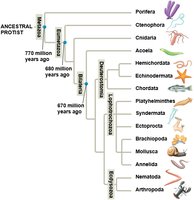
Animal phylogeny is based on morphological, molecular, and fossil data. All animals share a common ancestor, with sponges as the sister group to all other animals. Eumetazoa is a clade of animals with true tissues, and most animal phyla belong to Bilateria.
Bilateria: Divided into Deuterostomia, Ecdysozoa, and Lophotrochozoa.
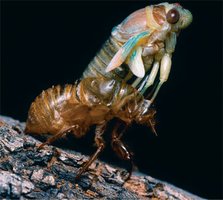
Ecdysozoa: Invertebrates that shed their exoskeletons (ecdysis).
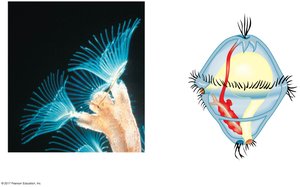
Lophotrochozoa: Invertebrates with lophophore feeding structures or trochophore larvae.
Practice Questions
What do animals ranging from corals to monkeys have in common? Presence of Hox genes
An organism with a head and sensory equipment is likely bilaterally symmetrical.
The primary difference between a coelom and a pseudocoelom is their developmental origin.
Radial and indeterminate cleavage allows for identical twins and embryonic stem cells.
To distinguish protostome from deuterostome, observe spiral or radial cleavage.
The "tube-within-a-tube" body plan features mouth and anus at opposite ends of the inner tube.
Early selective advantage of a coelom: hydrostatic skeleton for greater range of motion.
True/False:
Annelids shed their exoskeleton. False
Nematodes produce a trochophore larva. False
Arthropods undergo ecdysis. True
Clams possess a lophophore. True
Flatworms (Platyhelminthes) have a coelom that originates from splits in pockets of mesoderm. False
