 뒤로
뒤로Animal Diversity: Phylogeny and Major Invertebrate Phyla
스터디 가이드 - 스마트 노트
 자료에 맞춘 맞춤형 노트, 핵심 정의, 예시, 맥락을 확장해 제공합니다.
Animal Diversity and Phylogeny
Overview of Animal Phylogeny
The animal kingdom, Animalia, is a diverse group of multicellular, eukaryotic organisms. All animals share a common ancestor and are classified based on evolutionary relationships, body plans, and developmental characteristics. The major groups within Animalia include Porifera, Ctenophora, Cnidaria, Lophotrochozoa, Ecdysozoa, and Deuterostomia.
Poriferans (sponges) are the sister group to all other animals.
Eumetazoans possess true tissue layers.
Most animals are Bilaterians, characterized by bilateral symmetry and three tissue layers.
Bilaterians include Deuterostomia, Lophotrochozoa, and Ecdysozoa.
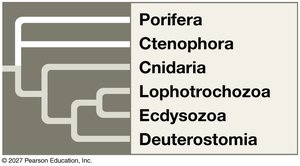
Key Features Unifying Animal Kingdom
Animals are defined by several unifying features:
Multicellularity: Composed of multiple cells with specialized functions.
Heterotrophy: Obtain energy by consuming other organisms.
Motility: Most animals can move at some stage of their life cycle.
Development from a blastula: Unique embryonic stage.
Absence of cell walls: Unlike plants and fungi.
Animals belong to the supergroup Opisthokonta within Eukaryotes, which also includes fungi.
Major Invertebrate Phyla
Porifera (Sponges)
Porifera are simple, aquatic animals lacking true tissues and organs. They are asymmetrical and have a porous body structure.
Tissues: None; cellular level of organization.
Symmetry: Asymmetrical.
Digestive system: None; filter feeders.
Example: Sponges.
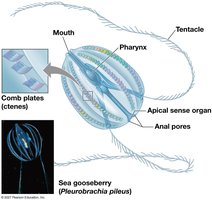
Ctenophora (Comb Jellies)
Ctenophores are marine animals characterized by rows of ciliary plates (ctenes) used for locomotion. They possess a simple digestive system and are often bioluminescent.
Tissues: True tissues.
Symmetry: Radial.
Digestive system: Complete digestive tract.
Example: Sea gooseberry (Pleurobrachia pileus).
Cnidaria
Cnidarians are aquatic animals with radial symmetry and specialized stinging cells called cnidocytes. They include jellyfish, corals, and sea anemones.
Tissues: True tissues (diploblastic).
Symmetry: Radial.
Digestive system: Gastrovascular cavity (incomplete digestive system).
Lophotrochozoa
Lophotrochozoa is a clade of bilaterian animals that includes several phyla, such as Mollusca and Annelida. Members often have a lophophore (feeding structure) or trochophore larva.
Symmetry: Bilateral.
Coelom: True coelom (body cavity).
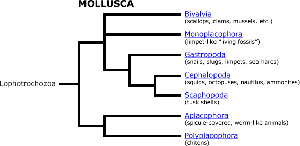
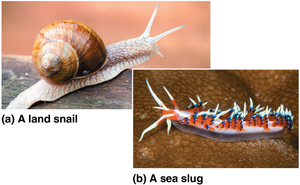
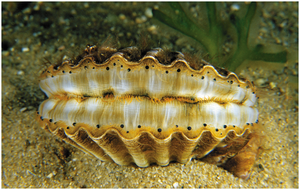
Phylum Mollusca
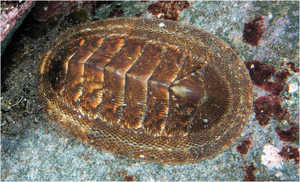
Mollusca is the second most diverse animal phylum, with over 100,000 species. Molluscs are characterized by a soft body, often protected by a hard shell.
Symmetry: Bilateral.
Special features: Foot (movement), mantle (shell secretion), visceral mass (internal organs).
Major classes: Bivalvia, Gastropoda, Cephalopoda, Polyplacophora, Scaphopoda.
Ecdysozoa
Ecdysozoa is a clade of animals that grow by molting their exoskeleton (ecdysis). This group includes nematodes and arthropods.
Defining feature: Ecdysis (molting).
Symmetry: Bilateral.
Coelom: True coelom.
Phylum Arthropoda
Arthropoda is the most diverse animal phylum, with over 1 million described species. Arthropods have jointed appendages and an exoskeleton made of chitin and protein.
Symmetry: Bilateral.
Coelom: True coelom.
Defining characteristics: Jointed appendages, exoskeleton, segmented body.
Major groups: Chelicerates (spiders, scorpions), Myriapods (centipedes, millipedes), Crustaceans (crabs, lobsters), Insects.
Deuterostomia
Deuterostomia is a clade of bilaterian animals characterized by deuterostome development (the blastopore becomes the anus). This group includes echinoderms and chordates.
Phylum Echinodermata
Echinoderms are marine animals with a unique water vascular system and tube feet. They exhibit radial symmetry as adults and have a coelom.
Symmetry: Radial (adults), bilateral (larvae).
Coelom: True coelom.
Defining features: Water vascular system, tube feet.
Evolutionary Trends in Animalia
Trends and Derived Features
Evolutionary trends in animals include the development of tissues, symmetry, body cavities, and segmentation. These features are used to classify animals and understand their evolutionary relationships.
Tissue development: From no tissues (Porifera) to true tissues (Eumetazoa).
Symmetry: Asymmetry (Porifera), radial (Cnidaria, Ctenophora), bilateral (Bilateria).
Body cavity: Acoelomate, pseudocoelomate, coelomate.
Segmentation: Present in some groups (e.g., annelids, arthropods).
Animalia in the Tree of Life
Kingdom Animalia is placed within the domain Eukarya and supergroup Opisthokonta. Animals are closely related to fungi and are distinct from plants and protists.
Domain | Kingdom | Supergroup |
|---|---|---|
Eukarya | Animalia | Opisthokonta |
Summary Table: Major Animal Groups
Group | Tissues | Symmetry | Digestive System | Special Features |
|---|---|---|---|---|
Porifera | No | Asymmetrical | None | Porous body |
Ctenophora | Yes | Radial | Complete | Ciliary plates |
Cnidaria | Yes | Radial | Gastrovascular cavity | Cnidocytes |
Lophotrochozoa (Mollusca) | Yes | Bilateral | Complete | Foot, mantle, visceral mass |
Ecdysozoa (Arthropoda) | Yes | Bilateral | Complete | Exoskeleton, jointed appendages |
Deuterostomia (Echinodermata) | Yes | Radial (adult) | Complete | Water vascular system |
Review Questions
What features unify the organisms within the Animal Kingdom?
How are major animal groups classified in the phylogenetic tree?
What are the evolutionary trends observed in Kingdom Animalia?
How do the defining characteristics of each phylum relate to their evolutionary significance?
