 뒤로
Balancing Chemical Equations – Step-by-Step Guidance
스터디 가이드 - 스마트 노트
 자료에 맞춘 맞춤형 노트, 핵심 정의, 예시, 맥락을 확장해 제공합니다.
Q1. Balance the equation: H2 + O2 → H2O
Background
Topic: Chemical Reactions & Stoichiometry
This question tests your understanding of how to balance chemical equations, which is essential for representing chemical reactions accurately. Balancing equations ensures the law of conservation of mass is followed, meaning the number of atoms for each element is the same on both sides of the equation.
Key Terms and Formulas:
Reactants: Substances present before the reaction (H2, O2)
Products: Substances formed after the reaction (H2O)
Coefficient: The number placed in front of a compound to indicate the number of molecules or moles.
Step-by-Step Guidance
Write the unbalanced equation:
Count the number of hydrogen and oxygen atoms on each side.
Adjust coefficients to balance hydrogen atoms first.
Next, adjust coefficients to balance oxygen atoms.
Check that all atoms are balanced and that coefficients are the smallest whole numbers.
Try solving on your own before revealing the answer!
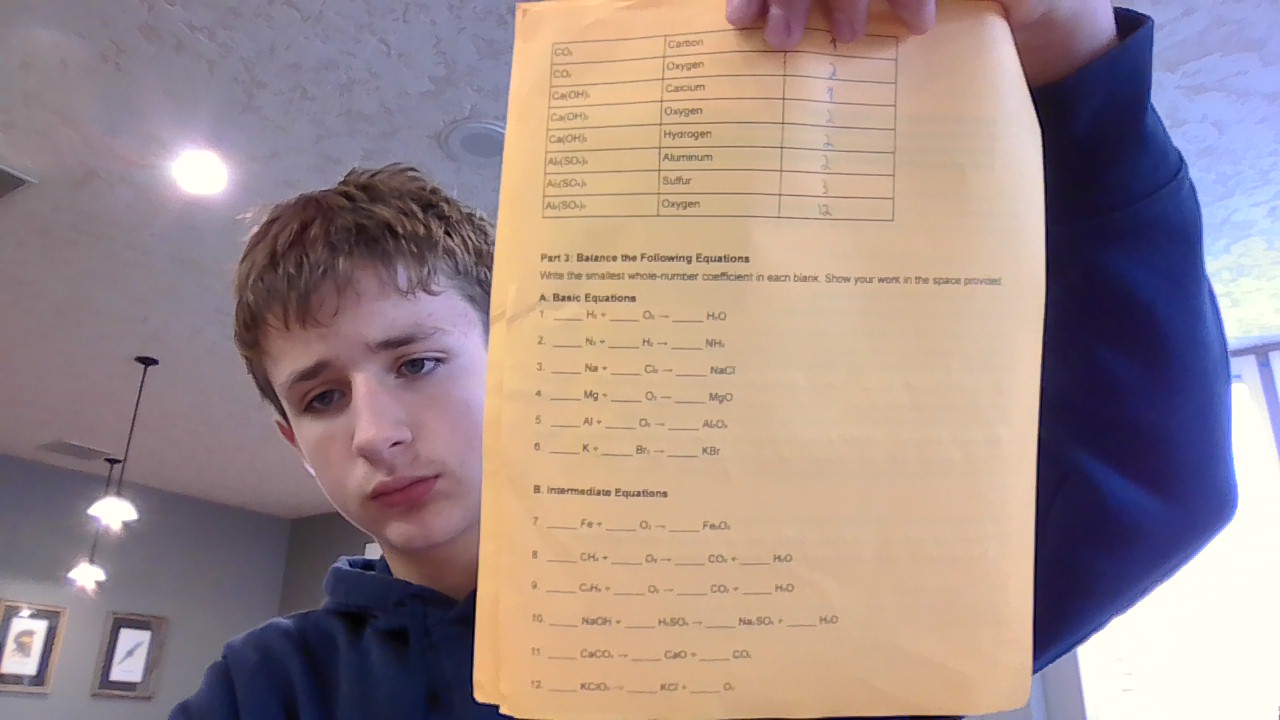
Final Answer: 2H2 + O2 → 2H2O
By placing a coefficient of 2 in front of H2 and H2O, both hydrogen and oxygen atoms are balanced on each side of the equation.
Q2. Balance the equation: N2 + H2 → NH3
Background
Topic: Chemical Reactions & Stoichiometry
This question is about balancing the synthesis reaction of ammonia, a classic example in chemistry.
Key Terms and Formulas:
Synthesis Reaction: Two or more reactants combine to form a single product.
Balancing: Ensuring equal numbers of each atom on both sides.
Step-by-Step Guidance
Write the unbalanced equation:
Count nitrogen and hydrogen atoms on both sides.
Adjust the coefficient for NH3 to balance nitrogen atoms.
Adjust the coefficient for H2 to balance hydrogen atoms.
Verify that all atoms are balanced and coefficients are the smallest whole numbers.
Try solving on your own before revealing the answer!
Final Answer: N2 + 3H2 → 2NH3
By placing a coefficient of 2 in front of NH3 and 3 in front of H2, both nitrogen and hydrogen atoms are balanced.
Q3. Balance the equation: Na + Cl2 → NaCl
Background
Topic: Chemical Reactions & Stoichiometry
This question tests your ability to balance a simple synthesis reaction involving sodium and chlorine.
Key Terms and Formulas:
Reactants: Na, Cl2
Product: NaCl
Step-by-Step Guidance
Write the unbalanced equation:
Count sodium and chlorine atoms on both sides.
Adjust the coefficient for NaCl to balance chlorine atoms.
Adjust the coefficient for Na to balance sodium atoms.
Check that all atoms are balanced and coefficients are the smallest whole numbers.
Try solving on your own before revealing the answer!
Final Answer: 2Na + Cl2 → 2NaCl
By placing a coefficient of 2 in front of Na and NaCl, both sodium and chlorine atoms are balanced.
Q4. Balance the equation: Mg + O2 → MgO
Background
Topic: Chemical Reactions & Stoichiometry
This question is about balancing a reaction between magnesium and oxygen to form magnesium oxide.
Key Terms and Formulas:
Reactants: Mg, O2
Product: MgO
Step-by-Step Guidance
Write the unbalanced equation:
Count magnesium and oxygen atoms on both sides.
Adjust the coefficient for MgO to balance oxygen atoms.
Adjust the coefficient for Mg to balance magnesium atoms.
Check that all atoms are balanced and coefficients are the smallest whole numbers.
Try solving on your own before revealing the answer!
Final Answer: 2Mg + O2 → 2MgO
By placing a coefficient of 2 in front of Mg and MgO, both magnesium and oxygen atoms are balanced.
Q5. Balance the equation: Al + O2 → Al2O3
Background
Topic: Chemical Reactions & Stoichiometry
This question tests your ability to balance a reaction between aluminum and oxygen to form aluminum oxide.
Key Terms and Formulas:
Reactants: Al, O2
Product: Al2O3
Step-by-Step Guidance
Write the unbalanced equation:
Count aluminum and oxygen atoms on both sides.
Adjust the coefficient for Al2O3 to balance aluminum atoms.
Adjust the coefficient for O2 to balance oxygen atoms.
Check that all atoms are balanced and coefficients are the smallest whole numbers.
Try solving on your own before revealing the answer!
Final Answer: 4Al + 3O2 → 2Al2O3
By placing coefficients of 4 for Al, 3 for O2, and 2 for Al2O3, both aluminum and oxygen atoms are balanced.
Q6. Balance the equation: K + Br2 → KBr
Background
Topic: Chemical Reactions & Stoichiometry
This question is about balancing a reaction between potassium and bromine to form potassium bromide.
Key Terms and Formulas:
Reactants: K, Br2
Product: KBr
Step-by-Step Guidance
Write the unbalanced equation:
Count potassium and bromine atoms on both sides.
Adjust the coefficient for KBr to balance bromine atoms.
Adjust the coefficient for K to balance potassium atoms.
Check that all atoms are balanced and coefficients are the smallest whole numbers.
Try solving on your own before revealing the answer!
Final Answer: 2K + Br2 → 2KBr
By placing a coefficient of 2 in front of K and KBr, both potassium and bromine atoms are balanced.
