 뒤로
BIO130T Exam 3 Review: Metabolism, Enzymes, Cellular Respiration, and Photosynthesis
스터디 가이드 - 스마트 노트
 자료에 맞춘 맞춤형 노트, 핵심 정의, 예시, 맥락을 확장해 제공합니다.
Q1. What is a metabolic pathway, and how do enzymes facilitate each step?
Background
Topic: Metabolism and Enzymes
This question is testing your understanding of metabolic pathways and the role of enzymes in catalyzing each step of a pathway. Metabolic pathways are central to cellular function, and enzymes are crucial for regulating the speed and specificity of reactions.
Key Terms and Concepts:
Metabolic pathway: A series of chemical reactions in a cell, where the product of one reaction becomes the substrate for the next.
Enzyme: A protein that speeds up (catalyzes) a specific chemical reaction by lowering the activation energy.
Substrate: The molecule upon which an enzyme acts.
Activation energy (): The minimum energy required to start a chemical reaction.
Key Formula:
Step-by-Step Guidance
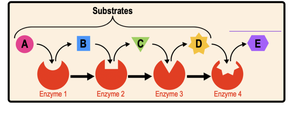
Recognize that a metabolic pathway consists of multiple steps, each catalyzed by a specific enzyme. In the diagram, each substrate (A, B, C, D, E) is transformed by a different enzyme (Enzyme 1, 2, 3, 4).
Understand that the substrate for each step fits into the active site of its corresponding enzyme, forming an enzyme-substrate complex.
Each enzyme lowers the activation energy for its specific reaction, allowing the substrate to be converted into a product efficiently.
The product of one enzyme-catalyzed reaction becomes the substrate for the next enzyme in the pathway, continuing the sequence.
Enzymes are not consumed in the reaction and can be reused for multiple cycles.
Try solving on your own before revealing the answer!
Final Answer:
A metabolic pathway is a series of enzyme-catalyzed reactions where each enzyme transforms a substrate into a product, which then becomes the substrate for the next step. Enzymes facilitate each step by lowering the activation energy, ensuring the pathway proceeds efficiently and specifically. The diagram shows how substrates A, B, C, D, and E are sequentially processed by Enzymes 1–4, illustrating the flow of a metabolic pathway.
This organization allows cells to regulate metabolism, control energy flow, and respond to changing conditions.
