 뒤로
Biological Macromolecules Study Guide – General Biology
스터디 가이드 - 스마트 노트
 자료에 맞춘 맞춤형 노트, 핵심 정의, 예시, 맥락을 확장해 제공합니다.
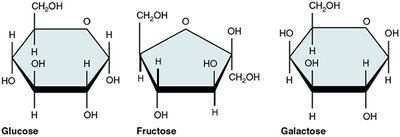
Q11. Examine each of the monosaccharides below identified as hexoses.
Background
Topic: Carbohydrates – Monosaccharides
This question tests your understanding of the structure and properties of monosaccharides, specifically hexoses, and the concept of isomers in biological molecules.
Key Terms and Formulas:
Monosaccharide: The simplest form of carbohydrate, consisting of a single sugar molecule.
Hexose: A monosaccharide with six carbon atoms.
Isomer: Molecules with the same molecular formula but different structural arrangements.
Molecular formula for hexoses:
Step-by-Step Guidance
Observe the structural diagrams of glucose, fructose, and galactose. Notice that each has six carbon atoms, twelve hydrogen atoms, and six oxygen atoms.
Write out the molecular formula for each monosaccharide based on the number of atoms present.
Compare the structures: even though the molecular formula is the same, the arrangement of atoms differs. This is the definition of isomers.
Consider why these molecules are called hexoses: count the carbon atoms in each structure.
To finish, summarize the molecular formula and explain the concept of isomers and hexoses.
Try solving on your own before revealing the answer!
Final Answer:
a) The molecular formula for each of these monosaccharides is .
b) Molecules with the same molecular formula but different structural arrangements are called isomers.
c) These molecules are called hexoses because they each contain six carbon atoms in their sugar structure.
The image shows the structural differences between glucose, fructose, and galactose, even though they share the same formula.
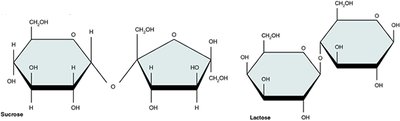
Q15. Identify the monosaccharide monomers in each molecule.
Background
Topic: Carbohydrates – Disaccharides
This question tests your ability to recognize the monosaccharide components that make up common disaccharides such as sucrose and lactose.
Key Terms and Formulas:
Disaccharide: A carbohydrate formed by the joining of two monosaccharides.
Monomer: A single molecule that can join with others to form a polymer.
Sucrose: Common table sugar, made from glucose and fructose.
Lactose: Milk sugar, made from glucose and galactose.
Step-by-Step Guidance
Look at the structural diagrams for sucrose and lactose. Identify the two monosaccharide units in each.
Recall that sucrose is formed from glucose and fructose, while lactose is formed from glucose and galactose.
Examine the bond connecting the two monosaccharides in each disaccharide. This is a glycosidic bond.
Label the monosaccharide monomers for each molecule based on their structure.
Try solving on your own before revealing the answer!
Final Answer:
Sucrose is made from glucose and fructose monomers.
Lactose is made from glucose and galactose monomers.
The image shows the structural arrangement of these monosaccharides in each disaccharide.
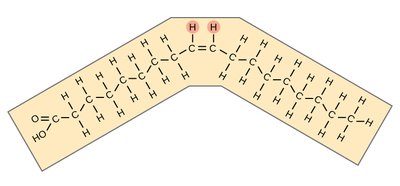
Q27. On the images below, identify the cis and the trans fat.
Background
Topic: Lipids – Fatty Acids
This question tests your understanding of the structural differences between cis and trans unsaturated fatty acids and their biological significance.

Key Terms and Formulas:
Cis fat: Unsaturated fatty acid with hydrogen atoms on the same side of the double bond, causing a bend in the molecule.
Trans fat: Unsaturated fatty acid with hydrogen atoms on opposite sides of the double bond, resulting in a straighter molecule.
Double bond: A chemical bond where two pairs of electrons are shared between atoms.
Step-by-Step Guidance
Examine the two fatty acid structures. Notice the position of the hydrogen atoms around the double bond.
Identify which structure is bent and which is straight. The bent structure is characteristic of cis fats, while the straight structure is typical of trans fats.
Label the left and right images as trans and cis fats, respectively, based on their structural features.
Try solving on your own before revealing the answer!
Final Answer:
The left image is trans fat (straight chain), and the right image is cis fat (bent chain).
Cis fats are healthier because their bent structure prevents tight packing, while trans fats can contribute to health issues.
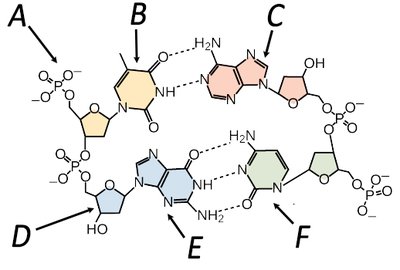
Q50. Label the DNA molecule: A: phosphate, B: thymine, C: adenine, D: 5’, E: guanine, F: cytosine
Background
Topic: Nucleic Acids – DNA Structure
This question tests your ability to identify the components of a DNA molecule, including the phosphate group, nitrogenous bases, and the directionality of the DNA strand.
Key Terms and Formulas:
Phosphate group: Part of the backbone of DNA.
Nitrogenous bases: Thymine, adenine, guanine, cytosine.
5’ (five prime): Indicates the directionality of the DNA strand.
Step-by-Step Guidance
Examine the labeled diagram of the DNA molecule. Identify the phosphate group (A), the nitrogenous bases (B, C, E, F), and the 5’ end (D).
Match each label to its corresponding component in the DNA structure.
Recall the base pairing rules: adenine pairs with thymine, guanine pairs with cytosine.
Label each part based on its position and structure in the diagram.
Try solving on your own before revealing the answer!
Final Answer:
A: Phosphate group
B: Thymine
C: Adenine
D: 5’ (five prime end)
E: Guanine
F: Cytosine
The image shows the labeled components of a DNA molecule, including the backbone and the nitrogenous bases.
