 뒤로
뒤로Cell Communication and Signal Transduction
스터디 가이드 - 스마트 노트
 자료에 맞춘 맞춤형 노트, 핵심 정의, 예시, 맥락을 확장해 제공합니다.
Cell Communication
Introduction to Cell Signaling
Cell signaling is the process by which cells detect and respond to external signals, allowing them to coordinate activities and adapt to changing environments. This process is essential for multicellular organisms, enabling cells to communicate both locally and over long distances.
External signals are converted into specific cellular responses.
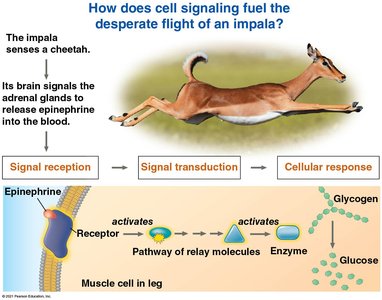
Epinephrine (adrenaline) is a hormone that triggers the breakdown of glycogen in liver and muscle cells, providing energy during stress or danger.
Cells communicate via signaling molecules that target specific cells, which may be adjacent or distant.
Types of Cell Signaling
Local Signaling
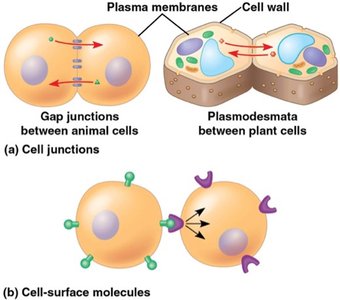
Direct contact: Cells communicate through cell junctions (gap junctions in animals, plasmodesmata in plants) or by cell-surface molecules binding directly.
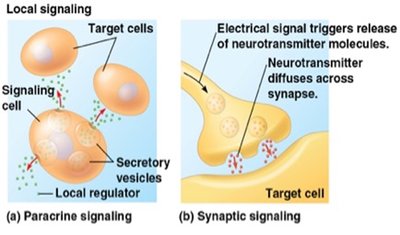
Paracrine signaling: Cells release local regulators that affect nearby target cells (e.g., growth factors).
Synaptic signaling: Neurons release neurotransmitters across synapses to target cells, enabling rapid communication in the nervous system.
Long-Distance Signaling
Hormonal (endocrine) signaling: Specialized cells release hormones into the bloodstream, which travel to distant target cells.
Only cells with the appropriate receptor can respond to a specific hormone.
Classes of Chemical Messengers
Type | Examples | Structure | Solubility | Transport in Blood | Receptor Location |
|---|---|---|---|---|---|
Peptide/Protein | Insulin, glucagon, oxytocin | Chain of amino acids | Water-soluble | Dissolved in plasma | Plasma membrane |
Steroid | Aldosterone, cortisol, estrogen, testosterone | Lipid, four fused rings | Lipid-soluble | Bound to carrier proteins | Intracellular |
Amine | Epinephrine, norepinephrine, thyroid hormone | Modified amino acid | Epinephrine: water-soluble Thyroid hormone: lipid-soluble | Epinephrine: free Thyroid hormone: carrier-bound | Epinephrine: membrane Thyroid hormone: nuclear |
Key idea: A messenger's solubility determines its transport, receptor location, and response type.
Signal Transduction Pathways
The Three Stages of Cell Signaling
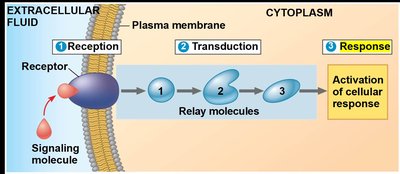
Reception: A signaling molecule (ligand) binds to a receptor protein, usually at the cell surface.
Transduction: The receptor changes shape, initiating a cascade of molecular events (signal transduction pathway).
Response: The transduced signal triggers a specific cellular response.
Reset: Components are switched off so the cell can respond to new signals.
Signal Reception: Receptors
Ligand–receptor binding is highly specific and usually causes a conformational change in the receptor.
Most receptors are plasma membrane proteins, but some are intracellular.
Receptor Type | Location | Ligands |
|---|---|---|
GPCRs (G protein-coupled receptors) | Plasma membrane | Hormones, neurotransmitters |
RTKs (Receptor tyrosine kinases) | Plasma membrane | Growth factors, insulin |
Ion channel receptors | Plasma membrane | Neurotransmitters |
Intracellular receptors | Cytoplasm or nucleus | Steroid and thyroid hormones |
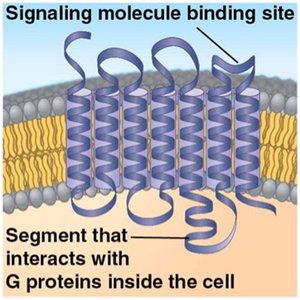
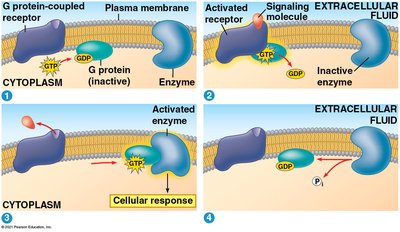
G Protein-Coupled Receptors (GPCRs)
Largest family of cell-surface receptors.
Work with G proteins, which bind GTP (active) or GDP (inactive).
Most water-soluble signals use GPCRs.
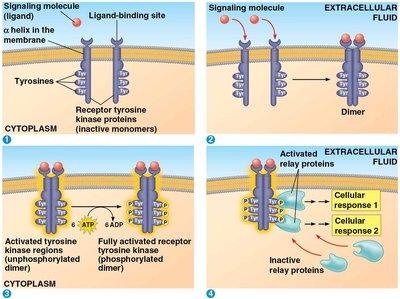
Receptor Tyrosine Kinases (RTKs)
Membrane receptors that transfer phosphate groups from ATP to proteins (phosphorylation).
Can trigger multiple pathways at once; abnormal RTK function is linked to cancer.
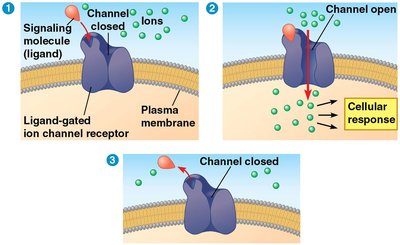
Ligand-Gated Ion Channel Receptors
Act as gates for ions (e.g., Na+, Ca2+).
Open or close in response to ligand binding, causing rapid changes in ion concentration.
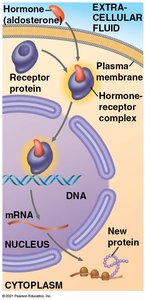
Intracellular Receptors
Located in the cytoplasm or nucleus.
Bind small or hydrophobic messengers (e.g., steroid hormones).
The hormone–receptor complex acts as a transcription factor, regulating gene expression.
Signal Transduction Mechanisms
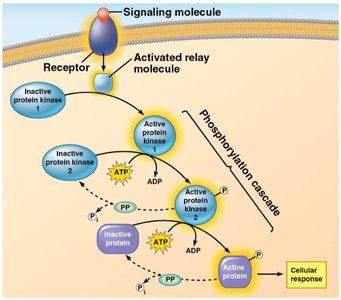
Phosphorylation Cascades
Relay signals via a series of protein kinases, each activating the next by phosphorylation.
Protein phosphatases remove phosphates, turning off the signal.
This molecular switch allows precise control of cellular activities.
Second Messengers
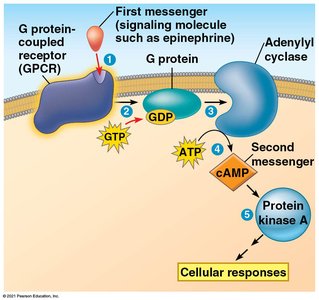
Small, nonprotein, water-soluble molecules or ions that diffuse rapidly and amplify the signal.
Common examples: cyclic AMP (cAMP) and calcium ions (Ca2+).
Adenylyl cyclase converts ATP to cAMP; phosphodiesterase converts cAMP to AMP, terminating the signal.

Cellular Responses to Signals
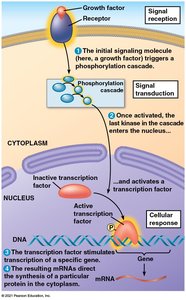
Nuclear Responses
Many pathways regulate gene expression by activating transcription factors in the nucleus.
Example: Growth factors can turn on genes for cell division.
Cytoplasmic Responses
Some signals regulate enzyme activity or other processes in the cytoplasm.
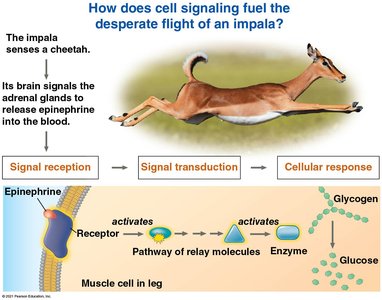
Example: Epinephrine stimulates glycogen breakdown in muscle cells, providing glucose for energy.
Signal Amplification
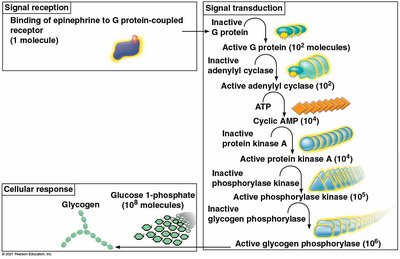
A single signaling molecule can trigger a cascade, resulting in the production of millions of product molecules.
Each step in the pathway amplifies the signal, allowing a small stimulus to have a large effect.
Specificity of Cell Signaling
Only cells with the correct receptor respond to a given signal.
Different cell types may respond differently to the same signal due to variations in their internal proteins.
Example: Epinephrine causes glycogen breakdown in liver cells, increased contraction in heart muscle, and constriction in gut blood vessels.
Resetting the Signal: Termination
To respond to new signals, all activated components must be switched off:
Ligand dissociates from receptor.
G protein hydrolyzes GTP to GDP.
cAMP is degraded to AMP.
Proteins are dephosphorylated by phosphatases.
Ion channels close and ions are pumped out.
The cell returns to its resting state, ready for new signals.
Case Study: Epinephrine Signaling in the Fight-or-Flight Response
When an impala senses a predator, its brain signals the adrenal glands to release epinephrine.
Epinephrine binds to GPCRs on muscle and liver cells, triggering a cascade that results in glycogen breakdown and glucose release for rapid energy.
This process illustrates the principles of signal reception, transduction, amplification, and response.
Insulin Signaling and Diabetes
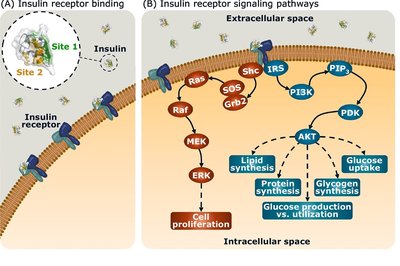
Insulin is a peptide hormone that enables glucose uptake into muscle and liver cells, where it is stored as glycogen.
Diabetes results from insufficient insulin production or improper insulin use, leading to high blood glucose levels.
When glucose is needed, glycogen is hydrolyzed to release glucose for cellular respiration and energy production.
Review Questions
Which would cause the most problems for a cell-signaling pathway involving a G protein-coupled receptor?
A steroid hormone is bound by an intracellular receptor. The resulting complex is most likely to do what?
Which gives the most complete and correct description of a signal transduction pathway?
There is a lack of ATP present as a signal transduction cascade begins to form. How is this process most likely going to be affected?
Additional info: ATP is required for phosphorylation cascades and the production of second messengers like cAMP. Without ATP, signal transduction would be impaired.
