 뒤로
뒤로Cell Communication: Mechanisms and Pathways
스터디 가이드 - 스마트 노트
 자료에 맞춘 맞춤형 노트, 핵심 정의, 예시, 맥락을 확장해 제공합니다.
Cell Communication
Introduction to Cell Signaling
Cell communication is essential for the coordination of cellular activities in multicellular organisms. Cells communicate through signaling pathways that allow them to respond to external and internal cues, ensuring proper development, homeostasis, and adaptation to environmental changes.
Cell signaling involves the transmission of signals from the cell surface to the interior, resulting in a specific cellular response.
Signaling can occur between cells of the same type or different types, and can be local or long-distance.
Evolutionary conservation of signaling mechanisms is observed across diverse organisms, such as yeast and mammals.
Types of Cell Signaling
Direct contact: Cells communicate through direct physical contact, often via cell junctions or cell surface molecules.
Local signaling: Involves secreted messenger molecules that affect nearby cells (e.g., paracrine signaling and synaptic signaling in animals).
Long-distance signaling: Utilizes hormones that travel through the circulatory system to reach target cells (e.g., endocrine signaling).
The Three Stages of Cell Signaling
Cell signaling typically involves three main stages:
Reception: The target cell detects a signaling molecule (ligand) that binds to a receptor protein on the cell surface or inside the cell.
Transduction: The binding of the ligand changes the receptor, initiating a signal transduction pathway, often involving multiple steps and relay molecules.
Response: The transduced signal triggers a specific cellular response, such as gene expression or changes in cell activity.
Signal Reception
Receptors in the Plasma Membrane
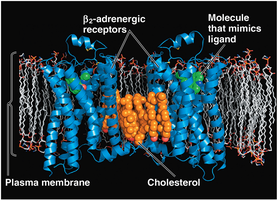
Most signal receptors are proteins located in the plasma membrane. They are highly specific for their ligands and undergo conformational changes upon ligand binding, initiating signal transduction.
G protein-coupled receptors (GPCRs): The largest family of cell-surface receptors. They work with the help of G proteins, which bind GTP and relay signals inside the cell. GPCRs are involved in a wide variety of physiological processes.
Receptor tyrosine kinases (RTKs): Membrane receptors that catalyze the transfer of phosphate groups from ATP to tyrosine residues on target proteins. RTKs can activate multiple signaling pathways simultaneously and are implicated in cancer when dysregulated.
Ligand-gated ion channels: Receptors that act as gates for ions. When a ligand binds, the channel opens or closes, allowing specific ions to pass through the membrane.
Intracellular Receptors
Some receptors are located inside the cell, in the cytoplasm or nucleus. These receptors typically bind small or hydrophobic signaling molecules that can cross the plasma membrane, such as steroid and thyroid hormones. The hormone-receptor complex often acts as a transcription factor, regulating gene expression.
Signal Transduction
Signal Transduction Pathways
Signal transduction involves a cascade of molecular interactions that relay and amplify the signal from the receptor to the final response molecule. Each step often involves a change in protein shape or activity.
Protein phosphorylation and dephosphorylation are key regulatory mechanisms. Protein kinases add phosphate groups to proteins (phosphorylation), while protein phosphatases remove them (dephosphorylation).
This creates a phosphorylation cascade, acting as a molecular switch to turn activities on or off as needed.
Second Messengers
Many signaling pathways use small, nonprotein molecules or ions called second messengers to propagate the signal within the cell. These include:
Cyclic AMP (cAMP): Produced from ATP by adenylyl cyclase in response to extracellular signals. cAMP activates protein kinase A, which phosphorylates various proteins.
Calcium ions (Ca2+): Widely used as a second messenger. Small changes in cytosolic Ca2+ concentration can have large effects. Pathways often involve inositol trisphosphate (IP3) and diacylglycerol (DAG) as additional second messengers.
Cellular Responses to Signals
Regulation of Cellular Responses
The final outcome of cell signaling is the regulation of cellular activities, which may include changes in gene expression, enzyme activity, or cell behavior. The response is not simply "on" or "off" but can be finely tuned by several mechanisms:
Amplification: Enzyme cascades can greatly amplify the signal, resulting in a large cellular response from a small initial signal.
Specificity: Different cells have different collections of proteins, allowing them to respond differently to the same signal.
Scaffolding proteins: These large relay proteins organize other proteins in the pathway, increasing efficiency and specificity.
Termination: Inactivation mechanisms ensure that signaling is temporary and reversible. Unbound receptors revert to an inactive state when the signal is removed.
Apoptosis: Programmed Cell Death
Mechanisms and Importance of Apoptosis
Apoptosis is a form of programmed cell death that is essential for development, maintenance, and defense in multicellular organisms. During apoptosis, cellular components are systematically dismantled and packaged into vesicles for removal, preventing damage to neighboring cells.
Triggered by signals from inside or outside the cell, such as irreparable DNA damage or excessive protein misfolding.
Involves a family of proteases called caspases.
Essential for normal development (e.g., formation of fingers and toes) and prevention of diseases such as cancer.
Summary Table: Types of Cell Surface Receptors
Receptor Type | Main Function | Example Ligands |
|---|---|---|
G protein-coupled receptor (GPCR) | Activates G proteins to relay signals | Epinephrine, neurotransmitters |
Receptor tyrosine kinase (RTK) | Phosphorylates tyrosine residues on target proteins | Growth factors, insulin |
Ligand-gated ion channel | Opens/closes to allow ion flow | Acetylcholine, GABA |
