 뒤로
Cell Cycle, Mitosis, Meiosis, and Mendelian Genetics: Exam 4 Study Guide
스터디 가이드 - 스마트 노트
 자료에 맞춘 맞춤형 노트, 핵심 정의, 예시, 맥락을 확장해 제공합니다.
Cell Cycle and Mitosis
DNA and Chromosome Structure
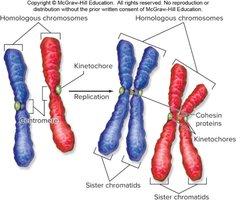
The structure and organization of DNA are fundamental to understanding cell division. DNA is composed of nucleotides and forms chromosomes, which are continuous molecules of DNA associated with histone proteins. Chromosomes can be duplicated or unduplicated, and the difference is crucial during cell division. Sister chromatids are identical copies of a chromosome joined at the centromere. In eukaryotes, DNA is linear and organized into multiple chromosomes, while prokaryotes typically have a single circular chromosome. Chromatin is the relaxed form of DNA found in eukaryotic cells, allowing gene expression; histone proteins help package DNA and regulate access for transcription.
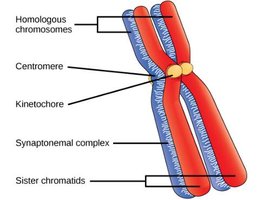
Chromosome: Continuous DNA molecule with associated proteins.
Sister Chromatids: Replicated chromosomes attached at the centromere.
Centromere: Region where sister chromatids are most closely attached.
Kinetochore: Protein structure on the centromere for spindle attachment.
Chromatin: DNA-protein complex allowing gene expression.
The Cell Cycle
The cell cycle is the series of events that cells go through as they grow and divide. It consists of three main stages: Interphase (cell growth and chromosome duplication), Mitotic (M) phase (division of genetic material), and Cytokinesis (division of cytoplasm). Interphase is subdivided into G1 (growth), S (DNA synthesis), and G2 (preparation for division). The G0 phase is a resting state where cells are not actively dividing.
Interphase: G1 (growth), S (DNA replication), G2 (preparation for division).
G0 Phase: Non-dividing state, distinct from G1.
Cell Cycle: Includes mitosis and cytokinesis.
Mitosis: Phases and Events
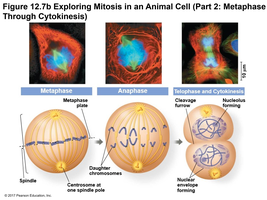
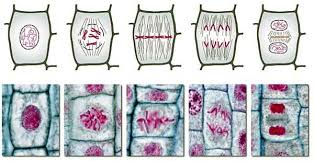
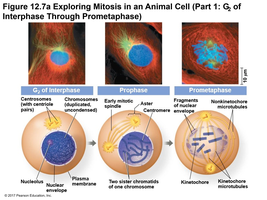
Mitosis is the process by which a cell divides its nucleus and genetic material. It is subdivided into five phases: Prophase, Prometaphase, Metaphase, Anaphase, and Telophase. Each phase is characterized by specific events and changes in chromosome structure and cell organization. Cytokinesis follows mitosis, resulting in two genetically identical daughter cells. The process differs between plant and animal cells: plants form a cell plate, while animals form a cleavage furrow.
Prophase: Chromatin condenses, nucleoli disappear, spindle forms.
Prometaphase: Kinetochores form, spindle attaches, nuclear envelope breaks down.
Metaphase: Chromosomes align at metaphase plate, spindle fibers attach.
Anaphase: Sister chromatids separate and move to opposite poles.
Telophase: Nuclear envelope reforms, chromosomes decondense.
Cytokinesis: Division of cytoplasm; cell plate in plants, cleavage furrow in animals.
Key Definitions
Haploid: Cell with a single set of chromosomes (n).
Diploid: Cell with two sets of chromosomes (2n).
Gametes: Haploid cells (sperm and egg) produced by meiosis.
Control of the Cell Cycle
Cell cycle progression is regulated by checkpoints that ensure accuracy and respond to internal and external signals. The main checkpoints are G1/S (decision to divide), G2/M (commitment to mitosis), and the spindle checkpoint (ensures chromosome attachment). Failure in cell cycle control can lead to cancer, characterized by uncontrolled cell growth and the formation of tumors. Metastasis occurs when malignant tumors spread to other parts of the body.
Checkpoints: G1/S, G2/M, spindle checkpoint.
Cancer: Uncontrolled cell division, loss of normal regulation.
Metastasis: Spread of cancer cells to distant tissues.
Bacterial Cell Division: Binary Fission
Bacteria divide by binary fission, a simpler process than mitosis. Chromosome replication begins, and each copy moves to opposite ends of the cell. The cell elongates, the membrane pinches inward, and two daughter cells are formed, each with a copy of the chromosome.
Binary Fission: Chromosome replication, cell elongation, membrane pinching, daughter cell formation.
Meiosis
Overview and Chromosome Behavior
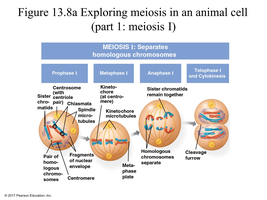
Meiosis is the process by which gametes are produced, reducing chromosome number by half and generating genetic diversity. It consists of two divisions: Meiosis I (separates homologous chromosomes) and Meiosis II (separates sister chromatids). Chromosomes duplicate before meiosis, and crossing over occurs during Prophase I, increasing genetic variation.
Homologous Chromosomes: Chromosome pairs, one from each parent.
Synapsis: Pairing of homologs during Prophase I.
Chiasmata: Sites of crossing over.
Meiosis I: Phases and Events
Meiosis I reduces chromosome number and shuffles genetic information. It includes Prophase I (synapsis and crossing over), Metaphase I (homologs align at metaphase plate), Anaphase I (homologs separate), and Telophase I (formation of haploid cells).
Prophase I: Homologs pair, crossing over occurs.
Metaphase I: Homologs align at metaphase plate.
Anaphase I: Homologs separate, sister chromatids remain attached.
Telophase I: Haploid cells form, chromosomes still duplicated.
Meiosis II: Phases and Events
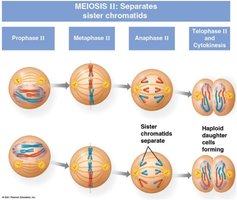
Meiosis II is similar to mitosis, separating sister chromatids to produce four haploid, genetically unique daughter cells. The phases are Prophase II, Metaphase II, Anaphase II, and Telophase II.
Prophase II: Spindle forms, chromosomes move toward metaphase plate.
Metaphase II: Chromatids align at metaphase plate.
Anaphase II: Sister chromatids separate.
Telophase II: Chromosomes decondense, nuclei form, cytokinesis produces haploid cells.
Comparison: Mitosis vs. Meiosis
Feature | Mitosis | Meiosis |
|---|---|---|
Number of divisions | 1 | 2 |
Number of daughter cells | 2 | 4 |
Chromosome number | Diploid (2n) | Haploid (n) |
Genetic identity | Identical | Unique |
Function | Growth, repair | Gamete production |
Mendelian Genetics
Key Terms and Laws
Mendelian genetics explains how traits are inherited through alleles. The Law of Segregation states that each individual has two alleles for each trait, which separate during gamete formation. The Law of Independent Assortment states that alleles of different genes assort independently during meiosis.
Allele: Variant form of a gene.
Genotype: Genetic makeup of an organism.
Phenotype: Observable traits.
Punnett Square: Diagram to predict offspring genotypes and phenotypes.
Monohybrid and Dihybrid Crosses
Monohybrid crosses involve one gene locus; dihybrid crosses involve two. Typical ratios for monohybrid crosses are 3:1 (phenotype) and 1:2:1 (genotype). Dihybrid crosses yield a 9:3:3:1 phenotypic ratio.
Monohybrid Cross: Heterozygous parents for one trait.
Dihybrid Cross: Heterozygous parents for two traits.
Test Cross: Used to determine genotype of dominant phenotype.
Non-Mendelian Inheritance
Incomplete Dominance: Heterozygote phenotype is intermediate (e.g., pink flowers from red and white parents).
Codominance: Both alleles express equally (e.g., AB blood type).
Pleiotropy: One gene affects multiple traits (e.g., sickle-cell disease).
Epistasis: One gene affects expression of another.
Polygenic Traits: Multiple genes contribute to phenotype (e.g., height, skin color).
Pedigrees and Probability
Pedigrees are family trees used to trace inheritance patterns. Probability rules (multiplication and addition) help predict phenotypes in offspring.
Pedigree: Diagram of family relationships and trait inheritance.
Probability: Used to predict likelihood of specific phenotypes.
Additional info: Academic context and expanded explanations were added to ensure completeness and clarity for exam preparation.
