 뒤로
뒤로Cellular Respiration and Fermentation: Chapter 9 Study Guide
스터디 가이드 - 스마트 노트
 자료에 맞춘 맞춤형 노트, 핵심 정의, 예시, 맥락을 확장해 제공합니다.
Cellular Respiration and Fermentation
Overview of Cellular Respiration
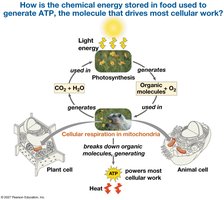
Cellular respiration is a fundamental metabolic pathway by which cells extract energy from organic molecules, primarily glucose, to produce ATP, the main energy currency of the cell. This process occurs in both plant and animal cells and involves a series of redox reactions and energy transformations.
ATP (Adenosine Triphosphate): The molecule that powers most cellular work.
Energy Flow: Energy enters ecosystems as light, is stored in organic molecules via photosynthesis, and is released as heat during cellular respiration.
Cellular Respiration: Occurs in mitochondria, breaking down organic molecules to generate ATP.
Key Waste Products: Carbon dioxide (CO2) and water (H2O).
Catabolic Pathways: Pathways that break down molecules and release energy.

Catabolic Pathways and ATP Production
Catabolic pathways release stored energy by breaking down complex molecules. Cellular respiration includes both aerobic (with oxygen) and anaerobic (without oxygen) processes. Fermentation is a partial degradation of sugars that occurs without oxygen.
Aerobic Respiration: Consumes organic molecules and oxygen, yielding ATP.
Anaerobic Respiration: Similar to aerobic but uses compounds other than oxygen as final electron acceptors.
Fermentation: Occurs without oxygen, producing less ATP.
Redox Reactions: Oxidation and Reduction
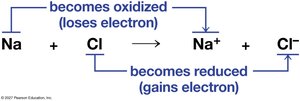
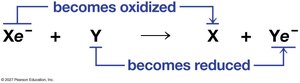
Redox reactions are central to cellular respiration, involving the transfer of electrons between molecules. The loss of electrons is called oxidation, while the gain is called reduction.
Reducing Agent: Electron donor.
Oxidizing Agent: Electron acceptor.
Energy Release: Electrons moving toward more electronegative atoms (like oxygen) release energy.
Oxidation of Organic Fuel Molecules
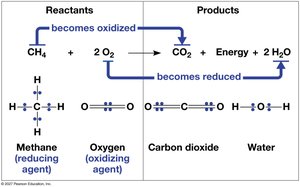
During cellular respiration, glucose is oxidized and oxygen is reduced. Organic molecules rich in hydrogen are excellent sources of high-energy electrons.
Glucose Oxidation: Transfers electrons from a higher energy state to a lower energy state with oxygen atoms, releasing energy for ATP synthesis.

Stepwise Energy Harvest: NAD+ and the Electron Transport Chain
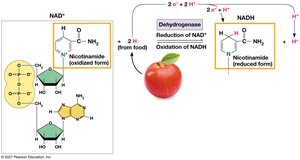
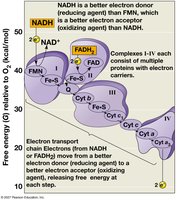
Energy from glucose is harvested in steps, with electrons transferred to carriers like NAD+ before reaching oxygen. NAD+ is a coenzyme functioning as an electron carrier, forming NADH when reduced.
Dehydrogenases: Enzymes that remove hydrogen atoms from substrates and transfer them to NAD+.
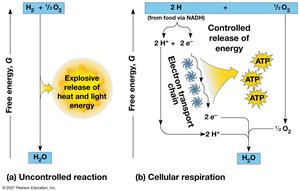
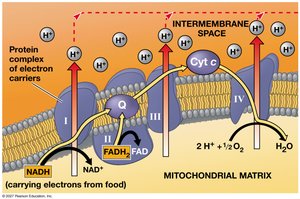
Electron Transport Chain: A series of molecules in the mitochondrial membrane that transfer electrons in a controlled manner, releasing energy for ATP synthesis.

The Stages of Cellular Respiration
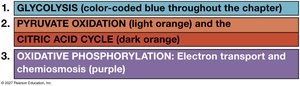
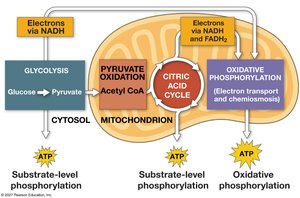
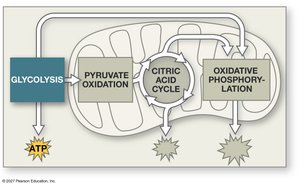
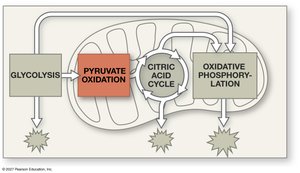
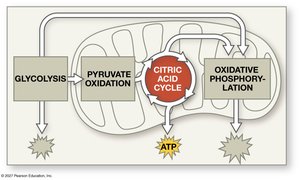
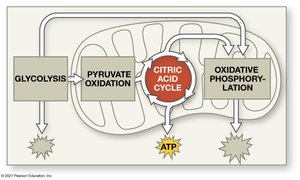
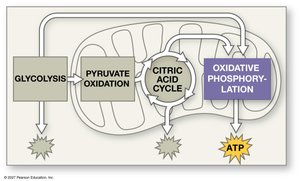
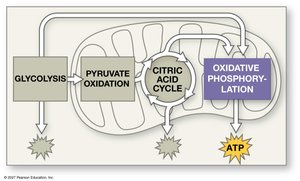
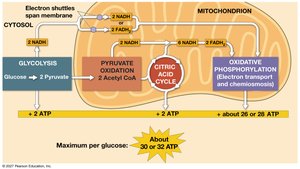
Cellular respiration consists of three main stages: glycolysis, pyruvate oxidation and the citric acid cycle, and oxidative phosphorylation.
Glycolysis: Breaks down glucose into two pyruvate molecules in the cytoplasm.
Pyruvate Oxidation and Citric Acid Cycle: Completes the breakdown of glucose in the mitochondria.
Oxidative Phosphorylation: Electron transport chain and chemiosmosis produce most ATP.
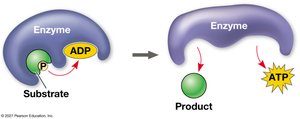
Substrate-Level Phosphorylation: Enzyme transfers a phosphate group directly to ADP.
ATP Yield: Up to 32 ATP per glucose molecule.
Glycolysis
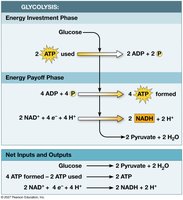
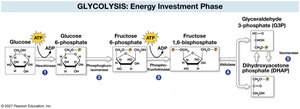
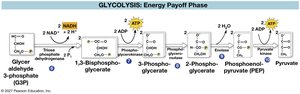
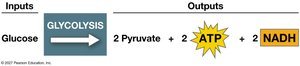
Glycolysis is the first stage of cellular respiration, occurring in the cytoplasm. It consists of two phases: energy investment and energy payoff.
Energy Investment Phase: 2 ATP are used to split glucose.
Energy Payoff Phase: 4 ATP are synthesized, NAD+ is reduced to NADH, and pyruvate is formed.
Net Yield: 2 ATP and 2 NADH per glucose.
Occurs: With or without oxygen.
Pyruvate Oxidation
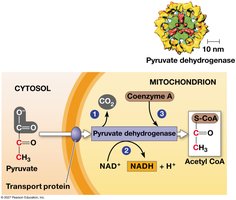
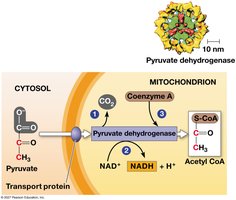
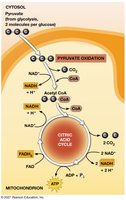
Pyruvate produced by glycolysis is converted to acetyl CoA before entering the citric acid cycle. This process is catalyzed by pyruvate dehydrogenase and involves three reactions.
Oxidation: Releases CO2.
Reduction: NAD+ is reduced to NADH.
Formation: Acetyl CoA is formed from the remaining two-carbon fragment and coenzyme A.
The Citric Acid Cycle (Krebs Cycle)
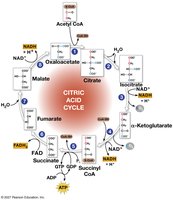
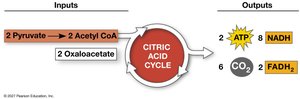
The citric acid cycle completes the oxidation of organic molecules, generating ATP, NADH, and FADH2 per turn. It runs twice per glucose molecule.
Eight Steps: Each catalyzed by a specific enzyme.
First Step: Acetyl group joins with oxaloacetate to form citrate.
Cycle: Citrate is decomposed back to oxaloacetate.
Electron Carriers: NADH and FADH2 carry electrons to the electron transport chain.
Oxidative Phosphorylation and Chemiosmosis
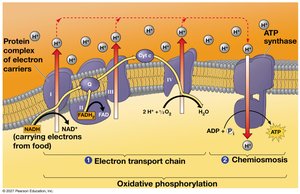
Oxidative phosphorylation is the process by which most ATP is generated, powered by redox reactions. It involves the electron transport chain and chemiosmosis.
Electron Transport Chain: Embedded in the inner mitochondrial membrane, passes electrons through carrier molecules.
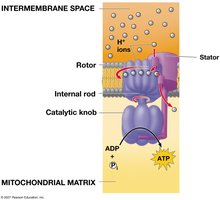
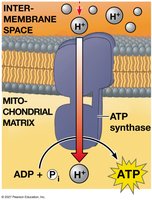
Chemiosmosis: Energy from electron transport is used to pump protons, creating a gradient that drives ATP synthesis via ATP synthase.
Proton-Motive Force: The gradient of protons across the membrane, used to do cellular work.
ATP Yield from Cellular Respiration
Most energy from glucose is transferred to ATP, with about 34% efficiency. The rest is lost as heat. The exact ATP yield varies due to several factors.
Maximum Yield: About 30–32 ATP per glucose.
Factors Affecting Yield: Coupling efficiency, electron shuttle mechanisms, and use of proton-motive force for other work.
Fermentation and Anaerobic Respiration
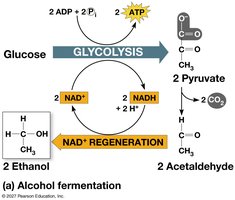
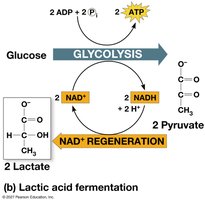
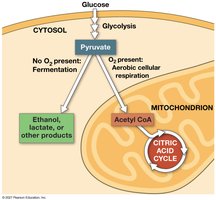
Cells can produce ATP without oxygen by fermentation or anaerobic respiration. Fermentation extends glycolysis by regenerating NAD+ using organic molecules as electron acceptors.
Anaerobic Respiration: Uses electron transport chain with a final electron acceptor other than oxygen.
Fermentation: Two common types are alcohol fermentation and lactic acid fermentation.
Comparing Fermentation, Anaerobic, and Aerobic Respiration
All three processes use glycolysis to oxidize glucose. The main differences are in the mechanisms for oxidizing NADH and the amount of ATP produced.
Fermentation: Organic molecule is final electron acceptor; produces 2 ATP.
Aerobic Respiration: Oxygen is final electron acceptor; produces up to 32 ATP.
Obligate Anaerobes: Cannot survive in presence of oxygen.
Facultative Anaerobes: Can use either fermentation or respiration.
Evolutionary Significance of Glycolysis
Glycolysis is the most widespread metabolic pathway, used by early prokaryotes before oxygen was present in the atmosphere. It remains a central pathway in both fermentation and cellular respiration.
Connections to Other Metabolic Pathways
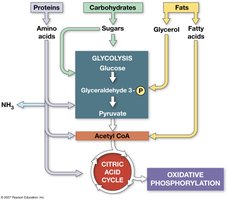
Glycolysis and the citric acid cycle are intersections for various catabolic and anabolic pathways. Catabolic pathways funnel electrons from carbohydrates, proteins, and fats into cellular respiration.
Deamination: Removal of amino groups from proteins used for fuel.
Beta Oxidation: Breakdown of fatty acids to acetyl CoA.
Biosynthesis: Small molecules from food are used to build macromolecules.
Regulation of Cellular Respiration
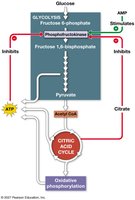
Cellular respiration is regulated by feedback mechanisms, primarily feedback inhibition. Enzyme activity is controlled at strategic points to prevent wasteful production.
Feedback Inhibition: If ATP is abundant, respiration slows; if ATP is low, respiration speeds up.
Enzyme Regulation: Key enzymes are regulated to control catabolic pathways.
Summary Tables
The following tables summarize the key inputs and outputs of glycolysis and the citric acid cycle:
Process | Inputs | Outputs |
|---|---|---|
Glycolysis | Glucose | 2 Pyruvate, 2 ATP, 2 NADH |
Citric Acid Cycle | 2 Pyruvate (as Acetyl CoA), 2 Oxaloacetate | 2 ATP, 8 NADH, 2 FADH2, 6 CO2 |
Key Equations:
Cellular Respiration Overall Equation:
Redox Reaction Example:
Additional info: Some details and context were inferred from standard biology knowledge to ensure completeness and clarity.
