 뒤로
Cellular Respiration and Fermentation: Energy Production in Cells
스터디 가이드 - 스마트 노트
 자료에 맞춘 맞춤형 노트, 핵심 정의, 예시, 맥락을 확장해 제공합니다.
Cellular Respiration and Fermentation
An Introduction to How Cells Produce Energy
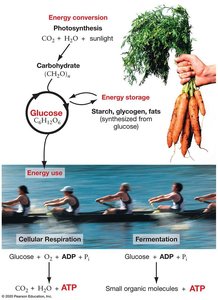
Cells require energy to perform essential functions, and ATP (adenosine triphosphate) is the primary molecule that fuels cellular work. Metabolic pathways harvest energy from high-energy molecules, such as glucose, and use this energy to add a phosphate group to ADP, forming ATP. The process of cellular respiration and fermentation allows cells to efficiently convert energy stored in glucose into usable ATP.
Overview of Cellular Respiration
Cellular respiration is a multi-step process that enables cells to generate ATP from glucose. Most cells continuously produce ATP because it is unstable and cannot be stored for long periods. Plants synthesize glucose during photosynthesis, while other organisms obtain glucose from food. Glucose can be stored as glycogen (in animals) or starch (in plants).

Oxidation of Glucose: Cellular Respiration vs. Fermentation
Glucose oxidation in cells occurs through a series of controlled redox reactions, releasing energy that is used to synthesize ATP. Cellular respiration fully oxidizes glucose, producing more energy than fermentation, which only partially oxidizes glucose and produces small, reduced organic molecules as waste.

Four Processes of Cellular Respiration
Cellular respiration consists of four main processes:
Glycolysis: A six-carbon glucose is broken down into two three-carbon pyruvate molecules.
Pyruvate Processing: Each pyruvate is oxidized to form acetyl CoA.
Citric Acid Cycle: Each acetyl CoA is oxidized to CO2.
Electron Transport and Oxidative Phosphorylation: Electrons move through a transport chain, creating a proton gradient used to make ATP.
Cellular Respiration and Metabolism
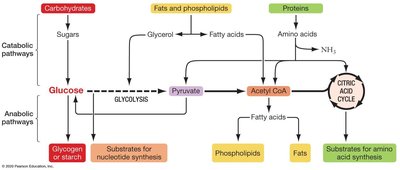
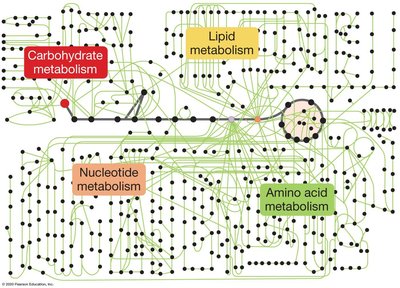
Cellular respiration plays a central role in metabolism, connecting catabolic and anabolic pathways:
Catabolic pathways: Break down molecules to harvest stored chemical energy and produce ATP.
Anabolic pathways: Synthesize larger molecules from smaller components, often using ATP.

Catabolic Pathways: Breakdown of Molecules
Cells use carbohydrates first for ATP production, followed by fats and proteins. Fats are broken down into glycerol (enters glycolysis) and fatty acids (converted to acetyl CoA for the citric acid cycle). Proteins are broken down into amino acids, which are deaminated and converted to intermediates used in glycolysis and the citric acid cycle.
Anabolic Pathways: Synthesis of Macromolecules
Intermediates from cellular respiration are used to synthesize macromolecules:
Glycolysis intermediates for nucleotide synthesis
Acetyl CoA for fatty acid synthesis
Citric acid cycle molecules for amino acid synthesis
Pyruvate for glucose production (glycogen and starch)

Glycolysis: Oxidizing Glucose to Pyruvate
Discovery and Process of Glycolysis
Glycolysis, discovered by Hans and Edward Buchner, is a sequence of 10 reactions occurring in the cytosol. It begins with an energy investment phase (using 2 ATP), followed by an energy payoff phase (producing NADH and ATP by substrate-level phosphorylation). The net yield is 2 NADH, 2 ATP, and 2 pyruvate per glucose molecule.

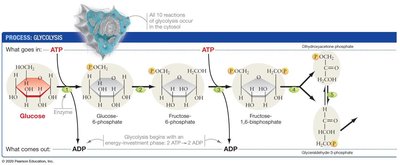
Table: The Reactions of Glycolysis
Step | Enzyme | Reaction |
|---|---|---|
1 | Hexokinase | Uses ATP to phosphorylate glucose, increasing its potential energy. |
2 | Phosphoglucose isomerase | Converts glucose-6-phosphate to fructose-6-phosphate. |
3 | Phosphofructokinase | Uses ATP to phosphorylate fructose-6-phosphate. |
4 | Fructose-bis-phosphate aldolase | Cleaves fructose-1,6-bisphosphate into two 3-carbon sugars. |
5 | Triose phosphate isomerase | Converts dihydroxyacetone phosphate to glyceraldehyde-3-phosphate. |
6 | Glyceraldehyde-3-phosphate dehydrogenase | Oxidizes G3P, produces NADH, and forms 1,3-bisphosphoglycerate. |
7 | Phosphoglycerate kinase | Transfers phosphate to ADP, making ATP and 3-phosphoglycerate. |
8 | Phosphoglycerate mutase | Rearranges phosphate to make 2-phosphoglycerate. |
9 | Enolase | Removes water to form phosphoenolpyruvate. |
10 | Pyruvate kinase | Transfers phosphate to ADP, making pyruvate and ATP. |
Regulation of Glycolysis
Glycolysis is regulated by feedback inhibition. High levels of ATP inhibit phosphofructokinase, the third enzyme in glycolysis. ATP binds to a regulatory site when abundant, inhibiting the enzyme, and to the active site when ATP levels are low, allowing catalysis.

Processing Pyruvate to Acetyl CoA
Mitochondrial Structure and Pyruvate Processing
In eukaryotes, pyruvate produced by glycolysis is transported into mitochondria, which have inner and outer membranes and cristae. Pyruvate is processed by pyruvate dehydrogenase in the mitochondrial matrix (or cytosol in prokaryotes), producing acetyl CoA, NADH, and CO2.
Regulation of Pyruvate Processing
Pyruvate processing is regulated by feedback inhibition. Pyruvate dehydrogenase is inhibited when phosphorylated, especially when NADH, acetyl CoA, or ATP levels are high. It is activated by dephosphorylation when ADP, pyruvate, CoA, or NAD+ levels are high.
The Citric Acid Cycle: Oxidizing Acetyl CoA to CO2
Citric Acid Cycle Process
Each acetyl CoA is oxidized into two CO2 molecules in the citric acid cycle, which occurs in the mitochondrial matrix (eukaryotes) or cytosol (prokaryotes). The cycle starts with acetyl CoA combining with oxaloacetate to form citrate, and oxaloacetate is regenerated at the end.
Table: The Reactions of the Citric Acid Cycle
Step | Enzyme | Reaction |
|---|---|---|
1 | Citrate synthase | Transfers acetyl group to oxaloacetate, forming citrate. |
2 | Aconitase | Converts citrate to isocitrate. |
3 | Isocitrate dehydrogenase | Oxidizes isocitrate, produces NADH, releases CO2. |
4 | α-Ketoglutarate dehydrogenase | Oxidizes α-ketoglutarate, produces NADH, releases CO2, forms succinyl CoA. |
5 | Succinyl-CoA synthetase | Converts succinyl CoA to succinate, produces ATP or GTP. |
6 | Succinate dehydrogenase | Oxidizes succinate, produces FADH2, forms fumarate. |
7 | Fumarase | Converts fumarate to malate. |
8 | Malate dehydrogenase | Oxidizes malate, produces NADH, regenerates oxaloacetate. |
Regulation of the Citric Acid Cycle
The citric acid cycle is regulated by feedback inhibition at multiple points. Reaction rates are high when ATP and NADH are scarce, and low when ATP or NADH is abundant.
Electron Transport and Chemiosmosis: Building a Proton Gradient to Produce ATP
Electron Transport Chain (ETC)
The ETC consists of four protein complexes and two mobile carriers (ubiquinone/Q and cytochrome c). Electrons from NADH and FADH2 are transferred through the chain, releasing energy used to pump protons from the matrix to the intermembrane space, creating a proton gradient.
Table: Components and Reactions of the Electron Transport Chain
ETC Component | Descriptive Name | Reaction |
|---|---|---|
Complex I | NADH dehydrogenase | Oxidizes NADH, reduces Q, pumps 4 H+ out. |
Complex II | Succinate dehydrogenase | Oxidizes FADH2, reduces Q. |
Q | Ubiquinone | Transfers electrons between complexes I/II and III. |
Complex III | Cytochrome c reductase | Oxidizes Q, reduces cytochrome c, pumps 4 H+ out. |
Cytochrome c | Cytochrome c | Transfers electrons between complexes III and IV. |
Complex IV | Cytochrome c oxidase | Oxidizes cytochrome c, reduces O2 to H2O, pumps 2 H+ out. |
ATP Synthase and Chemiosmosis
ATP synthase is the protein complex responsible for synthesizing ATP from ADP and inorganic phosphate, powered by the proton gradient. The process, called chemiosmosis, couples electron transport to ATP synthesis via the proton-motive force.
ATP Yield from Cellular Respiration
Oxidative phosphorylation produces about 29 ATP per glucose molecule, making it the most efficient pathway for ATP production. Most ATP is generated during this stage, compared to substrate-level phosphorylation in glycolysis and the citric acid cycle.
Diversity of Electron Acceptors
All eukaryotes and many prokaryotes use oxygen as the final electron acceptor (aerobic respiration). Some prokaryotes use other acceptors, such as nitrate or sulfate, in anaerobic respiration. Aerobic respiration yields the most energy due to oxygen's high electronegativity.
Fermentation
Fermentation Pathways
When no electron acceptor is available, the ETC stops, and NAD+ must be regenerated for glycolysis to continue. Fermentation is a metabolic pathway that regenerates NAD+ from NADH, allowing glycolysis to produce ATP by substrate-level phosphorylation in the absence of oxygen.
Types of Fermentation
Lactic Acid Fermentation: Pyruvate accepts electrons from NADH, producing lactate and NAD+. Occurs in muscle cells under low oxygen.
Alcohol Fermentation: Pyruvate is converted to acetaldehyde, which accepts electrons from NADH, producing ethanol and NAD+. Occurs in yeast and some bacteria.
Efficiency of Fermentation
Fermentation is much less efficient than cellular respiration, producing only 2 ATP per glucose compared to about 29 ATP in aerobic respiration. Some organisms, called facultative anaerobes, can switch between fermentation and aerobic respiration depending on oxygen availability.
Key Equations
Cellular Respiration:
Lactic Acid Fermentation:
Alcohol Fermentation:
Additional info: The notes expand on the original content by providing definitions, context, and examples for each process, as well as key equations and tables for clarity.
