 뒤로
Cellular Respiration and Fermentation: Energy Production in Cells
스터디 가이드 - 스마트 노트
 자료에 맞춘 맞춤형 노트, 핵심 정의, 예시, 맥락을 확장해 제공합니다.
Cellular Respiration and Fermentation
An Introduction to How Cells Produce Energy
Cells require energy to perform essential functions, and this energy is primarily supplied by ATP (adenosine triphosphate). Metabolic pathways harvest energy from high-energy molecules, such as glucose, and use it to add a phosphate group to ADP, forming ATP. This process is central to cellular metabolism.
ATP fuels cellular work: Used for movement, synthesis, and transport.
Metabolic pathways: Series of enzyme-catalyzed reactions that extract energy from nutrients.
Glucose: Main substrate for ATP production; produced by plants via photosynthesis and obtained by other organisms from food.
Storage: Glucose is stored as glycogen (animals) or starch (plants).
Overview of Cellular Respiration
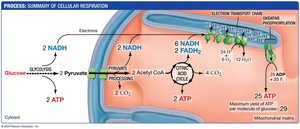
Cellular respiration is a multi-step process that oxidizes glucose to produce ATP. Cells contain only enough ATP for short-term activity, so continuous production is necessary. Cellular respiration consists of four main stages:
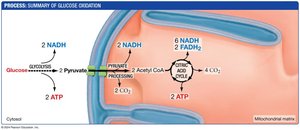
Glycolysis: Glucose is broken down into two pyruvate molecules.
Pyruvate Processing: Pyruvate is oxidized to form acetyl CoA.
Citric Acid Cycle: Acetyl CoA is oxidized to CO2.
Electron Transport and Oxidative Phosphorylation: Electrons move through a transport chain, creating a proton gradient used to make ATP.
Oxidation of Glucose: Cellular Respiration vs. Fermentation
Glucose oxidation can occur via cellular respiration or fermentation:
Cellular respiration: Complete oxidation of glucose, producing CO2, water, and large amounts of ATP.
Fermentation: Partial oxidation, producing small, reduced organic molecules and less ATP.
Energy yield: Cellular respiration is more efficient than fermentation.
Metabolic Pathways: Catabolic and Anabolic Processes
Cellular respiration interacts with other metabolic pathways:
Catabolic pathways: Break down molecules to harvest energy (e.g., carbohydrates, fats, proteins).
Anabolic pathways: Use energy to synthesize larger molecules from smaller ones.
Intermediates: Molecules from glycolysis and the citric acid cycle are used to build nucleotides, amino acids, fatty acids, and glucose.
Regulation of Metabolic Pathways
Metabolic pathways are regulated to maintain homeostasis:
Feedback inhibition: End products inhibit key enzymes to prevent overproduction.
Stable internal environment: Regulation ensures cells adapt to changing conditions.
Glycolysis: Oxidizing Glucose to Pyruvate
Discovery and Process of Glycolysis
Glycolysis is a sequence of 10 reactions occurring in the cytosol. It was discovered by Hans and Edward Buchner in the 1890s. The process involves:
Energy investment phase: Uses 2 ATP (reactions 1–5).
Energy payoff phase: Produces 2 NADH and 4 ATP (reactions 6–10) via substrate-level phosphorylation.
Net yield: 2 NADH, 2 ATP, and 2 pyruvate per glucose.
Regulation of Glycolysis
Glycolysis is regulated by feedback inhibition, primarily at the enzyme phosphofructokinase:
Low ATP: ATP binds to the active site, enzyme catalyzes reaction.
High ATP: ATP binds to regulatory site, inhibiting enzyme activity.
Processing Pyruvate to Acetyl CoA
Mitochondrial Structure and Pyruvate Processing
In eukaryotes, pyruvate is transported into mitochondria, which have inner and outer membranes and a matrix. Pyruvate is processed by pyruvate dehydrogenase:
Location: Mitochondrial matrix (eukaryotes), cytosol (prokaryotes).
Process: One carbon is oxidized to CO2, NADH is produced, and the remaining two-carbon unit is attached to coenzyme A, forming acetyl CoA.
Regulation of Pyruvate Processing
Feedback inhibition: Pyruvate dehydrogenase is inhibited by phosphorylation when NADH, acetyl CoA, or ATP levels are high.
Activation: Dephosphorylation occurs when ADP, pyruvate, CoA, or NAD+ levels are high.
The Citric Acid Cycle: Oxidizing Acetyl CoA to CO2
Citric Acid Cycle Overview
The citric acid cycle (Krebs cycle) oxidizes acetyl CoA to CO2 in the mitochondrial matrix (eukaryotes) or cytosol (prokaryotes). The cycle starts with acetyl CoA combining with oxaloacetate to form citrate and ends with regeneration of oxaloacetate.
Energy yield: Reduces three NAD+ to NADH, one FAD to FADH2, and phosphorylates ADP (or GDP) to ATP (or GTP).
Turns: Cycle turns twice per glucose molecule.
Regulation of the Citric Acid Cycle
Feedback inhibition: Reaction rates are high when ATP and NADH are scarce; low when abundant.
Electron Transport and Chemiosmosis
Electron Transport Chain (ETC)
The ETC consists of four protein complexes and two mobile carriers (ubiquinone/Q and cytochrome c). Electrons from NADH and FADH2 are transferred through the chain, releasing energy used to pump protons across the membrane.
Final electron acceptor: Oxygen, forming water.
Proton gradient: Energy from redox reactions creates a proton electrochemical gradient.
ATP Synthase and Chemiosmosis
ATP synthase is a protein complex that synthesizes ATP from ADP and inorganic phosphate, powered by the proton gradient. This process is called chemiosmosis.
Oxidative phosphorylation: ATP production driven by the proton-motive force.
Yield: About 29 ATP per glucose molecule.
Fermentation: An Alternative Pathway
Fermentation Overview
When oxygen is unavailable, cells use fermentation to regenerate NAD+ from NADH, allowing glycolysis to continue producing ATP by substrate-level phosphorylation.
Lactic acid fermentation: Pyruvate accepts electrons from NADH, forming lactate.
Alcohol fermentation: Pyruvate is converted to acetaldehyde, which accepts electrons from NADH, forming ethanol.
Efficiency: Fermentation yields only 2 ATP per glucose, compared to 29 ATP from cellular respiration.
Facultative anaerobes: Organisms that switch between fermentation and aerobic respiration depending on oxygen availability.
Summary Table: Comparison of Cellular Respiration and Fermentation
Process | Final Electron Acceptor | ATP Yield (per glucose) | End Products |
|---|---|---|---|
Cellular Respiration (Aerobic) | O2 | ~29 | CO2, H2O |
Fermentation (Lactic Acid) | Pyruvate | 2 | Lactate |
Fermentation (Alcohol) | Acetaldehyde | 2 | Ethanol, CO2 |
Key Terms and Concepts
ATP: Main energy currency of the cell.
Glycolysis: First step in glucose oxidation, occurs in cytosol.
Pyruvate: End product of glycolysis, substrate for further oxidation.
Acetyl CoA: Entry molecule for the citric acid cycle.
NADH/FADH2: Electron carriers used in the ETC.
Electron Transport Chain: Series of proteins that transfer electrons and pump protons.
ATP Synthase: Enzyme that synthesizes ATP using the proton gradient.
Fermentation: Anaerobic pathway to regenerate NAD+ and produce ATP.
Important Equations
Overall equation for aerobic cellular respiration:
ATP yield from glucose oxidation:
*Additional info: Academic context and explanations have been expanded for clarity and completeness.*
