뒤로
Cellular Respiration: Glycolysis, Citric Acid Cycle, and Electron Transport Chain
스터디 가이드 - 스마트 노트
 자료에 맞춘 맞춤형 노트, 핵심 정의, 예시, 맥락을 확장해 제공합니다.
Cellular Respiration
Overview of Cellular Respiration
Cellular respiration is the process by which cells extract energy from glucose and other organic molecules. It consists of three main stages: glycolysis, the citric acid cycle (Krebs cycle), and the electron transport chain. Each stage occurs in specific locations within the cell and produces different products essential for cellular energy.
Glycolysis: Occurs in the cytoplasm; breaks down glucose into pyruvate.
Citric Acid Cycle (Krebs Cycle): Occurs in the mitochondrial matrix; oxidizes acetyl-CoA to CO2.
Electron Transport Chain: Occurs in the inner mitochondrial membrane; produces ATP via oxidative phosphorylation.
Glycolysis
Glycolysis is the first step of cellular respiration, where one molecule of glucose is converted into two molecules of pyruvate. This process generates a small amount of ATP and NADH.
Location: Cytoplasm
Reactants: Glucose, 2 ATP, 2 NAD+
Products: 2 Pyruvate, 4 ATP (net gain: 2 ATP), 2 NADH
Key Steps: Energy investment phase (uses ATP), energy payoff phase (produces ATP and NADH)
Equation:
Citric Acid Cycle (Krebs Cycle)
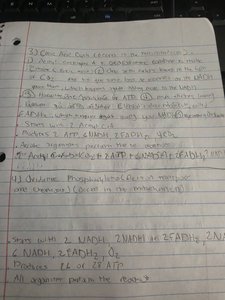
The citric acid cycle completes the breakdown of glucose by oxidizing acetyl-CoA to carbon dioxide. It produces NADH and FADH2 for use in the electron transport chain.
Location: Mitochondrial matrix
Reactants: Acetyl-CoA, NAD+, FAD, ADP
Products: CO2, NADH, FADH2, ATP
Key Steps: Acetyl-CoA combines with oxaloacetate to form citrate; cycle regenerates oxaloacetate
Equation:
Electron Transport Chain and Oxidative Phosphorylation
The electron transport chain uses electrons from NADH and FADH2 to create a proton gradient across the inner mitochondrial membrane. ATP synthase uses this gradient to produce ATP.
Location: Inner mitochondrial membrane
Reactants: NADH, FADH2, O2
Products: ATP, H2O
Key Steps: Electrons transferred through protein complexes; oxygen is the final electron acceptor
Equation:
ATP Yield: Approximately 34 ATP per glucose molecule (from oxidative phosphorylation)
Summary Table: Products of Cellular Respiration
The following table summarizes the products generated at each stage of cellular respiration:
Stage | Location | Main Products |
|---|---|---|
Glycolysis | Cytoplasm | 2 ATP, 2 NADH, 2 Pyruvate |
Citric Acid Cycle | Mitochondrial Matrix | 2 ATP, 6 NADH, 2 FADH2, 4 CO2 |
Electron Transport Chain | Inner Mitochondrial Membrane | ~34 ATP, H2O |
Additional info:
Some organisms perform fermentation instead of oxidative phosphorylation when oxygen is not available. Fermentation produces less ATP and results in products such as lactic acid or ethanol.