뒤로
뒤로Cellular Respiration: Key Steps and Products
스터디 가이드 - 스마트 노트
 자료에 맞춘 맞춤형 노트, 핵심 정의, 예시, 맥락을 확장해 제공합니다.
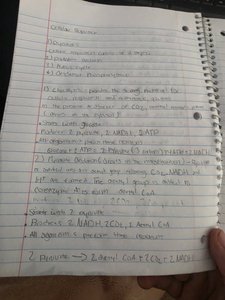
Cellular Respiration
Overview of Cellular Respiration
Cellular respiration is a fundamental metabolic process in which cells convert biochemical energy from nutrients into adenosine triphosphate (ATP), and release waste products. It is essential for the production of energy in all aerobic organisms.
Definition: The process by which cells extract energy from glucose and other organic molecules.
Main Steps: Glycolysis, Pyruvate Oxidation, Citric Acid Cycle (Krebs Cycle), and Electron Transport Chain.
Location: Glycolysis occurs in the cytoplasm; subsequent steps occur in the mitochondria.
Glycolysis
Glycolysis is the first step of cellular respiration, breaking down glucose into pyruvate and generating small amounts of ATP and NADH.
Reactant: Glucose (C6H12O6)
Products: 2 Pyruvate, 2 ATP, 2 NADH
Location: Cytoplasm
Equation:
Pyruvate Oxidation (Link Reaction)
Pyruvate produced in glycolysis is transported into the mitochondria, where it is converted into Acetyl-CoA, releasing CO2 and producing NADH.
Reactant: 2 Pyruvate
Products: 2 Acetyl-CoA, 2 NADH, 2 CO2
Location: Mitochondrial matrix
Equation:
Krebs Cycle (Citric Acid Cycle)
The Krebs cycle is a series of reactions that further oxidize Acetyl-CoA, producing ATP, NADH, FADH2, and CO2.
Reactant: 2 Acetyl-CoA
Products: 2 ATP, 6 NADH, 2 FADH2, 4 CO2
Location: Mitochondrial matrix
Equation:
Electron Transport Chain (ETC) and Oxidative Phosphorylation
The ETC uses electrons from NADH and FADH2 to generate a proton gradient, which drives ATP synthesis. Oxygen is the final electron acceptor, forming water.
Reactants: NADH, FADH2, O2
Products: ATP, H2O
Location: Inner mitochondrial membrane
Equation:
Summary Table: Key Steps and Products of Cellular Respiration
Step | Main Reactants | Main Products | Location |
|---|---|---|---|
Glycolysis | Glucose | 2 Pyruvate, 2 ATP, 2 NADH | Cytoplasm |
Pyruvate Oxidation | 2 Pyruvate | 2 Acetyl-CoA, 2 NADH, 2 CO2 | Mitochondrial matrix |
Krebs Cycle | 2 Acetyl-CoA | 2 ATP, 6 NADH, 2 FADH2, 4 CO2 | Mitochondrial matrix |
Electron Transport Chain | NADH, FADH2, O2 | ATP, H2O | Inner mitochondrial membrane |
Overall Equation for Cellular Respiration
The overall process of cellular respiration can be summarized by the following equation:
Additional info:
All organisms produce these results, but the number of ATP molecules generated can vary depending on the efficiency of the process and the organism.