 뒤로
Chapter 1: Introduction to Evolution and the Foundations of Biology
스터디 가이드 - 스마트 노트
 자료에 맞춘 맞춤형 노트, 핵심 정의, 예시, 맥락을 확장해 제공합니다.
Introduction to Biology
What is Biology?
Biology is the scientific study of life, encompassing a wide range of questions about living organisms and their interactions. Biologists investigate how single cells develop into complex organisms, how the human mind functions, and how various forms of life interact within ecosystems.
Biology: The study of living organisms and their vital processes.
Key questions include:
How does a single cell develop into an organism?
How does the human mind work?
How do different forms of life in a forest interact?
Unifying Themes of Biology
Theme 1: Organization
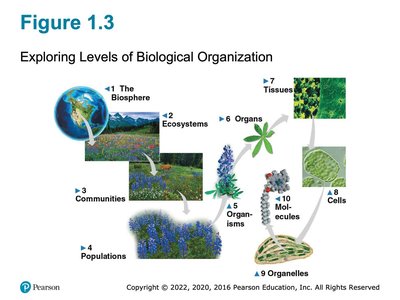
Life can be studied at multiple levels, from molecules to the entire biosphere. Biological organization is hierarchical, and reductionism is used to simplify complex systems for study.
Levels of biological organization: molecules, organelles, cells, tissues, organs, organisms, populations, communities, ecosystems, biosphere.
Reductionism: Breaking down complex systems into simpler components.
Theme 2: Information
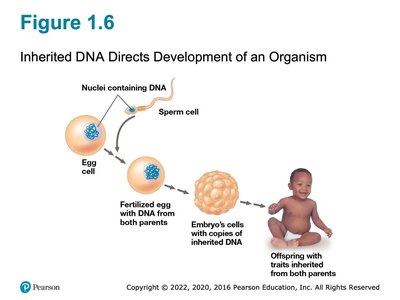
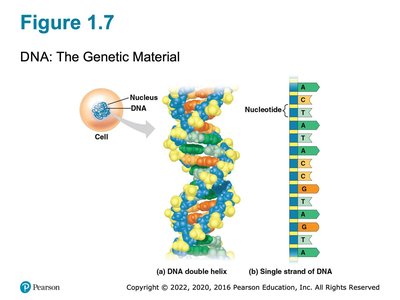
Information is central to life, with DNA serving as the genetic material that directs development and function. Inherited DNA from parents guides the formation of traits in offspring.
DNA: The molecule that stores genetic information.
Inheritance: Offspring inherit traits from both parents via DNA.
Gene Expression
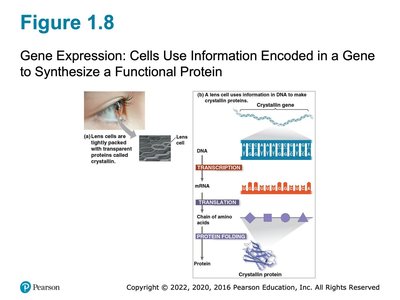
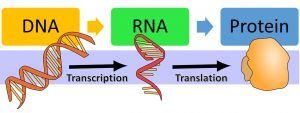
Cells use information encoded in genes to synthesize functional proteins through the processes of transcription and translation.
Transcription: DNA is transcribed into RNA.
Translation: RNA is translated into protein.
Central Dogma of Molecular Biology:
Theme 3: Energy and Matter
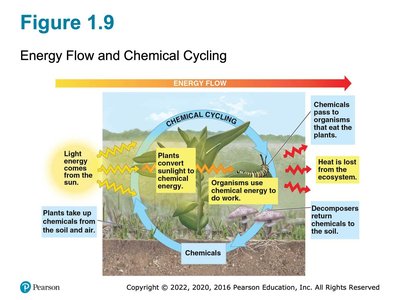
Energy flow and chemical cycling are essential for life. Organisms use energy to perform work, and matter cycles through ecosystems.
Energy flows from the sun to plants and then to other organisms.
Chemical cycling: Decomposers return chemicals to the soil.
Heat is lost from ecosystems during energy transfer.
Theme 4: Interactions
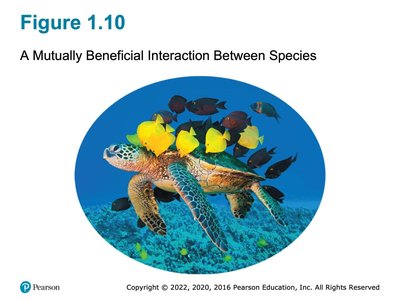
Organisms interact with each other and their environment, often forming mutually beneficial relationships.
Interactions can be cooperative, competitive, or neutral.
Mutualism: Both species benefit from the interaction.
Theme 5: Evolution
Evolution is the change of species over time and is the fundamental principle of biology. Natural selection is a force that selects for favorable traits, leading to adaptation.
Evolution: Change in species over generations.
Natural Selection: Process by which favorable traits become more common in a population.
Example: Beach mice and inland mice have different fur colors adapted to their environments.
Classifying Life
The Three Domains of Life
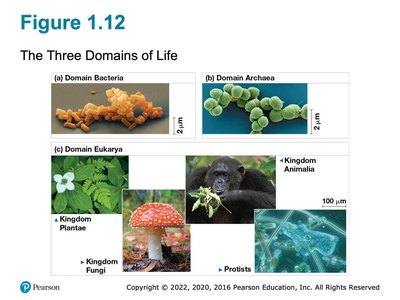
Life is classified into three domains: Bacteria, Archaea, and Eukarya. Each domain contains distinct groups of organisms.
Domain Bacteria: Prokaryotic, unicellular organisms.
Domain Archaea: Prokaryotic, often found in extreme environments.
Domain Eukarya: Eukaryotic organisms, including plants, fungi, animals, and protists.
Cell Types
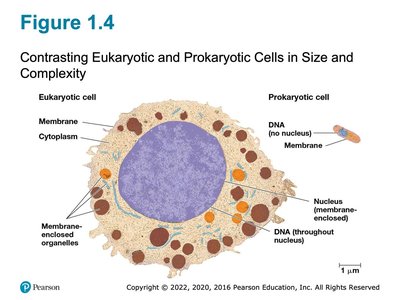
Cells are classified as either eukaryotic or prokaryotic based on their structure.
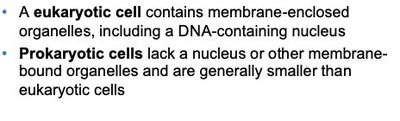
Eukaryotic cells: Contain membrane-enclosed organelles, including a nucleus.
Prokaryotic cells: Lack a nucleus and membrane-bound organelles; generally smaller.
Cell Division
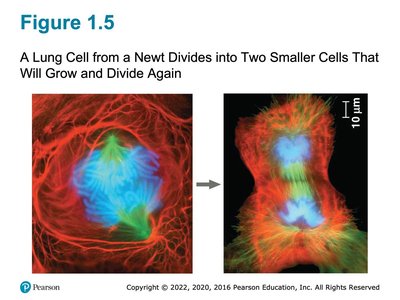
Cells divide to produce new cells, enabling growth and development in multicellular organisms.
Cell division is essential for growth, repair, and reproduction.
Example: Lung cells from a newt divide into two smaller cells.
Summary Table: Levels of Biological Organization
Level | Description |
|---|---|
Biosphere | All life on Earth and its environments |
Ecosystem | All living and nonliving things in a particular area |
Community | All organisms in an ecosystem |
Population | Individuals of the same species in an area |
Organism | Individual living entity |
Organ | Body part with a specific function |
Tissue | Group of cells performing a function |
Cell | Basic unit of life |
Organelle | Functional component within a cell |
Molecule | Chemical structure consisting of atoms |
Additional info:
Reductionism is a useful approach in biology but must be balanced with understanding emergent properties at higher levels of organization.
Gene expression is regulated at multiple levels, ensuring proper development and function.
