 뒤로
Chapter 10: Photosynthesis – Mechanisms and Significance
스터디 가이드 - 스마트 노트
 자료에 맞춘 맞춤형 노트, 핵심 정의, 예시, 맥락을 확장해 제공합니다.
Photosynthesis: Harnessing Sunlight to Make Carbohydrates
Introduction to Photosynthesis
Photosynthesis is the fundamental biological process by which autotrophic organisms convert sunlight into chemical energy, producing carbohydrates and oxygen. This process is essential for sustaining life on Earth, as it forms the basis of energy flow in ecosystems.
Autotrophs: Organisms capable of synthesizing their own food from inorganic substances using sunlight (e.g., plants, algae).
Heterotrophs: Organisms that obtain energy by consuming other organisms.
Overall Reaction: Photosynthesis is essentially the reverse of cellular respiration.
Equation:
Photosynthesis: Two Linked Sets of Reactions
Light-Capturing and Calvin Cycle Reactions
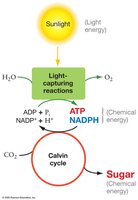
Photosynthesis consists of two interconnected sets of reactions:
Light-capturing reactions: Occur in the thylakoid membranes, use sunlight to split water and generate ATP and NADPH, releasing O2 as a by-product.
Calvin cycle reactions: Occur in the stroma, use ATP and NADPH to reduce CO2 and synthesize sugars.
Photosynthesis Occurs in Chloroplasts
Structure of Chloroplasts
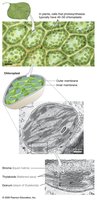
Chloroplasts are specialized organelles where photosynthesis takes place. Their structure is optimized for capturing light and facilitating the reactions of photosynthesis.
Outer and inner membranes: Enclose the chloroplast.
Thylakoids: Flattened, membrane-bound compartments arranged in stacks called grana.
Stroma: Fluid-filled space surrounding the thylakoids.
Thylakoid lumen: Internal space within thylakoids.
Pigments: Embedded in thylakoid membranes, absorb light energy.
Photosynthetic Pigments and Light Absorption
Nature of Light and Pigments
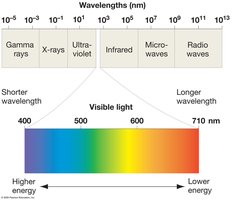
Light is a form of electromagnetic radiation, and its energy is carried by particles called photons. Pigments absorb specific wavelengths of light, which is crucial for photosynthesis.
Visible light spectrum: Ranges from approximately 400 nm (violet) to 710 nm (red).
Pigments: Molecules that absorb certain wavelengths and reflect or transmit others, giving plants their color.
Types of Photosynthetic Pigments
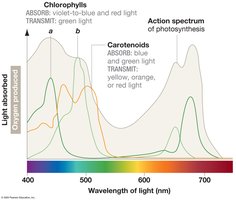
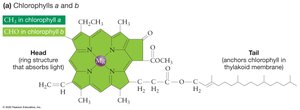
Chlorophylls (a and b): Absorb red and blue light, reflect green.
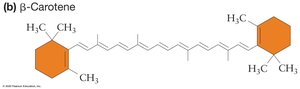
Carotenoids: Absorb blue and green light, reflect yellow, orange, and red.
Action spectrum: Shows correlation between pigment absorption and photosynthetic activity.
Structure of Chlorophyll and Carotenoids
Chlorophyll: Has a long hydrophobic tail anchoring it in the thylakoid membrane and a head with a magnesium atom that absorbs light.
Carotenoids: Accessory pigments with a structure that allows absorption of additional wavelengths and protection against free radicals.
Light Absorption and Electron Excitation
Excited States and Energy Transfer
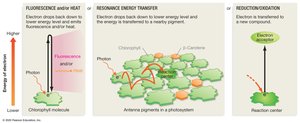
When pigments absorb photons, electrons are elevated to higher energy states. The fate of this energy depends on the pigment's environment.
Red photons: Excite electrons to a higher energy level.
Blue photons: Excite electrons even further.
Fluorescence: Some energy is released as light when electrons return to ground state.
Resonance energy transfer: Energy is transferred between pigment molecules, not the electron itself.
Photosystems: Organization and Function
Photosystem Structure
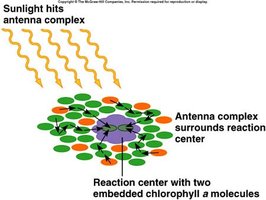
Photosystems are complexes of pigments and proteins that organize light absorption and energy transfer.
Antenna complex: Contains many pigment molecules that capture and transfer energy.
Reaction center: Specialized chlorophyll molecules where energy is converted to chemical energy via electron transfer.
Photosystems I and II: Discovery and Mechanisms
Enhancement Effect and Dual Photosystems
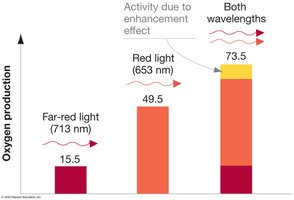
Photosynthesis is most efficient when both photosystem I and II operate together, as shown by the enhancement effect.
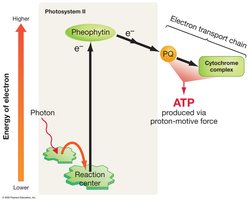
Photosystem II (PSII): Splits water, produces O2, and generates ATP.
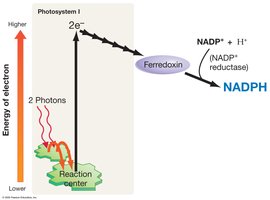
Photosystem I (PSI): Excites electrons to reduce NADP+ to NADPH.
Enhancement effect: Higher photosynthetic rates when both red and far-red light are available.
Electron Transport and ATP/NADPH Production
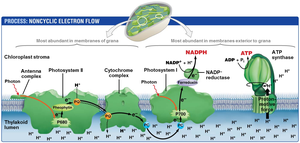
Light energy is converted to chemical energy through electron transport chains in the thylakoid membrane.
Photosystem II: Transfers electrons to the electron transport chain, creating a proton gradient for ATP synthesis.
Photosystem I: Transfers electrons to NADP+ via ferredoxin, forming NADPH.
Photophosphorylation: ATP synthesis driven by light-induced proton gradient.
The Z Scheme: Integration of Photosystems
Model of Electron Flow
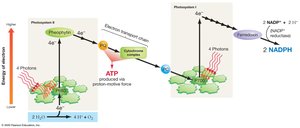
The Z scheme describes the sequential operation of photosystems II and I, maximizing energy capture and transfer.
Electron flow: Electrons excited in PSII are transferred to PSI via plastocyanin, then used to reduce NADP+.
ATP and NADPH: Both are produced and used in the Calvin cycle for carbohydrate synthesis.
Noncyclic and Cyclic Electron Flow
Noncyclic Electron Flow
Electrons move from water through both photosystems to NADP+, producing equal amounts of ATP and NADPH.
Noncyclic flow: Both photosystems operate, electrons end up in NADPH.
ATP and NADPH: Used in the Calvin cycle.
Cyclic Photophosphorylation
Photosystem I can cycle electrons back to the electron transport chain, increasing ATP production without producing NADPH.
Cyclic flow: Boosts ATP production when needed.
Occurs in: Green algae and land plants.
Oxygenic Photosynthesis and Earth's Evolution
Significance of Oxygen Production
Oxygenic photosynthesis, which splits water and releases O2, was crucial for the evolution of aerobic life and the formation of the ozone layer.
Ozone layer: Protects life from harmful UV radiation.
Evolutionary impact: Enabled complex life forms to thrive.
Summary Table: Photosystems I and II
Photosystem | Main Function | Electron Source | Final Electron Acceptor | Products |
|---|---|---|---|---|
Photosystem II | Splits water, generates ATP | H2O | Plastocyanin (PC) | O2, ATP |
Photosystem I | Reduces NADP+ | Plastocyanin (PC) | NADP+ | NADPH |
Additional info: These notes expand on the provided lecture slides and textbook images, adding academic context and explanations for clarity and completeness.
