 뒤로
Chapter 8: An Introduction to Metabolism – General Biology Study Notes
스터디 가이드 - 스마트 노트
 자료에 맞춘 맞춤형 노트, 핵심 정의, 예시, 맥락을 확장해 제공합니다.
Metabolism: Transforming Matter and Energy
Overview of Metabolism
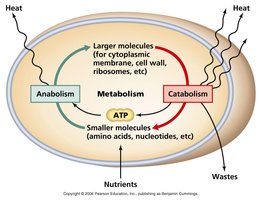
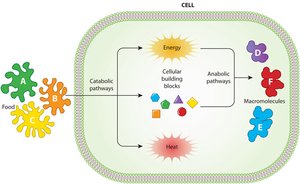
Metabolism encompasses all chemical reactions within a cell, including those that generate or consume energy. It is an emergent property of life, arising from the orderly interactions between molecules.
Catabolic pathways break down complex molecules into simpler ones, releasing energy.
Anabolic pathways build complex molecules from simpler ones, consuming energy.
ATP (adenosine triphosphate) is the central molecule linking catabolic and anabolic reactions.
Metabolic Pathways
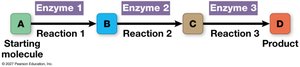
Metabolic pathways consist of a series of enzyme-catalyzed steps, transforming a starting molecule into a product.
Each step is catalyzed by a specific enzyme.
Catabolic pathways (e.g., cellular respiration) release energy by breaking down molecules.
Anabolic pathways (e.g., protein synthesis) consume energy to build molecules.
Forms of Energy and Thermodynamics
Types of Energy
Energy is the capacity to cause change and can be classified as:
Kinetic energy: Energy of motion.
Potential energy: Energy due to position or structure.
Chemical energy: Potential energy stored in chemical bonds.
The Laws of Thermodynamics
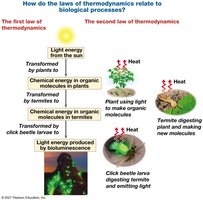
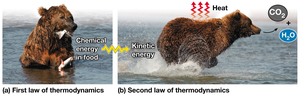
Biological processes obey the laws of thermodynamics:
First Law: Energy can be transferred and transformed, but not created or destroyed.
Second Law: Every energy transfer increases the entropy (disorder) of the universe; some energy is lost as heat.
Free Energy and Spontaneity
Gibbs Free Energy (ΔG)
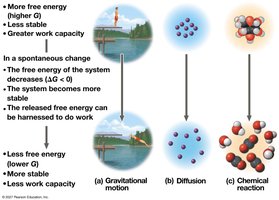
Free energy is the portion of a system’s energy available to do work at constant temperature and pressure. The change in free energy (ΔG) determines whether a reaction is spontaneous.
ΔG = ΔH - TΔS
ΔH: Change in enthalpy (total energy)
ΔS: Change in entropy
T: Temperature in Kelvin
Spontaneous reactions have negative ΔG.
Equation:
Free Energy, Stability, and Equilibrium
Systems move toward equilibrium, a state of maximum stability. Spontaneous processes decrease free energy and increase stability.
Exergonic vs. Endergonic Reactions
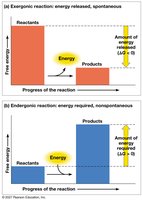
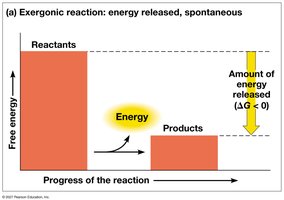
Reactions are classified by their free-energy changes:
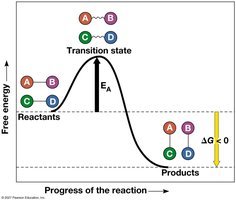
Exergonic reactions: Release energy, ΔG < 0, spontaneous.
Endergonic reactions: Absorb energy, ΔG > 0, nonspontaneous.
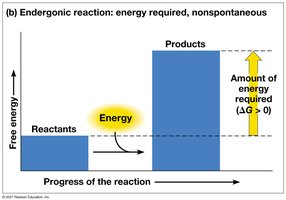
ATP: The Energy Currency of the Cell
Structure and Function of ATP
ATP consists of ribose, adenine, and three phosphate groups. It is a nucleotide and a key energy carrier.
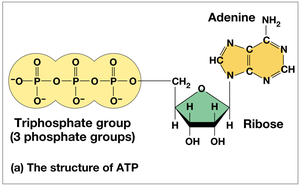
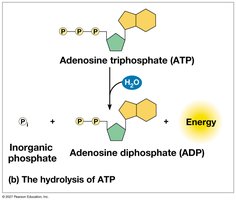
ATP Hydrolysis and Energy Release
Hydrolysis of ATP releases energy by breaking the terminal phosphate bond, converting ATP to ADP and inorganic phosphate.
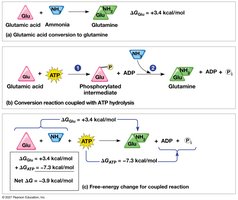
ATP Coupling and Cellular Work
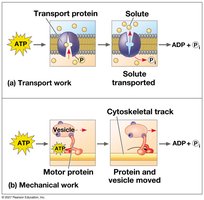
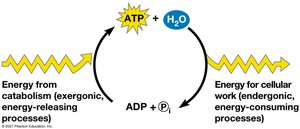
ATP powers cellular work by coupling exergonic reactions (energy-releasing) to endergonic reactions (energy-consuming).
Chemical work: Driving endergonic reactions.
Transport work: Pumping substances across membranes.
Mechanical work: Moving cellular structures.
The ATP Cycle
ATP is regenerated from ADP and inorganic phosphate using energy from catabolic reactions. This cycle couples energy-yielding and energy-consuming processes.
Enzymes: Biological Catalysts
Role and Function of Enzymes
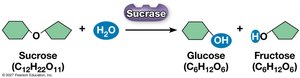
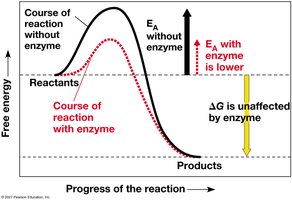
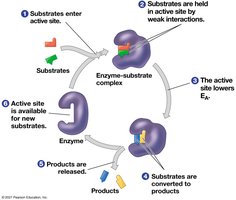
Enzymes are proteins that act as catalysts, speeding up reactions by lowering activation energy barriers.
Enzymes are not consumed in the reaction.
Each enzyme is specific to its substrate.
Activation Energy and Reaction Profile
Activation energy is the initial energy required to start a reaction. Enzymes lower this barrier, allowing reactions to proceed at moderate temperatures.
Enzyme Specificity and Induced Fit
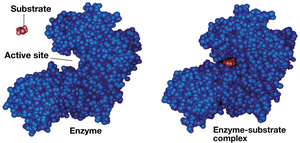
Enzymes bind substrates at their active site, forming an enzyme-substrate complex. The induced-fit model describes how the enzyme changes shape to enhance catalysis.
Factors Affecting Enzyme Activity
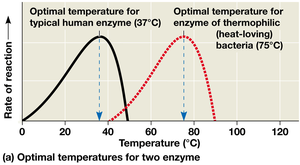
Enzyme activity is influenced by substrate concentration, temperature, pH, cofactors, and inhibitors.
Optimal temperature and pH vary by enzyme and environment.
Cofactors (inorganic or organic) assist enzyme function.
Inhibitors can be competitive (block active site) or noncompetitive (change enzyme shape).
Regulation of Enzyme Activity
Allosteric Regulation
Allosteric regulation involves binding of regulatory molecules at sites other than the active site, affecting enzyme activity.
Can activate or inhibit enzymes.
Enzymes may oscillate between active and inactive forms.
Feedback Inhibition
Feedback inhibition occurs when the end product of a pathway inhibits an earlier step, preventing overproduction and conserving resources.
Type of Regulation | Mechanism | Effect |
|---|---|---|
Allosteric Regulation | Regulatory molecule binds to enzyme at a site other than active site | Activates or inhibits enzyme |
Feedback Inhibition | End product inhibits pathway | Prevents waste, maintains balance |
Example: The binding of oxygen to hemoglobin illustrates cooperativity, a form of allosteric regulation.
*Additional info: The notes have been expanded with academic context, definitions, and examples to ensure completeness and clarity for exam preparation.*
